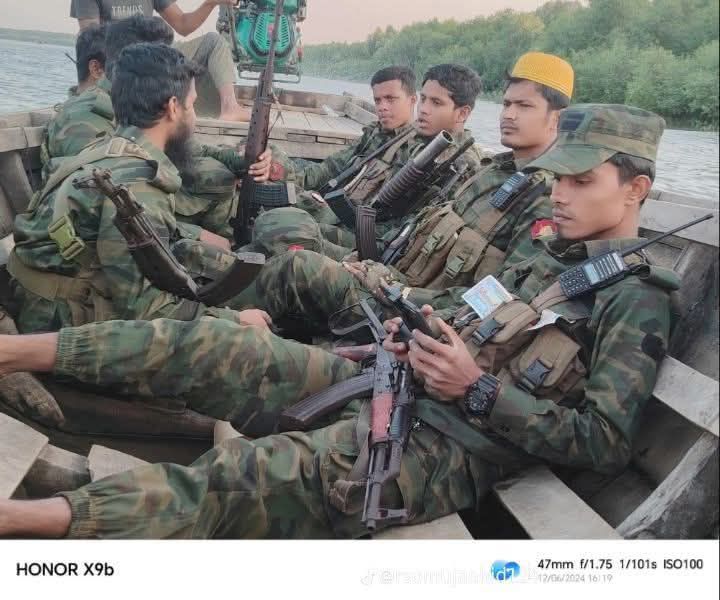

Minority communities living along the Arakan-Bangladesh border in Maungdaw District, under the control of the Arakan Army (AA), report that they are facing insecurity due to the violent actions of armed extremist groups claiming to be Rohingya militants.
Local residents in Maungdaw Township report that on January 4, in the Mayu Mountain Pass route area of Kyauk Pandu village tract, a violent attack by arned extremists claiming to be Rohingya resulted in one death and three injuries.
Local residents in Maungdaw Township report that near the area lies Mro Yu Village, home to war-displaced ethnic Mro communities, and militants claiming to be Rohingya extremists are allegedly taking shelter in certain parts of the Mayu Mountain.
As a result, the ethnic Mro minority communities report that they no longer dare to venture into the forests or mountains and are even worried about returning to their villages located near these areas.
“We have no jobs to earn food and drink. We cannot go into the forest because there are ARSA militants. Things are very difficult right now,” an elderly displaced Mro woman from Maungdaw Township told Border News Agency.
Although the Arakan Army (AA) fully seized control of the Arakan-Bangladesh border on December 8, armed groups identified as Rohingya extremists are reportedly committing acts of violence against civilians, according to local residents in Arakan.
In Maungdaw District, local residents in Arakan report that armed extremist groups such as the Arakan Rohingya Salvation Army (ARSA), Rohingya Solidarity Organization (RSO), Arakan Rohingya Army (ARA), and militant Muslims trained in combat are committing acts of violence against civilians.
Political analysts suggest that the ongoing acts of violence are driven by a desire to target civilian populations and seize territory, with the extremist groups committing these acts as part of their broader agenda.
“Groups like ARSA, RSO, and others in the Buthidaung and Maungdaw regions collaborated with the Myanmar junta to fight against the Arakan Army. However, when they were unsuccessful, and the junta collapsed, they began calling for all Muslim forces to unite and enter Rakhine. Some have been causing disruptions by crossing borders and harassing local civilians in the region, even engaging in drug trafficking and other criminal activities,” said U Aung Thaung Shwe, a former People’s Parliament representative from Buthidaung Township, in an interview with Border News Agency.
According to refugees, a group of armed militants claiming to be Rohingya extremists gathered nearly a hundred thousand refugees in a camp in Bangladesh on December 25, 2024, and encouraged them to unite and commit acts of violence.
According to the Muslim refugees, some of these groups have been assigned to carry out acts of violence along the Arakan-Bangladesh border, while other groups are responsible for areas extending from Naf River to Ah Ngu Maw.
The Muslim community reports that these militants, disguised as fishermen with fishing boats and equipment, are operating within Naf River and moving around the area. They also attempt to infiltrate the Mayu Mountain range during opportunities, including at night, to carry out further violent activities.
Local residents in Maungdaw report that on December 24, a vehicle traveling from Kyaing Chaung village to Taungpyo Letwe for shopping was attacked by armed groups claiming to be Rohingya extremists. The attack resulted in the death of one woman and numerous injuries.
Due to the threat posed by armed groups claiming to be Rohingya extremists, minority communities in Maungdaw Township report feeling fearful and anxious, making it difficult for them to travel or work.
“The difficulties are so great that we can’t even go down the mountain. We are afraid to travel. Right now, we are struggling to do any farming because of the ARSA,” said a Mro resident from Maungdaw Township to Border News Agency.
Local Mro residents in Maungdaw report that four ethnic Mro individuals from Kaine Gyi village have been missing since September 30, when they went fishing near a river close to the village. Despite efforts, they have not been found after several months of searching.
Local residents in Buthidaung report that on December 5, armed militants claiming to be Rohingya extremists entered Sin Swe Ya village and carried out an attack, setting fire to buildings. They also killed a 16-year-old girl and abducted five men.
Muslim villagers report that the Arakan-Bangladesh border, with its vast and dense mountainous terrain, allows extremists to hide and carry out violent activities. Additionally, these militants are reportedly blending in with civilian populations in Muslim villages.
Local residents in Arakan report that after the Arakan Army fully seized control of Maungdaw District, the number of violent activities carried out by armed militants claiming to be Rohingya extremists has increased significantly. As a result, the safety and security of civilian populations have deteriorated.
Local residents in Maungdaw District report that armed militants claiming to be Rohingya extremists, numbering in the thousands, continue to carry out daily acts of violence. As a result, civilians feel compelled to undergo militia training to protect their lives and villages.
Political analysts suggest that while the people of Myanmar are engaged in their own struggle against the military dictatorship, the Rohingya militants, who are collaborating with the Myanmar junta, will eventually face defeat at the hands of the Arakan Army (AA), which has gained significant momentum in its efforts against the junta.
U Aung Thaung Shwe, former MP representative for Buthidaung Township, stated to the Border News Agency, “The Arakan Army (AA) possesses the strength to challenge even the powerful military junta. If the entire nation unites, it can successfully weaken the junta’s grip. Currently, only three townships remain under the junta’s control in Rakhine. In this context, groups like ARSA and RSO, which are Muslim extremist factions, cannot compete with the AA. They can only create disruption. Over time, they will inevitably face defeat due to the AA’s persistent offensive.”
In the decisive stages of the Arakan war, the Arakan Army (AA) has fully seized control of several key regions, including Paletwa, Maungdaw, Buthidaung, Rathetaung, Ponnakyun, Kyauktaw, Mrauk U, Minbrar, Myaybon, Pauktaw, Rambre, Thandwe, Taunggoke, Ann, and Gwa townships.
According to local residents in Arakan, only three townships—Sittwe, Kyaukphru, and Manaung—remain under junta control. Even in these townships, intense military tensions continue to prevail.
Local residents in Arakan report that while the Arakan Army (AA) is governing the territories under its control and focusing on rebuilding efforts, armed groups claiming to be Rohingya extremists are continuing to carry out acts of violence, undermining the progress of the Arakan People’s Revolution.


Comments 1
Có nhiều trò chơi phù hợp với mọi người 188v com TONY05-21