
Written By Zarni
Rakhine News Media
“The media is the most powerful entity on earth. It has the power to make the innocent guilty and to make the guilty innocent because they control the minds of the masses.” This was once said by Malcolm X, an American political activist.
Malcolm X’s words hold deep meaning and offer much to reflect upon. News media not only have the ability to shape public perception but also play a significant role in history and daily life.
Especially in areas such as politics, military conflicts, economics, and education sectors that directly impact the public news media possess the power to influence and shape society.
The moment a person reads a news article; their emotions can shift they may go from their normal state to feeling joyful or even becoming angry. Moreover, news can contribute to an increase in violence and conflicts in daily life, just as it can also play a positive role in building a progressive and developed society.
For this reason, authoritarian regimes tend to keep a close watch on the media and suppress it even more.
In the past, news media were the primary leaders in the media landscape. However, in today’s era, alongside news media, propaganda media, entertainment media, and yellow media have also emerged as strong competitors.
Despite this, news media face numerous challenges to sustain themselves. At the same time, they continue to strive to serve the public interest through responsible journalism.
Challenges Faced by News Media
After the military coup in February 2021, the junta’s suppression of journalists intensified. Many media organizations were forced to relocate abroad, while most journalists inside the country faced arrests and repression by the military council.
Press freedom became criminalized, and journalists were increasingly tracked and arrested for their reporting.
As a result, some journalists left the media industry and shifted to other professions for survival.
The Independent Press Council of Myanmar (IPCM) announced that over 200 journalists have been arrested by the military junta in the more than four years since the coup.
Among those arrested, 43 journalists are still under detention as of January 25, 2025, according to a statement from IPCM.
The Committee to Protect Journalists (CPJ) also highlighted that Myanmar ranks among the worst countries in the world for the arrest and imprisonment of journalists.
On the other hand, most media outlets rely on funding from donor organizations to sustain themselves.
With the cessation of support from USAID, which had funded many media organizations in Myanmar, it has become even more difficult for these media outlets to survive.
Additionally, the escalating internal conflicts and the difficulties in communication, including phone and internet restrictions, have made it increasingly challenging to access and report news.
Journalists working in areas controlled by armed revolutionary groups and conflict zones are also facing threats, including intimidation and arrest by these armed organizations.
Declining Journalistic Ethics and Unprofessionalism.
For a good journalist, journalistic ethics are the fundamental principles that must be followed.
Furthermore, the reputation of a good media outlet is built on transparency, accountability, and responsibility.
However, in the current political climate, many media organizations themselves have engaged in unprofessional actions and unethical practices that tarnish their credibility and reputation.
After the coup, the lack of collaboration and communication between media outlets has contributed to a growing disregard for journalistic ethics. This is an important factor in the decline of professionalism among the media.
In the current political situation, the belief that political alignment is more important than ethics has pushed journalists to prioritize political views over ethical standards.
Another issue is the reduced financial support for media organizations, leading them to rely on revenue from social media platforms like Facebook and YouTube.
As media outlets rely on revenue from social media, they increasingly prioritize popularity over quality.
Some media organizations focus on gaining likes and shares on social media, leading them to publish sensationalized or fake news, fabricate quotes, and use unreliable sources to create stories.
Even when inaccurate or fake news is published, editors and the editorial team often ignore the need to correct mistakes or inform the readers about the errors, further damaging the integrity of the media.
Additionally, newsrooms have increasingly focused on breaking news, prioritizing speed over accuracy. As a result, the verification of sources and the fact-checking of information have become less thorough.
The Decline in Trust Towards Media Outlets
For a story to be considered newsworthy, it must go through several stages in the newsroom. It involves determining the location, the source of the news, the verifier, and those connected to the story, as well as including opposing viewpoints in the report.
While speed and accuracy are essential for the quality and value of news, many media outlets have prioritized breaking news, neglecting the importance of accuracy and journalistic ethics.
Additionally, journalists are facing numerous challenges in gathering news amid ongoing political conflicts and battles, which complicates the process of obtaining reliable information.
In areas affected by conflicts and battles, communication difficulties, such as issues with phone lines and internet connections, have become more prevalent than before.
As a result, media outlets have found it increasingly difficult to present accurate and reliable news.
On the other hand, due to concerns over the safety of news sources, media organizations have started refraining from revealing the names of certain sources.
Protecting the security of news sources is a key aspect of proper journalism ethics.
However, behind news sources that lack transparency, media outlets have been utilizing sources that are either not directly involved in the news process or sources with questionable reliability.
Media outlets often proclaim themselves as the fourth pillar of the state.
However, some major media outlets themselves have been less diligent in following journalistic ethics, and the presence of biased or inaccurate reporting has contributed to the spread of misinformation among the public.
Although news outlets may have different sources for obtaining information, accuracy and precision are essential when reporting events that occur on the ground.
However, even some major media outlets themselves fail to ensure accuracy, presenting unverified news without proper scrutiny.
When media outlets publish inaccurate news, the public often criticizes and points out the errors, yet editors and journalists tend to overlook or ignore such criticisms.
Moreover, media outlets rarely make corrections or apologize to their readers when they publish inaccurate or misleading information.
The decline in the quality of media and the lack of accountability and responsibility have significant impacts on the public’s social life.
On one hand, many journalists increasingly rely on confirmation bias, prioritizing popularity over accuracy rather than striving for truthful reporting. Instead of ensuring that their news is factual, they focus on making it more appealing to the audience.
As a result, gathering information on the military junta’s human rights violations and war crimes committed against civilians has become more difficult.
Additionally, the junta’s propaganda channels and state-controlled media are expanding their influence by misrepresenting the reports of local news agencies, further amplifying misinformation.
(Some news reports that require further questioning for accuracy and fact-checking have been retracted by Border News Agency as a precaution.
The retraction by Border News Agency is not intended to attack any media outlet but rather to present the information in a balanced and responsible manner.)
On February 28, the Myanmar junta carried out an airstrike on the Kyikanpyin Headquarters in Maungdaw Township, which is under the control of the Arakan Army (AA). This incident was reported not only by Rakhine media outlets but also by other news agencies.
Regarding the airstrike, Narinjara News, a Rakhine-based news outlet, published a report on March 1 with the headline: “Maungdaw Kyikanpyin Headquarters Bombed, over 30 Junta Personnel Killed, and More Than 10 Injured.” The report stated that the information was confirmed by a source who provided details to Narinjara.
To read the full report from Narinjara, visit:
https://burmese.narinjara.com/news/detail/67c29ce4c40002f2936ec778?fbclid=IwY2xjawIyktpleHRuA2FlbQIxMAABHX-rnRd0rsxGIGFggdgCEUnptIb7Ipf-4KHrCOeJfK4QtjpFiY8SwSpReg_aem_nVvtt8ByeP9NONR0929rjA
On March 1, another Rakhine-based media outlet, Development Media Group (DMG), reported the same incident with the headline: “Junta Airstrikes Target Former Kyikanpyin Headquarters.” However, DMG’s report contradicts that of Narinjara News.
Notably, DMG’s report states that no casualties or injuries resulted from the Kyikanpyin airstrike, citing confirmation from a source close to the Arakan Army (AA).
To read the full report from DMG, visit:
https://www.facebook.com/share/p/168xC1gEAe/

For readers comparing both reports, questions arise regarding whether there were casualties or injuries in the Kyikanpyin airstrike.
Furthermore, determining which report presents accurate information becomes even more critical when documenting the human rights violations committed by the Myanmar junta.
News readers seek accurate information, but when they come across conflicting reports from DMG and Narinjara, they are left questioning how to interpret the situation.
Did the airstrike cause casualties, or were there no casualties at all? This becomes a critical point for them to consider.
As these uncertainties accumulate, it is inevitable that public trust in the media may begin to erode.
Some inaccurate reports have been published by news agencies, including Narinjara, as seen in previous cases.
For example, on May 14, 2023, during Cyclone Mocha, Narinjara News shared a 15-second video with the caption: “Water levels in Maungdaw are rising as Cyclone Mocha makes landfall.”
To watch the full video shared by Narinjara, visit:
https://www.facebook.com/share/p/15DqPbKo4V/
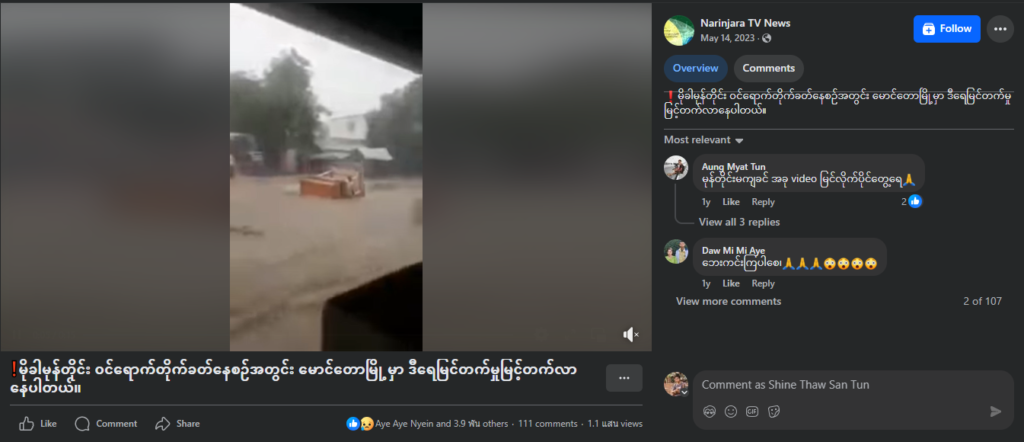
However, the video shared by Narinjara was not actually recorded in Maungdaw during Cyclone Mocha.
The video was originally from a flooding incident in Mogadishu, Somalia, on May 4, 2023.
It was first uploaded by the Twitter (X) account “Arab_Storms”.
A fact-checking organization, Vera Files Fact Check, verified this on May 23, 2023.
To read the full report, visit:
https://verafiles.org/articles/vera-files-fact-check-clips-of-old-typhoon-events-passed-off-as-mawar-onslaught

The locals in Maungdaw have confirmed that there was no flooding during Cyclone Mocha, and the incident was criticized externally as well.
Although Narinjara made the mistake of sharing misleading information, they did not issue a correction or acknowledge the error.
The video file has not been removed, and Narinjara still has not corrected or updated the information on their website to this day.
In the current conflict in the Arakan region, several news agencies are emerging.
Notably, Laywaddy FM, Arakha Time, and Coastal News Agency are among those that have gained attention.
These agencies have increasingly focused on speedy news reporting, but many of the news pieces they publish often lack accuracy, with headlines and content often inconsistent.
According to information gathered by Border News Agency, on November 11, 2024, Coastal News Agency published a report stating that:
“The Arakan Army (AA) has taken control of the entire Maungdaw town.”
In the report from Coastal News Agency, it was mentioned that the last remaining military post of the Myanmar junta in Maungdaw was fully taken over by the Arakan Army (AA) on November 11, 2024.
The report further states that the news was confirmed by a reliable source from Coastal News Agency.
To read the full report from Coastal News Agency, visit:
https://archive.ph/AA1IL

However, the news published by Coastal News Agency on November 11, 2024, was found to be inaccurate. The headline and content of the report were inconsistent, and there were contradictions within the article.
The report was fact-checked by Akyab Post, a media outlet from the Rakhine region that specializes in identifying false news. It was confirmed that the report was indeed inaccurate.
To read the full fact-check by Akyab Post on the news from Coastal News Agency published on November 11, 2024, visit:
https://www.facebook.com/share/p/16DkKg5aiJ/
Additionally, the Arakan Army (AA) successfully captured and took control of the Nakhakha-5 Border Guard Police (BGP) Unit in Maungdaw Township at 9:30 AM on December 8, 2024. This was officially announced on December 10, 2024.
For the full announcement from the Arakan Army regarding the capture of Nakhakha-5, you can read the statement here:
https://t.me/aainfodesk/1184
Despite the fact that there have been fact-checking investigations and official statements from relevant organizations, Costal News Agency did not make any corrections for the false reporting, nor did they comment on the misinformation they spread. They have remained silent regarding the incorrect news they published.
Another Rakhine media outlet, Lay Waddy FM, reported on December 16, 2024, about intense clashes between the Arakan Army (AA) and Myanmar junta forces in Ann Township. The report stated, “Napaka Division Commander Colonel Kyaw Kyaw Than and over 20 of his forces were captured dead.”
Lay Waddy FM reported that a military source confirmed the capture and death of Napka Division Commander Colonel Kyaw Kyaw Than in a battle near Ann Township. The news outlet cited this confirmation when reporting the incident.
However, despite the initial report, it turned out that the news shared by Lay Waddy FM was false.
You can read both reports from Lay Waddy FM here:


The Napaka Division Commander Colonel Kyaw Kyaw Than has not been confirmed dead. As of today, it has been reported that he was captured by the Arakan Army as a prisoner of war, but not killed.
Furthermore, AA released an interview with Colonel Kyaw Kyaw Than on December 26. The interview is featured in a video, which also includes footage of the Arakan Army capturing the Western Division Military Headquarters of the Myanmar junta. This video shows the captured commander in a segment at 9 minutes and 54 seconds.

For the full video of the interview with Colonel Kyaw Kyaw Than, you can view it here:
https://t.me/aainfodesk/1221
It seems that Lay Waddy FM did not make any corrections or issue a clarification regarding the false report that Napka Division Commander Colonel Kyaw Kyaw Than was killed along with 20 other forces, despite the presence of official statements and other news agencies confirming his capture. They have also not taken responsibility for the misinformation and kept the story up without any revisions.
Additionally, Western News, another Rakhine news outlet, has also disseminated several serious misinformation pieces.
When the military junta increased its pressure on the Rakhine people, Western News was among the outlets that spread some false news related to this issue.
On February 18, 2024, Western News reported that ‘five Rakhine women were arrested in Yangon’s Shwepyitha, and the arrested individuals were burned and tortured.’
In the report, Western News stated that the source of the information was from the families of the detainees.
Additionally, Western News stated that the individuals arrested were women working in a garment factory in Shwepyitha, Yangon.
To read the full report by Western News titled ‘Five Rakhine women arrested in Yangon’s Shwepyitha, the arrested individuals were burned and tortured,’ click here – https://www.facebook.com/share/p/1DqmM7i4Fm/
However, this news was clarified by U Tin Htoo Aung, the chairman of the Arakan National Network, which supports and assists Rakhine people in Yangon, stating that it was a rumor and false news.
U Tin Htoo Aung responded on his social media page: “In the Shwepyithar’s community association for life events (around Htanchaukpin area), there are more than 200 members. The point we need to consider is that there are senior people from this association in our Facebook group. Why is it that we cannot investigate this issue? When trivial matters related to marital issues are brought to us for advice, why are we not informed about these matters? Therefore, as Rakhine media, we need to follow media ethics and avoid sensationalizing issues to scare the public.”
The complete response from U Tin Htoo Aung, the chairman of the Arakan National Network, can be found here: https://www.facebook.com/share/p/15iF7K8HEJ/

However, Western News did not make any corrections or address the mistakes in the news report and chose to ignore it.
Subsequently, many Rakhine people have been struggling to return from Yangon to the Rakhine region, facing high prices for bus tickets and the risk of being arrested by the military junta on the roads.
Media outlets should exercise caution and be mindful
With the expansion of propaganda outlets by the military junta, media outlets today have increasingly presented fake and misleading news. In this context, the role of the media and journalism ethics has become more crucial for society.
On the other hand, media organizations should more carefully scrutinize the authenticity of sources, especially when fake news and fabricated reports are disseminated with the intent to instill fear among the public. The use of false sources in news should be rigorously examined by editorial teams.
Adherence to ethics and transparency remains the cornerstone of credible journalism.
“Journalists must have sufficient research and experience to lead media organizations in adhering to ethical standards. While it is a positive development that new news platforms and Telegram channels continue to emerge, it is equally important to ensure that these platforms strive to maintain high-quality standards. In order to become a public news outlet that adheres to ethics, media organizations must understand and establish the ethical guidelines to follow and educate their journalists to comply with them,” said journalist U Myint. Kyaw, expressing his views on the adherence to ethics in media.
The public must also be cautious in accepting news, understanding that they should not easily accept every piece of news broadcast by media outlets without discernment.
Accepting the spread of false or misleading news will have more negative consequences than benefits.
Journalists, too, must adhere to ethical standards and work to become journalists who serve the public good, as emphasized by media professionals.
A media ethics trainer shared her view: “If media outlets do not follow ethical guidelines, they may end up broadcasting misinformation and disinformation. In this revolutionary and war period, some news can occasionally create false hopes or mistaken expectations. These false hopes can negatively impact the public. The responsibility of the media is to present the truth as it is, without bias. Media must report events as they happen, accurately and honestly. To follow media ethics, one must understand them first, and once understood, they must be applied effectively.”
The conflicts that occurred in Rakhine in 2012 and 2017 have shed light on these issues.
The nature of news often leads to an emotional response, and as such, the public is encouraged to critically assess the news before accepting it.
Furthermore, both journalists and media outlets must recognize that if they violate media ethics, they risk eroding the trust of the public. Civil society groups have emphasized that this is a critical time for journalists to be more cautious and thoughtful in their work.
“Media outlets often claim to be the fourth pillar of democracy, but they must serve as a bridge that connects and balances the public through checks and balances. If they fail to report accurate news, the public will only have access to misinformation. This can lead to wrong decisions and misunderstandings. If journalists provide false information, it can harm the public. When journalists violate ethical standards, public trust can be undermined. This is a critical time for journalists to be more thoughtful and cautious in their work,” said Ko Wai Hun Aung, who is involved in social work in Rakhine, expressing his views on the media.
In Myanmar, including ethnic and religious conflicts, armed conflicts have occurred, and the role of media in the Arakan region is said to be extremely important by the international community.
Therefore, to prevent further conflicts and to ensure a society governed by law that is peaceful, stable, and develops progressively, media outlets must play a crucial role in upholding ethical standards.
Only then can media help nurture a good society. It is essential for media to be responsible and adhere to ethics, as this is crucial for media outlets to fulfill their roles effectively and be accountable to society.







Comments 2
Sau gần 5 năm hoạt động, thương hiệu không chỉ có được vị thế vững chắc trên thị trường mà còn khẳng định đẳng cấp của mình khi sở hữu đầy đủ giấy chứng nhận hợp pháp từ PAGCOR và CEZA. 66B Do vậy, bạn hoàn toàn có thể yên tâm tham gia cá cược thỏa mãn đam mê của mình mà không cần lo ngại về những vấn đề pháp lý khác. TONY04-18
Your point of view caught my eye and was very interesting. Thanks. I have a question for you. https://accounts.binance.com/register/person?ref=IHJUI7TF