
Written By Zarni
Food security is one of the most critical sectors for every region and country, as it is directly linked to the lives of millions of people.
Therefore, governments, large corporations, companies, international organizations, and regional institutions around the world are placing greater emphasis on food security efforts.
Around 60 countries worldwide lack the resources to produce enough food for their own needs and must rely on international sources for food security. However, Myanmar is not among the countries that depend on foreign nations for food security.
However, due to the ongoing conflicts following the 2021 military coup, natural disasters, inflation, and the sharp rise in commodity prices, people across Myanmar are facing severe food shortages and food insecurity.
Out of Myanmar’s 54 million population, 14.4 million people require humanitarian assistance, while 13.2 million are struggling with food insecurity, according to a report by the United Nations World Food Programme (WFP).
Among them, food insecurity is more severe in areas heavily affected by armed conflicts, including Kachin, Chin, Rakhine, Magway, Sagaing, Karenni, Shan, and Karen regions, as stated in the WFP report.
In the remote and logistically challenging Arakan region, which is Myanmar’s westernmost area, intense conflicts have led to a severe food crisis.
Restrictions on movement, lack of trade flow, a decline in local agricultural and livestock production, widespread unemployment, and reduced income opportunities have further exacerbated the food crisis in the region.
The entire Arakan region is on the brink of a humanitarian disaster due to the severe shortage of food and humanitarian aid, as indicated by various reports.
The impact of conflict on food production, local access to food, and the overall food security situation in the Arakan region presents significant challenges that need to be addressed.

Additionally, both short-term and long-term difficulties related to food security in the region require strategic approaches and thorough assessments to find sustainable solutions.
Displacement due to Conflicts
As part of the “Operation 1027” led by the Three Brotherhood Alliance, which includes the Arakan Army (AA), the AA launched an attack on November 13, 2023, capturing the junta’s Done Pike outpost along the Maungdaw – Ah Ngu Maw Road in the Arakan region.
Since the beginning of the decisive Arakan war, the junta forces have been deliberately targeting and destroying the Arakan region while also arresting and killing Arakanese civilians, according to local residents.
In the decisive Arakan war, the Arakan Army (AA) has successfully captured 14 townships and Paletwa region, leaving only Sittwe, Kyaukphru, and Man Aung under junta control. Intense clashes continue in Sittwe and Kyaukphru.
As a result of these battles, many local civilians have lost their properties and have been forced to flee their homes, seeking safety as war-displaced persons.
Many local civilians have sought refuge in areas controlled by the Arakan Army (AA), while others have also been displaced in territories under junta control.
Additionally, a significant number of Muslim refugees, who fled due to the conflict, have crossed into Bangladesh.

According to the Humanitarian and Development Cooperation Office (HDCO), the number of war-displaced people in areas controlled by the Arakan Army (AA) reached 553,696 between November 13, 2023, and November 18, 2024.
This figure does not include those displaced in junta-controlled areas or those who fled to Bangladesh.
Humanitarian aid workers report that the number of war-displaced people continues to rise due to ongoing armed conflicts.
Although the Arakan Army (AA) has taken control of most townships in the decisive Arakan war, the majority of displaced civilians have not yet been able to return to their homes.
The Arakan Army (AA)-controlled areas have been subjected to frequent attacks by the junta forces using drones, fighter jets, and heavy artillery, leading to civilian casualties and injuries. Local residents also report difficulty in finding work to sustain themselves due to the ongoing conflict.
In addition, the people of Arakan are facing dangers from unexploded ordnance and landmines, with risks present in forests, agricultural lands, and along rivers and canals, as described by local residents.
Economic Challenges in the Region
Due to the final phase of the Arakan war, the number of displaced people has increased. Additionally, the Myanmar military junta has blocked trade flows and travel routes, causing the entire economy of the Arakan region to deteriorate, as reported by the Arakan people.
The people of Arakan are facing shortages of goods, and the prices have been rising significantly. The closure of banking operations has led to a shortage of cash, which has worsened the situation.
However, despite illegal goods entering through the Arakan-India and Arakan-Bangladesh borders under the control of the Arakan Army, the shortages of goods and price hikes persist, as reported by the people of Arakan.
Regarding the rising prices of goods, the people of Arakan are calling for the Arakan People’s Revolutionary Government to intervene and provide a solution, as well as to implement precise and effective policies to stabilize the market.
The Arakan People’s Revolutionary Government has formed a coalition of major traders to address the rising prices. However, despite their efforts, the prices continue to rise in the areas controlled by the Arakan Army, as reported by the people of Arakan.
The Arakan region, even during the previous government period, faced many challenges, including the scarcity of small and medium-sized industries, the absence of industrial zones, limited employment opportunities, and various labor-related issues. With the outbreak of war, government and business activities, which were the main sources of income, also came to a halt.

In addition, due to the ongoing battles, the people have faced theft, destruction of their properties, and a reduction in income. The middle class has seen a decline in their income flow, while the lower-income groups are facing severe consequences of reduced earnings, as reported by the people of Arakan.
The primary economic sectors of Arakan, such as agriculture and fisheries, have been severely impacted, with local farmers and fishermen suffering from the effects of Cyclone Mocha in May 2023.
During the intense period of the Arakan war, the people also had to deal with floods and environmental destruction, according to the people of Arakan.
In August and October of the previous year, heavy rains in the Arakan region caused widespread flooding. As a result of the floods, farmers had to face the destruction of agricultural land and crops, which led to further losses. The people of Arakan reported these difficulties.
The impact of the conflict has also severely affected local agricultural production, water-related industries, and livestock farming.
Farmers in Arakan are unable to cultivate their usual crops in full capacity due to rising land prices and the inability to purchase seeds, making it even more difficult for them to maintain their normal farming activities.
Additionally, due to the seizure and attacks by the Myanmar junta’s naval forces on rivers, estuaries, and fishing boats in the Arakan coastal areas, most of the Arakanese fishing industry has come to a halt, causing significant damage and hardship, according to the people of Arakan.
Facing Severe Food Shortage
According to data collected by the United Nations Development Programme (UNDP), food production in the Arakan region between March and April 2025 will meet only 20% of the region’s food demand. With domestic and international trade nearly halted, approximately 95% of the population in Arakan is at risk of food insecurity, as highlighted by the UNDP.
Furthermore, the UNDP’s report released on November 7 states that over two million people in the Arakan region are at risk of famine.
“With the daily income no longer matching the rising cost of goods, we have to reduce our food intake. Some people are surviving on just rice porridge, while others, unable to bear the hunger, are selling whatever little they have just to get by each day. The number of unemployed people and those begging for food is increasing day by day,” said Daw Hla Hla May, a war-displaced resident from Ponnakyun town.
Food insecurity is measured through key factors such as access to food, availability of food, utilization of food, and stability in food supply.
For most people in the Arakan region, all four aspects of food security are increasingly under threat.
As a result, many are facing malnutrition, food shortages, and health-related difficulties due to the ongoing crisis.
Among those most severely affected by the food crisis are women, children, and the elderly, who are facing extreme hardship due to the worsening shortages.
“The imbalance between consumers and producers is the main reason for the food crisis in Rakhine. There are fewer producers but a high number of consumers, so agricultural production needs to be prioritized. For over 20 years, Rakhine has relied on imports, but now that the military council has blocked all trade, we are facing these severe food shortages,” said U Maung Maung, a representative of a civil society organization leading food security efforts in the region.
He further explained that the ongoing food crisis in the Arakan region has been worsened by the prolonged impact of armed conflict since 2016, restrictions on farmers’ ability to cultivate freely, and shortages of essential seeds. These factors have significantly contributed to the current food shortages.
Ko Phoe Zaw, the responsible person of the Humanitarian and Development Cooperation Office (HDCO) of the Arakan Army, told Border News Agency that the food crisis has worsened due to factors such as displacement, lack of job opportunities and income, skyrocketing commodity prices, trade restrictions, and the blockade of humanitarian aid organizations.
“The main challenge in food aid delivery is the lack of phone and internet access, which makes it difficult to respond to emergencies. Additionally, financial donations for assistance are limited, making it hard to operate effectively. Even when we can purchase supplies, they are insufficient, further worsening the situation,” he added.

The World Food Programme (WFP) announced on March 14 that it will cease its life-saving food assistance and food aid for over one million people in Myanmar starting in April.
The suspension of food aid by the WFP could have severe impacts, particularly on displaced persons from the Arakan region, as well as other local populations already facing extreme food insecurity.
As of now, there are no specific statistics available that fully represent the extent of the food crisis faced by the people in the Arakan region.
However, reports from both urban and rural areas indicate that people are facing severe food insecurity.
In more remote districts, where transportation is difficult and far from urban centers, local residents report experiencing even more intense food shortages.
How are they addressing the food crisis?
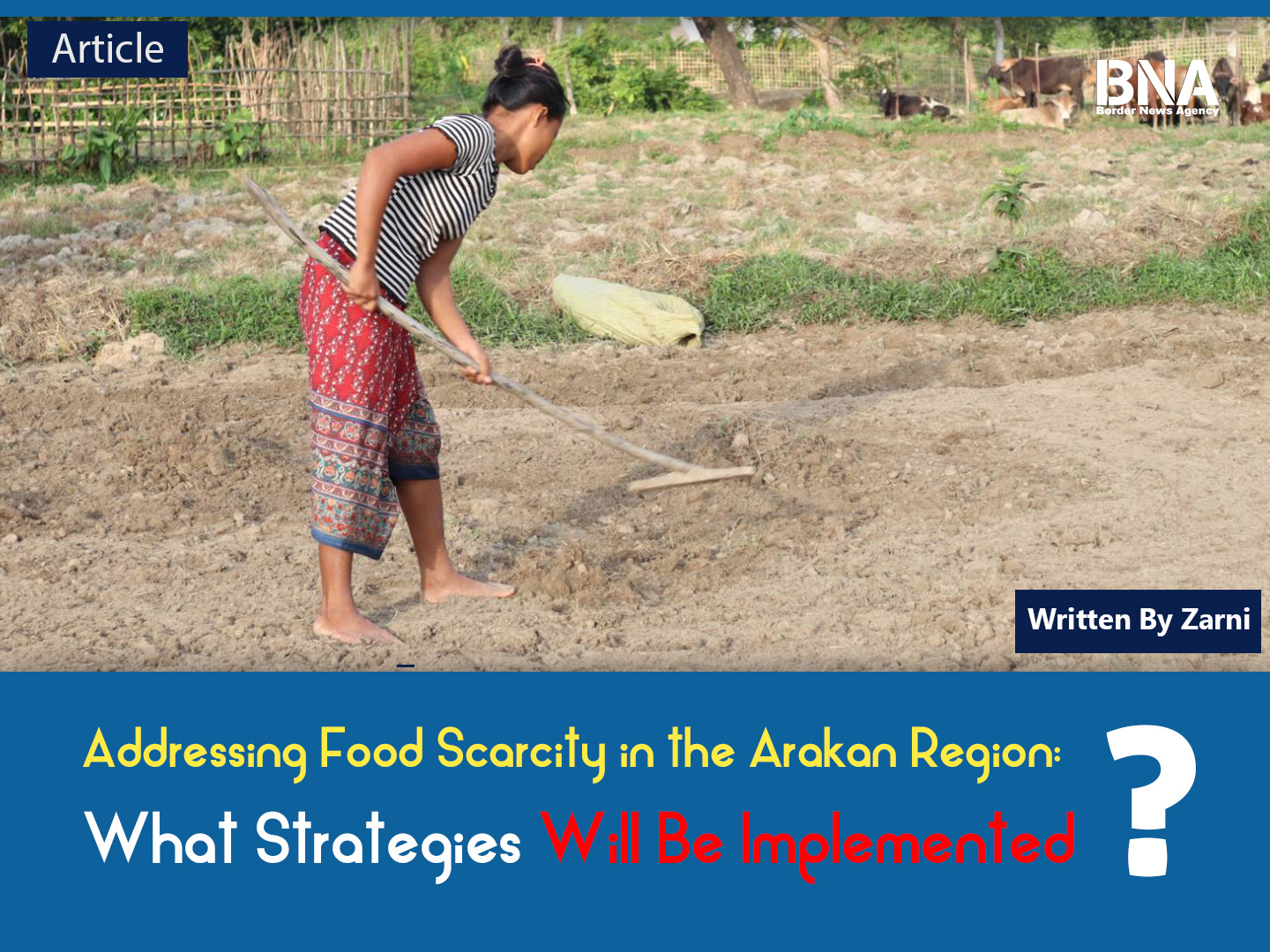
When faced with food insecurity, local communities have expanded their agricultural activities to cope with the crisis. However, the scale of farming remains limited to subsistence farming, and there is still a need for commercial farming and higher-level agricultural productivity to meet the demand.
Although there is support from civil society organizations, local humanitarian efforts, and international groups, food assistance remains critically needed by the local population.
The support from international organizations and civil society groups has been limited to short-term assistance, with long-term agricultural and food production solutions still facing significant challenges.

Furthermore, in remote areas, food insecurity remains severe. Local residents in refugee camps and villages are forced to rely on foraging for fruits, vegetables, herbs, and fish from nearby forests and waters to cope with the food crisis, as reported by the people of Arakan.
“Transportation in this area is difficult, and the support from international organizations and civil society groups is limited, so the assistance reaching here is minimal. The people are enduring significant hardships due to food insecurity. They are foraging for vegetables and fish in nearby forests and mountains to address the food crisis,” said Zaw Zaw, a humanitarian worker supporting displaced people in Ann Township, to Border News Agency.
In the current situation, access to cash for local residents facing food insecurity has become a critical need for humanitarian efforts. Civil society organizations have stated that while assistance is necessary, the limitations of support in the region mean that many locals are still receiving minimal aid.
The Arakan People’s Revolutionary Government (APRG) has provided some food aid to local residents; however, they lack the capacity to provide adequate support. As a result, Arakanese people have expressed concerns over insufficient assistance.
Furthermore, some international humanitarian aid organizations have faced rejection of their assistance from the APRG, leading some of these organizations to highlight their difficulties in providing aid.
The Arakanese people living in areas controlled by the Arakan Army (AA) have stated that the lower-income classes and temporary workers with unstable incomes lack the capacity to overcome food shortages.
They have mentioned that people are reducing their food consumption, eating less nutritious foods, and that elderly family members are often the ones who reduce their meals in an effort to manage resources.
Additionally, they are exchanging labor for food, and in some cases, selling household items to cope with the food crisis. These strategies are among the ways people in the region are attempting to overcome food shortages.
Strategies are needed to address food security
Food security is closely tied to the livelihoods of countless individuals across a region, and its impact is also influenced by the management abilities of governing elites, whose decisions can lead to both positive and negative outcomes.
In the governance of the Arakan region, the Arakan People’s Revolutionary Government, which holds a significant role, is urged by the international community to establish long-term strategies that will address food security challenges. These strategies should ensure the protection and well-being of the local population.

Food sovereignty and food safety are essential factors that must be considered when formulating policies by the Arakan People’s Revolutionary Government. These elements are crucial in addressing the food security issues of the local population.
Furthermore, the international community emphasizes that the Arakan People’s Revolutionary Government needs to develop and clearly articulate a strategy that ensures the protection and well-being of the people in terms of food security.
Relying on foreign investments is not a sustainable solution to address food security issues. Instead, the focus should be on boosting domestic production, particularly supporting small and medium-sized businesses related to food production through technology and financial assistance, according to the international community.
Currently, the increasing involvement of the local population in agriculture and food production is seen as a positive sign. However, this growth has not led to significant improvements in productivity; rather, it is a result of exploiting existing resources, which may not be sustainable in the long term. This progress needs to be enhanced by more effective and sustainable practices, as highlighted by the international community.
Therefore, natural disasters such as storms, flooding, river contamination, deforestation, and the impacts of climate change are threats that continue to jeopardize food security and the livelihoods of the people in the Arakan region, according to the international community.
In the Arakan region, the lack of technological resources and the absence of market guarantees for production have resulted in a scarcity of innovative businesses. As a result, people in the region continue to face significant challenges in enhancing production, as noted by the Arakan people.
It is also emphasized by business experts that there is a need to support innovative initiatives and small to medium-scale production related to food production. Additionally, there is a necessity to transform subsistence farming into a more viable economic activity to enhance food security and improve the livelihoods of the people.
Border News Agency interviewed local residents, civil society organizations, agricultural experts, and humanitarian workers about possible solutions to the ongoing food crisis in the Arakan region.
All the sources interviewed by Border News Agency unanimously stated that the Arakan People’s Revolutionary Government needs to implement long-term plans to address the current food shortages.
Agricultural expert Ko Zaw Zaw shared his perspective, stating, “To ensure food security, we first need to analyze consumption patterns based on population ratios. We must determine how much food a household consumes, and with that data, we can plan agricultural production at the township, regional, and zonal levels. To increase production and reduce reliance on imports, relevant authorities must also collaborate to ensure food sovereignty.”
To stabilize food security in the Arakan region, key approaches include strengthening social protection systems, supporting household-level food production, and safeguarding local food supply chains to minimize resource waste. Additionally, ensuring market stability and creating an accessible and affordable marketplace for the people remains a crucial priority.
U Maung Maung, a leader from a civil society organization working on food security in the Arakan region, emphasized, “When it comes to food, we must be self-reliant. Dependence is not an option. To ensure food security, we need to produce food. Arakan has abundant resources, making food production relatively easy. The produced food must be brought to the market, and market stability must be maintained. In the long run, authorities need to implement policies, including establishing agricultural production systems and setting up agricultural training schools.”
For decades, agriculture, livestock, and fisheries in the Arakan region have suffered from a lack of attention and prioritization due to successive governments’ neglect. As a result, technological advancements and adequate support for these sectors have remained insufficient.
Humanitarian aid from both domestic and international organizations, as well as donations, cannot fully resolve the root causes of food insecurity. Short-term assistance often leads to increased dependence, and the long-term impacts on food production are severe.
Therefore, a single international humanitarian assistance program cannot solve food insecurity. Sustainable support should focus on fostering long-term production, with emphasis on technology support, strengthening markets, and improving quality.
The Arakan People’s Revolutionary Government, along with international humanitarian organizations such as the United Nations, civil society groups, and experts, must develop policies that are suitable for the Arakan region and beneficial to its people. These policies should aim to ensure food security in Arakan by considering the needs of the entire population, including small-scale farmers and day laborers.
Such policies are essential for sustainable development and for creating food security systems that allow communities to be self-reliant, as international experts suggest.



Comments 4
Đây là một trong những nhà cái cá cược trực tuyến hàng đầu tại khu vực châu Á, đặc biệt nổi bật tại Việt Nam. Với nền tảng hiện đại, uy tín và phong phú về dịch vụ, 66b triều khúc đã nhanh chóng được mọi người ưa thích nhằm những dịch vụ đem lại những trải nghiệm giải trí đa dạng, bao gồm cá cược thể thao, sòng bài trực tuyến, bắn cá đổi thưởng nhiều trò chơi khác. TONY04-14O
Can you be more specific about the content of your article? After reading it, I still have some doubts. Hope you can help me. https://www.binance.info/register?ref=QCGZMHR6
Thanks for sharing. I read many of your blog posts, cool, your blog is very good. https://www.binance.com/ES_la/register?ref=VDVEQ78S
I don’t think the title of your article matches the content lol. Just kidding, mainly because I had some doubts after reading the article.