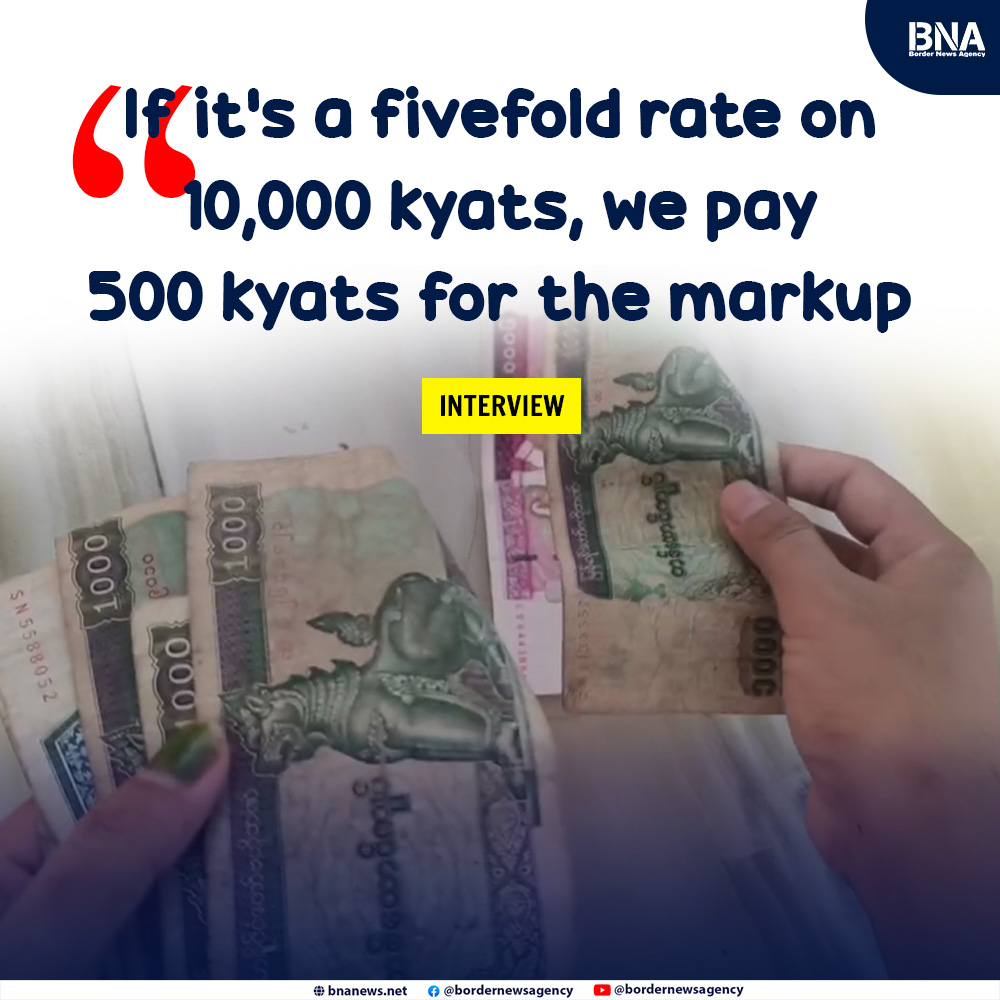

Interview
Border News Agency
Mrauk-U, June 17
In areas controlled by the Arakan Army, local residents say that fewer and fewer people are accepting old banknotes and worn-out bills for use.
In addition, locals report a rise in counterfeit banknotes and an ongoing shortage of cash. Although many places are no longer accepting old or damaged bills, some individuals continue to purchase them.
Border News Agency interviewed a woman involved in buying these rejected banknotes.
“When we transfer money now, we face a lot of difficulties. For instance, when dealing with 1 million kyats, sometimes more than 100,000 kyats end up being problematic. I’ve received fake 10,000 and 5,000 kyat notes mixed in. Some notes are torn into two parts and stuck back together, but the halves don’t match. The serial numbers and letters are different, which causes us to lose money. For torn notes, if the letters on the two halves don’t match, we can’t use them or deposit them into the bank. The bank staff tell us they won’t accept them. Even if the halves fit together, the letters must match exactly for the note to be considered valid.”
“The main issue is that we lose the most when counterfeit notes are mixed in. Sometimes, at the very least, there are four or five fake 10,000-kyat notes, or a couple of fake 5,000-kyat notes included. So we have to check carefully to avoid losses. I know what to look out for to some extent, but when I’m not paying close attention, the fake ones still slip through.”
“She said the banks are also exchanging money. These days, the workload has increased for them as well. It’s not just our group bringing in money for exchange – others are also doing it, with amounts reaching 40 to 50 million kyats at a time. That’s how much they’re depositing in one go. While we’re sending in amounts in the hundreds of thousan
“Yes, since we don’t have work, it’s hard to manage basic needs like food and clothing. We’re just getting by. Honestly, we don’t really know what to do to earn a living. While struggling like this, one of our acquaintances is a driver – he drives a tuk-tuk.”
“There’s a group in Minbya that buys damaged and old banknotes — I heard about them. If your work isn’t going well, maybe you should look into it and try buying too. I usually only have a small amount of worn-out money to exchange. I don’t have a lot to sell either. It’s not like I had money saved up – I actually borrowed it from others with interest to start this business. So I invest just a small amount and go make a small deposit each time. When I do, I can make tens of thousands of kyats in return. It works out well when it goes through, and the person there accepts it.”
“One time, after covering the travel and meal expenses, I was left with almost nothing. If I invest around 500,000 kyats and end up with nothing after expenses, then I’d need to invest at least 1 million kyats to make it worthwhile. Once you subtract the travel costs, only about 500,000 kyats would actually be for me. That’s how it works.”
“For 1,000 kyats, we pay 700; for 10,000, it’s 7,000; and for 100,000, we pay 70,000. When it’s our turn, we have to give five or six times the amount. For example, If it’s a fivefold rate on 10,000 kyats, we pay 500 kyats for the markup. But when it comes to trading by the hundreds of thousands, I don’t really want to go with a fivefold rate – I’d prefer to ask for six times. Paying six times is more common now.”





Comments 3
Thanks for sharing. I read many of your blog posts, cool, your blog is very good.
Thanks for sharing. I read many of your blog posts, cool, your blog is very good. https://accounts.binance.bh/register/person?ref=JW3W4Y3A
Điều khiến mình hài lòng là 188v nhà cái hoạt động ổn định cả trên wifi lẫn 4G. TONY08-17