
Interview
Border News Agency
Ponnakyun, July 15.
Displaced people in Arakan say they are facing numerous hardships during the monsoon season, including inadequate shelter from heavy rains, lack of proper bedding, and frequent flooding.
They also report that, due to the absence of international humanitarian assistance, their struggles with access to food and basic necessities have worsened.
The displaced people say they are in urgent need of international humanitarian assistance, as well as livelihood opportunities to survive and sustain themselves.
A person in charge of an IDP camp in Arakan was interviewed by Border News Agency.
“These displaced people here are from Sittwe, including Ponnakyun, and also from Thandwe and Kyaukphru. All four towns are represented among those staying here,” one person explained.
“During the rainy season, the area floods constantly. It floods every time it rains. We have to deal with the severe impacts of flooding again and again.”
“Getting around is also difficult, roads to the toilets are in poor condition. In terms of health, we’ve had more than two outbreaks of dengue fever.”
“We’ve also tried to report our situation to organizations, but that has been quite difficult. There are challenges with getting proper shelter and enough food. Some people can manage to feed themselves, but there are also many who can’t.”
“Since the day we fled our homes, we haven’t been able to bring anything with us. We escaped with just the clothes on our backs. These are the kinds of difficulties we’re facing.”
“We’re in need of everything here. It’s now been two years since we became displaced by the conflict.”
“In my area, there are 33 households in total.”
“As for how we’re surviving, there’s no work available for us.”
“Around here, some people work in the fields. In the paddy farms, they can earn about 5,000 to 10,000 kyats a day. Those who don’t have such work go up into the hills to cut firewood and earn the same 5,000 to 10,000 kyats per day just to get by.”
“When it comes to education, there’s no real support for us. While the schools may offer some care, consistent encouragement and support are seriously lacking.”
“I’m trying to do my best under these circumstances. We’ve received some support from organizations like ZOA, KYA, RWYO, Generation, and HDCO. No other groups have been allowed to operate here. RI has been in contact—they said they would help, but they haven’t been granted access yet. We’ve also submitted a request to CTA, but they haven’t been allowed in either. Generation is a Rakhine-led organization, and they provided 100,000 kyats to each household. KYA gave us water bottles, mosquito nets, blankets, and soap. RWYO distributed hygiene kits and sanitary products for women, along with soap. Generation also gave an additional 150,000 kyats in cash assistance.”
“There are no clear restrictions. If the organizations want to provide aid, it reaches us. If they don’t, then it doesn’t. That’s the reality here. The last time we received any assistance was in June.”
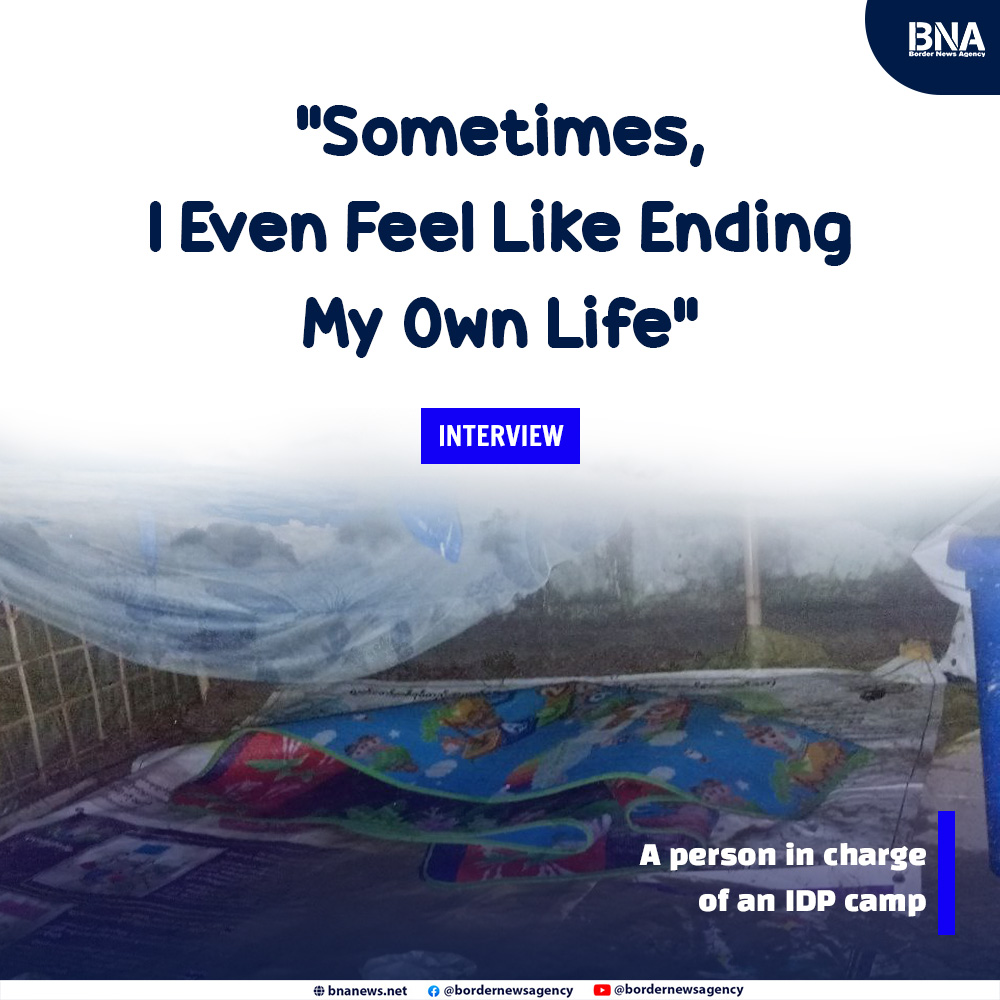
“As displaced people, we’re completely exhausted. Education isn’t going well, and our health situation is getting worse. Children are getting fevers and suffering from dengue. We don’t have any money. Sometimes, I even feel like ending my own life.”
“This is not even our own place or land. Even when we need to use the toilet, we have to carry the children on our backs. It rains heavily, and while we sleep, strong winds blow through. We live with constant worry and anxiety.”
“It’s very difficult. Don’t even ask about food and drinking water… there’s a lot that we lack. As the children grow older, their nutrition is no longer sufficient.”
“We face many difficulties like that. We work as day laborers. Before, we used to carry loads and earn around 500 kyats per load, climbing hills. Now, it’s about 1,000 kyats, but we can hardly work anymore. After working once, we feel pain in our backs and knees.
Also, we don’t work every day—only two or three days a week. We have to stretch that little over 10,000 kyats to cover our food and expenses. We’re still figuring out how to manage it all. The torch we use is unreliable; we can’t even see our way clearly at night. Buying candles is also difficult.”
“We’re facing many difficulties and feeling very distressed. We want to return to our village. We really want to go back to Sittwe city. I’m originally from there.”
“We have no clothes, absolutely none. As for our children, it’s hard to even talk about; they only have one set of clothes to wear. We can’t afford to buy another set.”
“I have no job here. I work as a day laborer, but I can hardly manage the heavy work anymore. There are days when we have no work, and when we don’t work, we go hungry. Sometimes we climb the hills to gather bamboo shoots, but during the rainy season, we can’t go up. Now, we’re no longer able to collect bamboo shoots. We are not locals of this area.”
“I can’t endure these hardships anymore. The difficulties are overwhelming—lack of food, shelter, and when it rains heavily, our homes get flooded. The water rises significantly. Even if I want to go somewhere, I have to walk. If I can’t go far enough, I have no choice but to sleep on the road. This is not my own land anymore, and it really breaks my heart.”
“We feel really sad. We wait patiently, hoping that aid organizations will come to help us. We don’t ask for much—we just want assistance to arrive about once a month. Right now, we wait each month, wondering if help will come or not. Sometimes we wait two months without anything arriving. When aid finally comes after three months, we feel very happy.”
“Some organizations have come, conducted training sessions, and then left. They also gave us soap, but when we’re hungry, soap isn’t something we can eat.”
“When I’m hungry, I can bear it, but I cannot bear to see my children suffer from hunger. That breaks my heart deeply. It has happened three or four times. Unfortunately, one of my children became so ill that we had to take them to the hospital, fearing for their life.”
“My youngest son was lucky because a nurse came and helped him with medicine. Otherwise, we would have had to take him to the hospital. But even if we need to go to the hospital, we don’t have the money to afford it.”
“We have no support or backing here. Everyone is scattered and fleeing separately. There’s no financial aid, only good fortune and prayers keep us going. We would like to be allowed access to health check-ups at least once. It’s been two years since we arrived here, and we’ve never even seen the health department.”
“Right now, the children are sick, and my wife is also running a fever. When there’s a fever, it’s usually dengue. She has had it three or four times already. We have also shared these concerns with aid organizations during community meetings.”
“The current projects run by aid organizations are facing interruptions. Although we have communicated our needs to them, direct contact is still limited. There are also some international organizations operating here.”
“When someone contracts dengue fever, we have to go from one place to another for treatment. The medical expenses are high. Aid and support from organizations have not yet reached us directly.”
“There is absolutely no support for education. For the past one or two years, our children have not received any schooling at all. This year, after holding meetings with village leaders, a decision was made.”
“We reported the teacher’s request that her salary not be equal to that of the villagers, and we also informed the administration and school authorities about this. They accepted the request and said it would be arranged. She spoke about this with sadness. These kinds of difficulties do exist.”
“Since we are living in the refugee camp, we have set up resting areas where people can gather. Now, if education is to be provided, we wonder whether it would be better to do it this way or to hold classes in the village area. As much as possible, we want education and support to be provided right here within our own camp.”
“Right now, the water level is high—it rises whenever it rains. The school is quite far away, at the very end of the area. When flooding occurs, it becomes very difficult for us to travel back and forth. If possible, we would prefer to have education provided right here inside our own camp.”
“In education, we do want to do things like that. Currently, there are three children: one is nine years old, one is fourteen years old, and nearby there is also one who is eight years old. Among them, there are two girls and one boy. The fourteen-year-old is a girl, the nine-year-old is a girl, and the eight-year-old is a boy.”
“That’s basically what has happened. Common illnesses like simple fevers, bird flu, and diarrhea have occurred. During the season when fruits like mangoes are ripe, these illnesses tend to happen. The water is also not clean; you can see the condition of the lake water for yourself.”