
Border News Agency
Mrauk-U, July 29.
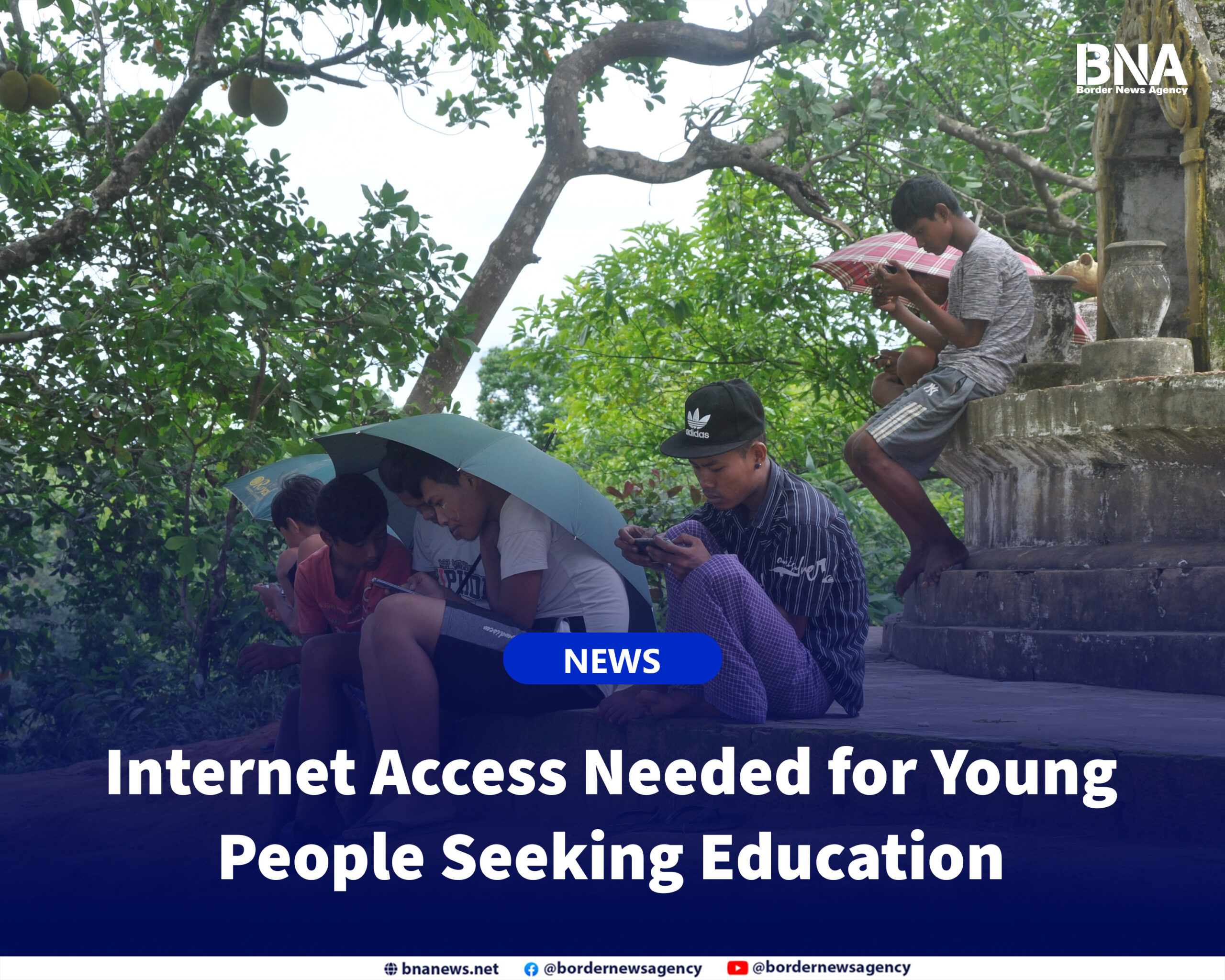
People and youth from the Arakan region say there is a need to provide internet services for young people to study and learn.
In Arakan, where the Myanmar’s military regime has shut down phone lines and mobile internet connections, the Arakan People’s Revolutionary Government has also blocked access to satellite internet, according to locals.
Because of this, many young people have lost educational opportunities and job prospects. Therefore, the community says it is necessary to arrange internet access for the youth.
“People can’t attend online courses anymore, and even working has become difficult. Currently, the internet service is only available for limited hours, and the cost is high, so no one can afford to use it full-time,” a young person from Minbra Township told Border News Agency.
The entire Arakan region has experienced phone line and internet shutdowns. Although some Arakan People’s Government departments and military-related groups use satellite internet Starlink systems, locals say they do not have full access to the internet.
The Arakan People’s Government’s technology department has opened public internet service points for civilians, but because these locations are limited and the prices are high, not everyone can use the internet freely, according to residents.
Because of this, young people who missed the chance to continue university education, those working online, and those attending school remotely have all experienced disruptions in their education and lost job opportunities, according to youth in the region.
The Arakan People’s Government’s technology department not only provides public internet services but also charges fees to money transfer operators and international and local aid organizations (INGOs and NGOs) for internet access, according to residents.
Young people who want to study or work online say that affordable and convenient internet access should be provided for them.
“Isn’t it the youth who will build the nation? A dedicated space should be provided for young people. Otherwise, they will face many difficulties—they need to be given the chance to open their eyes and ears,” a young person from Kyauktaw Township told Border News Agency.
In the Arakan region, there are only about ten places where people can access internet services, and they have to pay around 2,000 kyats per hour to use them.
However, residents said that there has not yet been any permission for people to buy and use their own Starlink devices, nor have there been any reductions to make prices more affordable for public use.
“The technology department cites security concerns, but even now there are still security risks, and people are able to use the internet. Arrangements need to be made so that everyone can have access. Otherwise, all the youth will lose their way. It’s not easy anymore to go to schools or attend training courses outside the state like before,” a young Arakanese working for an international aid organization told Border News Agency.
The Arakan People’s Revolutionary Government has been providing education up to the university entrance level and conducting examinations inside the Arakan region, but it has not yet been able to open universities or colleges.
“Students who have passed grade 12 don’t know what to study next or what to pursue,” a high school teacher told Border News Agency.
Therefore, both the international community and the public have pointed out that the Arakan People’s Revolutionary Government should ease restrictions and allow broader internet access for the sake of young people’s education.
During the previous National League for Democracy (NLD) government in 2019 and 2020, internet access in the Arakan region was cut off for several months citing security reasons.
At that time, human rights activists and student youth expressed their demands and protests for the restoration of internet services.




Comments 2
Your point of view caught my eye and was very interesting. Thanks. I have a question for you.
Your article helped me a lot, is there any more related content? Thanks!