
Border News Agency
The Hague 29 July 2025
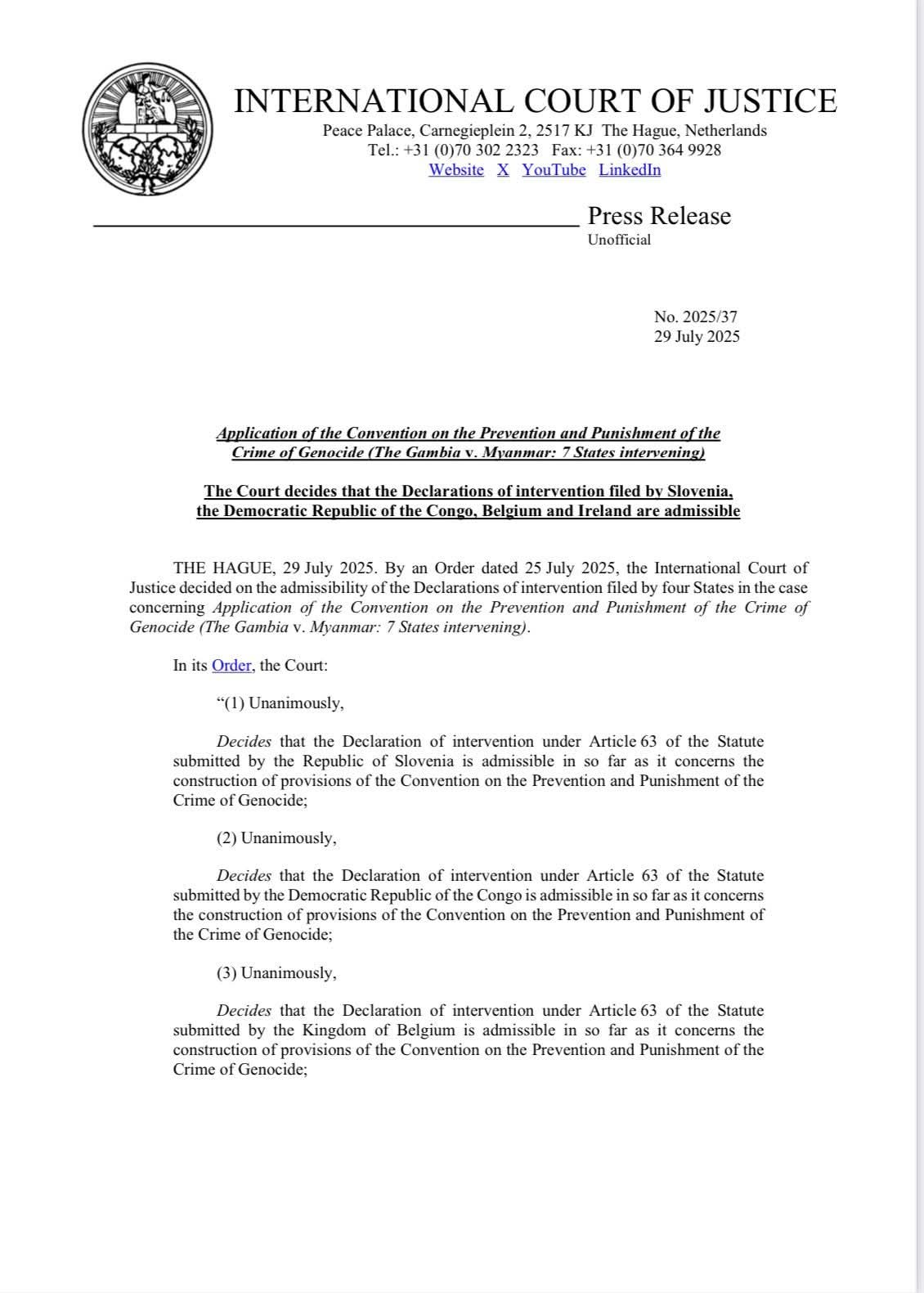
The International Court of Justice (ICJ) has ruled that the Declarations of intervention submitted by Slovenia, the Democratic Republic of the Congo (DRC), Belgium, and Ireland in the ongoing case of The Gambia v. Myanmar is admissible under Article 63 of the Statute of the Court.
The case, officially titled Application of the Convention on the Prevention and Punishment of the Crime of Genocide (The Gambia v. Myanmar: 7 States intervening), involves allegations that Myanmar violated its obligations under the Genocide Convention, particularly concerning acts committed against the Rohingya population.
In its Order dated 25 July 2025, the Court unanimously decided that the declarations by each of the four intervening States were admissible as they concern the interpretation of the Convention. It further fixed 25 September 2025 as the deadline for these States to submit their written observations.
Background of the Case
The proceedings began on 11 November 2019, when The Gambia instituted legal action against Myanmar, accusing it of committing genocidal acts against the Rohingya community in violation of the Genocide Convention. The Gambia requested the Court to declare Myanmar responsible for these violations and to ensure guarantees of non-repetition and reparations for victims.
The Court issued provisional measures on 23 January 2020, instructing Myanmar to prevent acts of genocide, preserve evidence, and report on its compliance every six months. Legal submissions continued through 2020 and 2021, with Myanmar raising preliminary objections on 20 January 2021.
Following public hearings, the Court rejected Myanmar’s objections on 22 July 2022, affirming its jurisdiction and the admissibility of the case.
Widening International Involvement
Over time, several States have filed declarations of intervention under Article 63, expressing interest in contributing to the interpretation of the Genocide Convention:
In November 2023, Canada, Denmark, France, Germany, the Netherlands, the United Kingdom, and the Maldives submitted their Declarations.
On 3 July 2024, the Court ruled those Declarations admissible.
The four latest admissible Declarations by Slovenia (29 Nov 2024), DRC (10 Dec 2024), Belgium (12 Dec 2024), and Ireland (20 Dec 2024) were the subject of the current ruling.
Written Observations and Objections
Following standard procedure, certified copies of the interventions were sent to The Gambia and Myanmar, and deadlines were set for submission of written observations. Myanmar opposed the admissibility of all four recent declarations, while The Gambia supported them.
The Court, required to hear the intervening States and both Parties due to Myanmar’s objections, conducted a written procedure. By 3 April 2025, all relevant written observations had been submitted. The ICJ’s unanimous decision on 25 July 2025 confirmed that the declarations complied with legal standards under the Genocide Convention.
Judge Cleveland appended a declaration to the Order.
Significance
The ICJ’s acceptance of these interventions underscores a growing international interest in the legal interpretation and enforcement of the Genocide Convention. The involvement of now 11 third-party States reflects increasing global concern over Myanmar’s treatment of the Rohingya population.
A summary of the Order is available in the Court’s document “Summary 2025/5”, and the full text can be accessed on the case page of the Court’s website.
For further information, the ICJ’s Information Department can be contacted via media@icj-cij.org.





Comments 2
Slot tại slot365 apk hỗ trợ chế độ autoplay và turbo spin – tiết kiệm thời gian, tăng tốc độ quay, phù hợp với dân chơi chuyên nghiệp. TONY03-11O
tải 888slot cam kết không can thiệp vào kết quả trò chơi. Hệ thống RNG (Random Number Generator) được kiểm toán định kỳ bởi GLI – tổ chức kiểm định hàng đầu thế giới trong lĩnh vực iGaming. TONY04-27H