
Border News Agency
Sittwe, August 13.
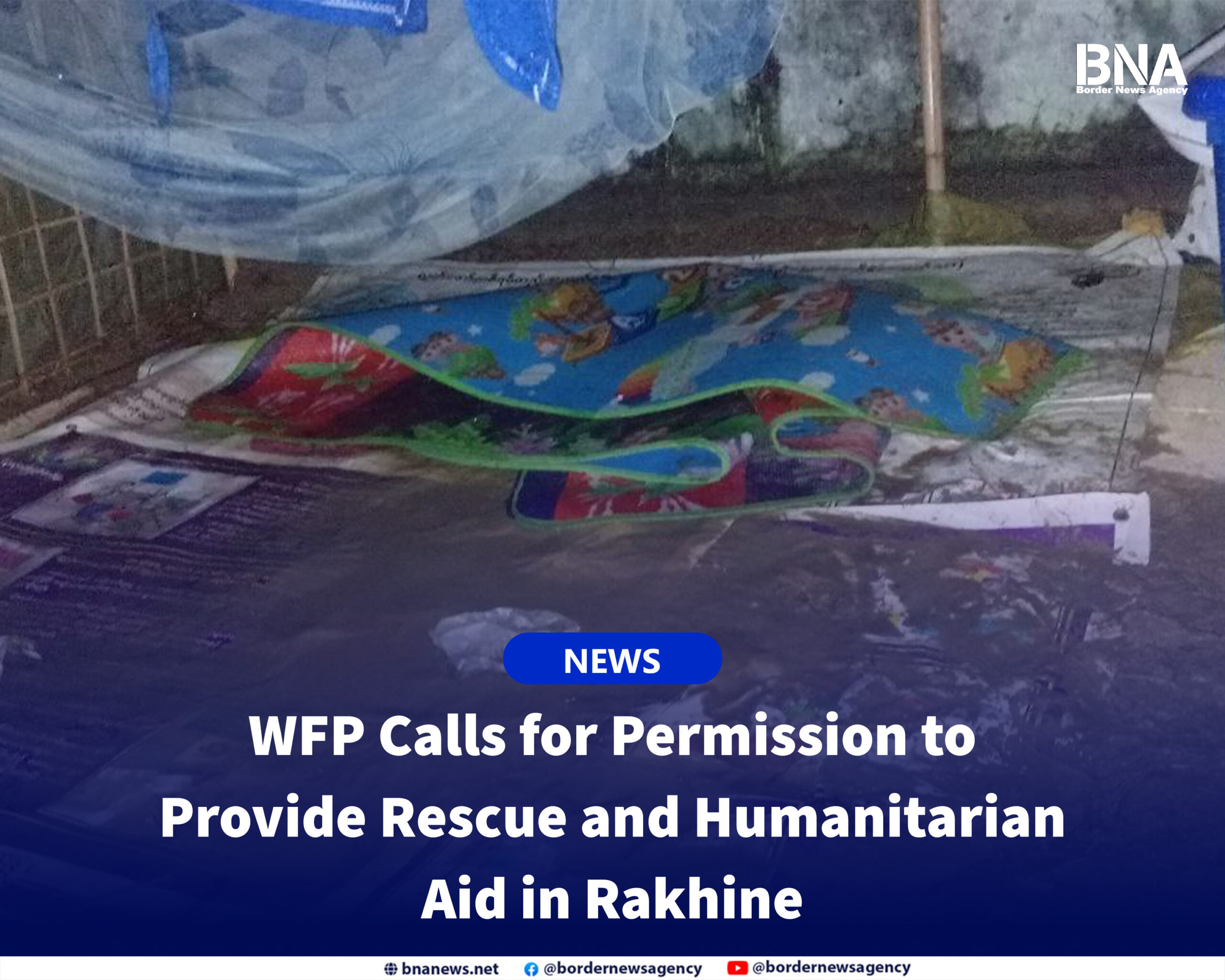
On August 12, the World Food Programme (WFP) urgently called for greater humanitarian assistance to be provided in Rakhine.
In Rakhine, due to armed conflict, restrictions imposed by the military junta, and nationwide cuts to humanitarian funding, the local people are experiencing increasing levels of hunger and malnutrition.
In Rakhine, the percentage of families unable to consume an adequate basic diet was 33% last December, but it has now risen to as high as 57%.
Food security in Rakhine has reached a critically alarming level, with malnutrition worsening significantly.
Movement restrictions caused by armed conflicts in Rakhine are also expected to become increasingly severe.
“People are trapped amid the conflicts. They have lost the ability to find food for themselves and are left without humanitarian aid and protection. In the midst of this worsening crisis, they are caught in a vicious cycle,” said Michael Dunford, the Myanmar Representative of the World Food Programme (WFP).
It’s said that the people of Rakhine are experiencing severe hardships, including taking on debt, begging for food, domestic violence, dropping out of school, social tensions, and human trafficking, all threatening their ability to sustain their family lives.
“We hear heartbreaking stories every day about children crying from hunger and mothers unable to feed their families due to lack of food. Families are doing everything they can to survive, but in these conditions, it is extremely difficult for them to keep going,” said Michael Dunford, the Myanmar Representative of the World Food Programme (WFP).
The prolonged fighting in Rakhine, movement restrictions, rising food prices, reduced humanitarian funding, and cuts to aid are all pushing civilians closer to starvation.
Therefore, the World Food Programme (WFP) is calling on authorities on the ground to allow unhindered humanitarian access to provide life-saving assistance.
The World Food Programme (WFP) says it needs 30 million US dollars to assist 270,000 people in Rakhine over the next six months.
“Immediate action is needed. If not, this crisis will turn into a truly catastrophic disaster,” said Michael Dunford, the Myanmar Representative of the World Food Programme (WFP).
On August 11, at a press briefing, the Arakan Army (AA) said that over 600,000 people in areas under its control are in need of international humanitarian assistance.
In Sittwe, still under the control of the Myanmar junta, civilians, unable to withstand the hardships of hunger, have been forced to split up their families in order to survive.
In Sittwe, unable to endure the hardships of hunger, some families have resorted to suicide, with at least 20 people affected across more than five households, according to records compiled by Border News Agency.
“This cannot be ignored by the international community,” said Michael Dunford, the Myanmar Representative of the World Food Programme (WFP).
In areas under the control of the Arakan Army, civilians including conflict-displaced people are reportedly facing severe risks of starvation.
Since the start of the AA’s decisive offensive, the Myanmar junta has blocked all land and water routes and restricted the delivery of international humanitarian assistance.
The international community says that in areas controlled by the Arakan Army, civilians face an increased risk of starvation because they are legally restricted from leaving these areas.







Comments 1
Can you be more specific about the content of your article? After reading it, I still have some doubts. Hope you can help me.