
Border News Agency
Minbra, August 17.
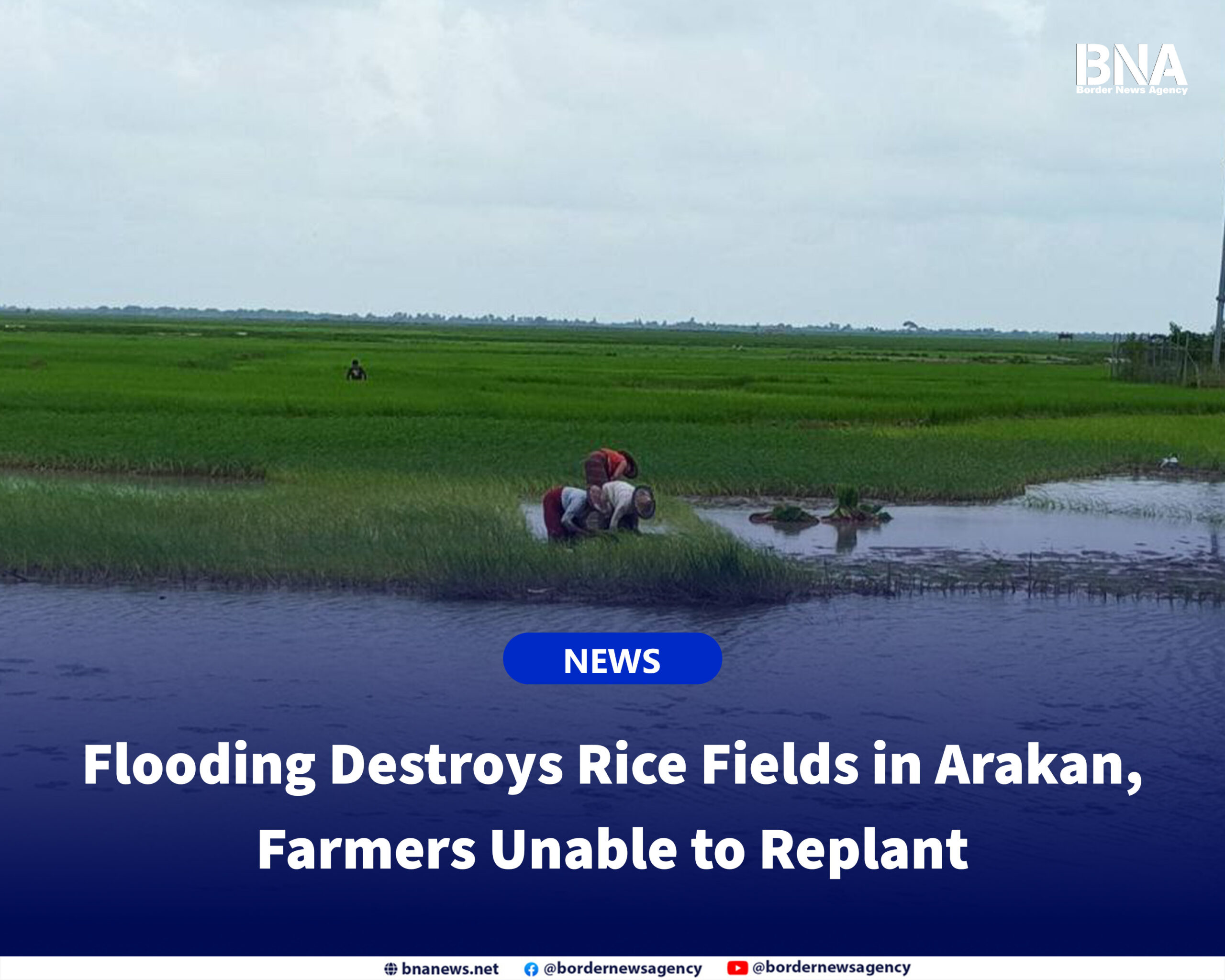
Farmers and aid workers in the Arakan region report that around 20,000 acres of already planted rice fields have been destroyed by flooding, and most farmers are unable to replant.
According to the farmers, they lack the necessary seeds, funding, and time to restore the flooded fields, preventing them from planting rice again this season.
“We can’t even find seeds. Some have been washed away by the flood. Even if we could get seeds, we don’t have the money to replant or try again. Farming now just adds to our losses,” a farmer from Minbya Township told the Border News Agency.
In townships such as Taunggoke, Kyauktaw, Ponnakyun, Mrauk-U, Minbra, Buthidaung, Maungtaw, and Rathedaung, continuous heavy rains from early June to July caused rivers and streams to overflow, resulting in widespread flooding.
Due to the flooding, Kyauktaw, Mrauk-U, and Minbra townships experienced the most extensive damage to rice fields, according to farmers and relief workers.
“If even part of a rice field is flooded, that section can be destroyed. In some areas, plant growth may be stunted, and in some cases, crops could be completely lost. In Mrauk-U Township, the Poung Toke fields were affected. In Kyaukphru, fields near Nyaung Chaung and Sapar Seik were impacted. Overall, the damage is widespread,” said U Maung Thein Hla, General Secretary of the Dhanyawaddy Farmers’ Development Association, to the Border News Agency.
Farmers say that while it is technically possible to replant the flooded rice fields, they are hesitant because of unpredictable weather.
“Even if we have the resources to replant, without proper rainfall, the rice won’t grow. In the nursery stage, we need to fertilize the soil at the right time, and then we still need rain. If it doesn’t rain, it’s wasted effort. That’s why we aren’t replanting,” a farmer from Minbra Township told the Border News Agency.
Farmers in the Arakan region say that due to high costs of agricultural inputs and poor market prices for rice, they are unable to cultivate all their farmland, managing to plant only a portion of it.
Although there are over 120,000 acres of rice fields in the region, relief workers estimate that farmers were unable to cultivate only about half of that area.
Under these conditions, around 20,000 acres of already planted rice fields were destroyed by flooding.
As the number of rice farmers in the Arakan region gradually declines, it could affect domestic food security. Farmers are urging the Arakan People’s Revolutionary Government to provide support by making agricultural inputs more affordable and ensuring better market prices for rice.
The Arakan People’s Revolutionary Government has provided some support to farmers, such as seeds and fertilizers, but farmers say the prices are still not affordable for them.
Since the start of the decisive battle in Arakan, the Myanmar junta has blocked roads and trade routes, disrupting the flow of goods. As a result, farmers have had to rely on neighboring countries to purchase and transport seeds, fertilizers, and diesel fuel, often at great difficulty, according to local farmers.





Comments 3
Your point of view caught my eye and was very interesting. Thanks. I have a question for you.
Can you be more specific about the content of your article? After reading it, I still have some doubts. Hope you can help me.
I don’t think the title of your article matches the content lol. Just kidding, mainly because I had some doubts after reading the article.