
Border News Agency
Kyauktaw, August 18.
Residents in areas controlled by the Arakan Army (AA) have reported that the Central Land Management Committee of the Arakan People’s Revolutionary Government has been collecting records related to farmland usage.
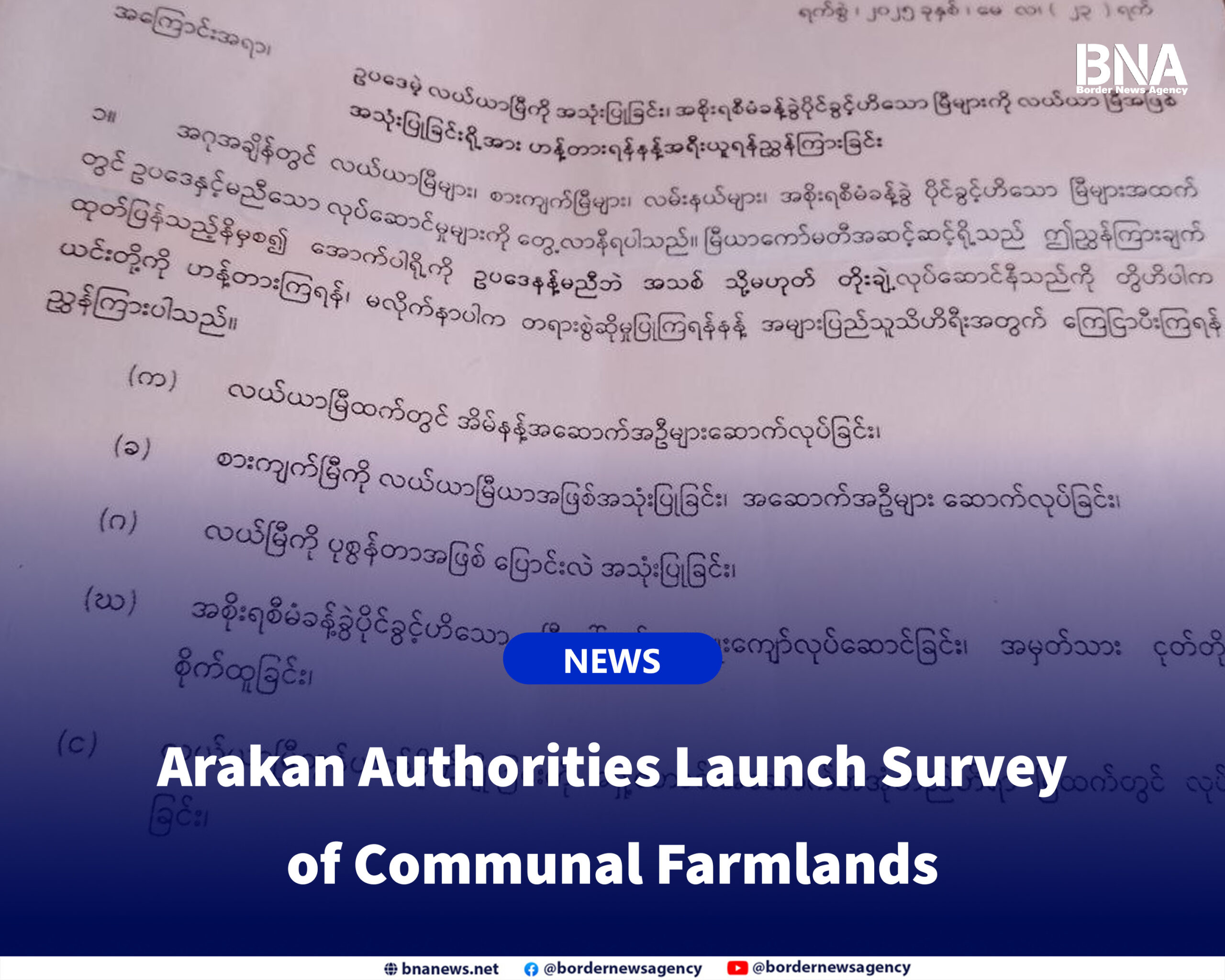
In villages within Kyauktaw Township, starting from August 15, the Central Land Management Committee reportedly summoned farmers to the homes of village administrators to gather records of cultivated land, grazing routes for cattle, and the expansion of agricultural plots, according to local farmers.
“A meeting was held at the village administrator’s house, where farmers were called in and their records collected. They said the meeting was convened to request the previously mentioned farmland records. The Land Management Committee is expected to come down to inspect the land in person. For now, only the records have been collected,” a farmer from Kyauktaw Township told Border News Agency.
Farmers said that during the record collection, not only the area of communal farmland was documented, but also the individual landholdings of each farmer were recorded.
The farmers also mentioned that this record collection may not necessarily require all communal farmlands to be reworked, but could instead be used to determine land-use allocations.
“I don’t think we will be asked to give up the communal farmlands. They will likely allow us to continue working the land. It is expected that we may have to pay taxes on the area we cultivate to the Arakan Army. If we were completely forbidden from using the land and forced to give it up, it would cause double hardship for us farmers. I don’t think the Arakan Army intends to harm or create suffering for the farmers in Arakan,” a farmer from Arakan told Border News Agency.
Farmers in the Arakan region said that because the amount of farmland they personally own is limited, they lack sufficient resources to sustain their families. As a result, they have been clearing uncultivated land and fallow areas to expand their farmland.
In addition, as agriculture in the Arakan region is gradually developing into a more industrialized form, the use of cattle has decreased. Therefore, farmers have been applying for and using communal farmlands to secure their families’ food and livelihood, according to local farmers.
Since the start of the decisive battle in Arakan, farmers have faced difficulties because the military commission has blocked transportation routes, preventing rice and paddy from being shipped and sold.
As a result, farmers are worried that the collection of records for communal and individual farmlands may be a prelude to imposing new taxes, according to local farmers.
“The collection of records for communal farmlands is a necessary measure for legal oversight. It is also important to carefully assess the daily livelihoods and impacts on village farmers amid the ongoing conflict. What is needed is not a method that makes farmers’ lives more difficult, but a precise and fair system,” a farmer from Arakan told Border News Agency.
In Myanmar, farmlands and communal lands can be used freely by farmers, but they are officially considered government-owned property.
Under the 1991 Land Management Law, farmers are allowed to use communal lands, but they are required to submit a formal application to obtain legal permission for use.
According to the 2012 Farmland Management Law and the 2012 Farmland Law, farmers’ use of farmlands and communal lands must be recorded. If the land is not in use, the relevant authorities have the right to reclaim it.
These laws also state that while communal lands can be used specifically for livestock rearing, authorities can reclaim them if they are used for purposes other than housing or cultivation.
On May 23, the Central Land Management Committee of the Arakan People’s Revolutionary Government stated that it would take legal action against farmers for the illegal use of farmlands. The statement cited cases where farmers had encroached on government-managed lands including cattle routes, communal lands, and farmlands by cultivating them in ways that do not comply with the law.
In addition, the committee has instructed that legal action should be taken if any of the following activities are observed on farmland: constructing houses or buildings, converting farmland for shrimp farming, installing survey markers on government-managed land, cultivating on archaeological or previously occupied sites, extracting bricks, sand, or stones from farmland, or creating or expanding agricultural or livestock areas and buildings beyond legal boundaries without authorization.







Comments 5
Thanks for sharing. I read many of your blog posts, cool, your blog is very good. https://www.binance.com/register?ref=JW3W4Y3A
Thank you for your sharing. I am worried that I lack creative ideas. It is your article that makes me full of hope. Thank you. But, I have a question, can you help me?
Thanks for sharing. I read many of your blog posts, cool, your blog is very good.
Thanks for sharing. I read many of your blog posts, cool, your blog is very good.
[2931]bdbajje লগইন ও অ্যাপ ডাউনলোড – বিকাশ দিয়ে অনলাইন ক্যাসিনো,bdbajje লগইন করুন এবং সেরা স্লট গেম সাইটে যাত্রা শুরু করুন। বিকাশ দিয়ে অনলাইন ক্যাসিনো গেমে অংশ নিন ও অ্যাপ ডাউনলোড করে আজই খেলা শুরু করুন। visit: bdbajje