
Border News Agency
Mrauk-U, October 17
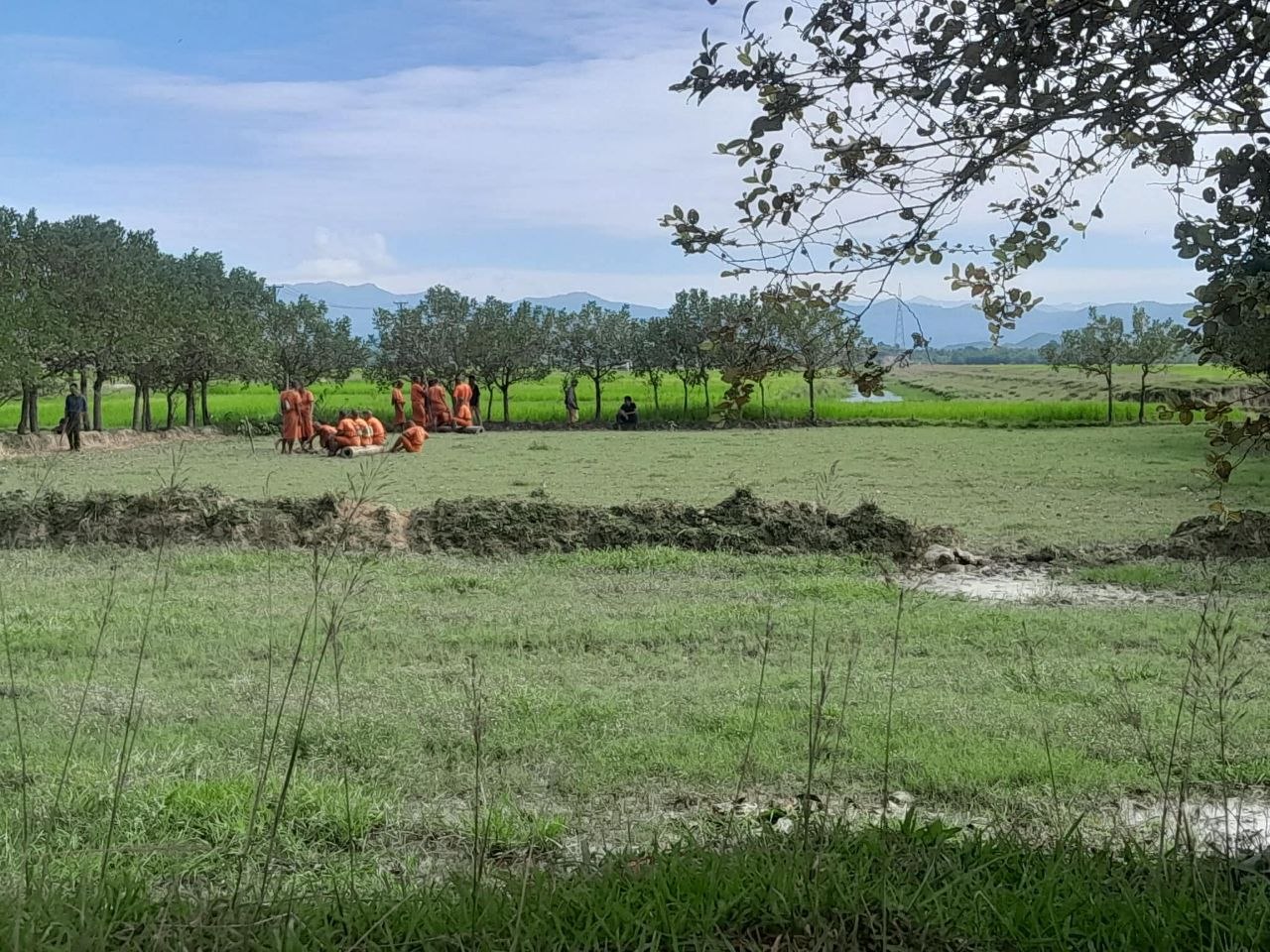
The Arakkha People’s Revolutionary Government is attempting to forcibly acquire land near Paung Doke Village in Mrauk-U Township, an area under the control of the Arakan Army (AA), and began surveying and demarcating plots at around 9 a.m. today, October 17, according to residents of Paung Doke Village.
Armed security personnel are carrying out the land surveys. Landowners say they were neither notified nor informed in advance, and no compensation has been paid. They described the operation as an act of forcible encroachment and seizure of private property.
“A large number of security personnel are surveying the land. The landowners have not been informed, and no compensation has been paid. It is like seizing our land by force at gunpoint. We want the international community to intervene and resolve this matter,” a landowner from Paung Doke Village told Border News Agency.
Although the United League of Arakan/Arakan Army (ULA/AA) has officially announced that the land will be acquired under the Land Acquisition Act of 1894, it is violating the provisions of that law by failing to follow the prescribed procedures.
While the ULA/AA claims that it is handling the land acquisition in accordance with the 1894 law, it has allegedly bypassed the required legal procedures. At the time the land surveys were announced, compensation was prematurely set at 80 million kyats per acre, before the proper stages of the process had been completed.
Because this amount is many times lower than the prevailing market value, the landowners have refused to accept the proposed compensation of 80 million kyats per acre.
Human rights activists have criticized the authorities for surveying and demarcating the land without paying the landowners any compensation, saying they are acting with disregard for landowners, the public, and the international community, relying instead on armed force to do as they please.
“Dr. Tin Mar Aung’s recommendations are being primarily implemented by Daw Khin Than of the Department of Archaeology. The main argument being promoted is that Mrauk-U will be designated a UNESCO World Heritage Site and that, once it receives UNESCO status, the military will be unable to carry out airstrikes there. In reality, the land is being forcibly seized to launder drug lords’ black money into legitimate funds. The international community should investigate and take action against everyone involved and all those connected to them,” a human rights activist in Rakhine told Border News Agency.
Residents of Mrauk-U confirmed that the acquisition was authorized by the Central Land Management Committee, chaired by Brigadier General Kyaw Han of the Arakan Army. They said that Daw Khin Than, also known as Ma Kha, a brigadier general in the AA’s Central Intelligence Department, is playing a leading role in the operation, while the Mrauk-U Township administration under the Arakkha People’s Revolutionary Government is implementing it.
The Land Acquisition Act of 1894 stipulates a series of procedures that must be followed, including land surveys, inviting objections, reviewing and examining objections, issuing an acquisition order, and determining compensation.
Under the 1894 law, compensation should not be limited to the current market value of the land. It should incorporate the prevailing market value, all resulting losses and damages, and an additional 15 percent as solatium. The Collector, or district administrator, is responsible for conducting an on-site assessment and making a determination.
If the affected landowners are dissatisfied with the Collector’s compensation decision, the Collector must inform them of their right to apply to a court to seek a determination of the compensation amount they believe they are entitled to receive.
Following this notification, the affected landowners must submit an application to the Collector requesting that the compensation dispute be referred to a court.
The Collector must then refer the case to the court and appear in the proceedings personally or through a representative.
In the land acquisition case involving Paung Doke Village in Mrauk-U Township, the landowners have already formally submitted written objections, notifying the authorities that they reject the compensation set by the Collector because it is substantially below the prevailing market value.
Consequently, the Collector’s office is required to facilitate the landowners’ right to seek a judicial determination of the compensation.
Instead of implementing this procedure, the authorities are allegedly avoiding payment of the land’s actual value by installing boundary posts on the land to be acquired and deploying armed security personnel to intimidate the owners through a show of force.
Such actions seriously undermine the rule of law under the Arakkha People’s Revolutionary Government and severely damage the institutional credibility and strength of the United League of Arakan (ULA).
Residents of Mrauk-U said that members of the Central Land Management Committee, the family members and siblings of Arakan Army (AA) Commander-in-Chief General Twan Mrat Naing, members of the United League of Arakan (ULA) Central Committee, and senior officials of the Arakkha People’s Revolutionary Government primarily reside in the area.
They said preparations are underway to designate Mrauk-U as the main administrative capital of the Arakkha People’s Revolutionary Government and to seek international assistance to protect it from airstrikes by the military junta.
However, human rights activists warned that the efforts to secure UNESCO World Heritage status for Mrauk-U could be jeopardized because, rather than making systematic preparations that would gain international acceptance, the authorities are forcibly acquiring land in ways that the international community may not accept.
Local residents also confirmed that AA soldiers have been forcibly detaining civilians, including workers, Rakhine truck drivers, and Muslim landowners, who were entering their land to carry out cleaning and clearing work.
U Kyaw Zan, secretary of the ULA Central Land Management Committee, said that land acquisitions were being handled on the basis of the Land Acquisition Act of 1894, with the authorities selecting and applying what they considered the most appropriate methods.
In addition, while the authorities have yet to pay compensation based on the prevailing market value, as required under the Land Acquisition Act of 1894, they are allegedly threatening and coercing landowners. In Ponnagyun Township, hundreds of acres of shrimp farms have also reportedly been forcibly seized under the leadership of U Aung Thar Win, the uncle of AA Commander-in-Chief General Twan Mrat Naing and head of the Department of Law Enforcement and Public Security (DeLAPS). Armed personnel have reportedly been stationed on the seized land.
In AA-controlled territories, the ULA Central Land Management Committee is chaired by Brigadier General Kyaw Han, with U Kyaw Zan serving as secretary. Other committee members include U Tet Tun Aung, a former Amyotha Hluttaw representative for Ponnagyun Township from the Arakan National Party (ANP), U Maung Oo Kyaw, U Thar Tun Shwe, and others.
Landowners have also confirmed that public land belonging to residents in Kyauktaw Township, along the Kyauktaw–Mrauk-U road, has been fenced off and seized without formal notification to the owners, reportedly on the verbal orders of Colonel Min Khant of the AA intelligence department.
Furthermore, residents of AA-controlled territories say that the ULA/AA has been forcibly acquiring public land without notifying or consulting the original landowners or providing compensation.
International human rights observers have assessed that such forced land acquisitions violate both the land acquisition laws that the ULA/AA itself claims to follow and international land governance principles. They warn that the ULA/AA could face declining international assistance and support, as well as potential punitive measures and sanctions.
In addition, Rohingya rights activists say that the ULA/AA’s management and redevelopment of former Rohingya village sites in Maungdaw District, which are subject to provisional measures ordered by the International Court of Justice (ICJ), may violate international law and destroy evidence relevant to allegations of genocide. They warn that those responsible could face legal proceedings and punishment under international law.