
In-depth Report
Border News Agency
Mrauk-U, October 31
The Decisive War
As part of Operation 1027, launched by the Three Brotherhood Alliance, which includes the Arakan Army (AA), the Arakan Army launched an offensive on November 13, 2023, and captured the military junta’s Don Paik Border Guard Outpost along the Maungdaw–Ahngumaw road.
Since the beginning of this decisive war in Arakkha, the military junta has blocked and restricted all land and water transportation routes in the region, while also imposing a complete blockade on the movement of goods.
In addition, healthcare services for the people of Arakkha have deteriorated to their worst levels because healthcare facilities and hospitals have also been targeted in attacks, according to local residents.
During the most intense periods of the decisive war, people in Arakkha were forced to travel to Bangladesh under extremely difficult circumstances to receive treatment for emergency medical conditions and illnesses requiring surgery. Residents said that some patients even died while receiving medical treatment in Bangladesh.
People have also been travelling to India’s Mizoram State to seek medical treatment, facing numerous difficulties, including poor transportation access, high expenses, and language barriers, according to Arakkha residents.
After capturing and taking control of 15 townships, including Paletwa Township, during the decisive war, the Arakan Army has been establishing administrative mechanisms under the Arakkha People’s Revolutionary Government.
The Arakkha People’s Revolutionary Government established the Arakkha Health Department (AHD) in 2025 and also founded the Arakkha Institute of Medical Sciences.
The Arakkha Health Department, together with the medical institute, has been conducting midwifery training courses and public health supervision training programmes to produce community health workers.
However, as the decisive war in Arakkha continues to intensify and the military junta carries out almost daily airstrikes, healthcare services for local residents continue to face serious challenges and difficulties, according to Arakkha residents.
Hospitals Targeted in Attacks
During the decisive war in Arakkha, the military junta has deliberately targeted not only civilians but also basic healthcare infrastructure and facilities.
Hospitals and clinics that civilians in territories controlled by the Arakan Army rely on have been deliberately targeted in airstrikes by the military junta.
These airstrikes demonstrate a disregard for international laws and a lack of respect for international humanitarian principles. As the airstrikes continue, the military junta is continuing to commit war crimes, according to Arakkha residents.
In October 2025, the Humanitarian and Development Coordination Office (HDCO) of the United League of Arakan (ULA) released a report on airstrikes carried out by the military junta.
The report, entitled “War Crimes from the Sky,” documented evidence of atrocities committed by the military junta.
According to the report, 12 hospitals and clinics were completely destroyed by military junta airstrikes between November 2023 and September 2025.
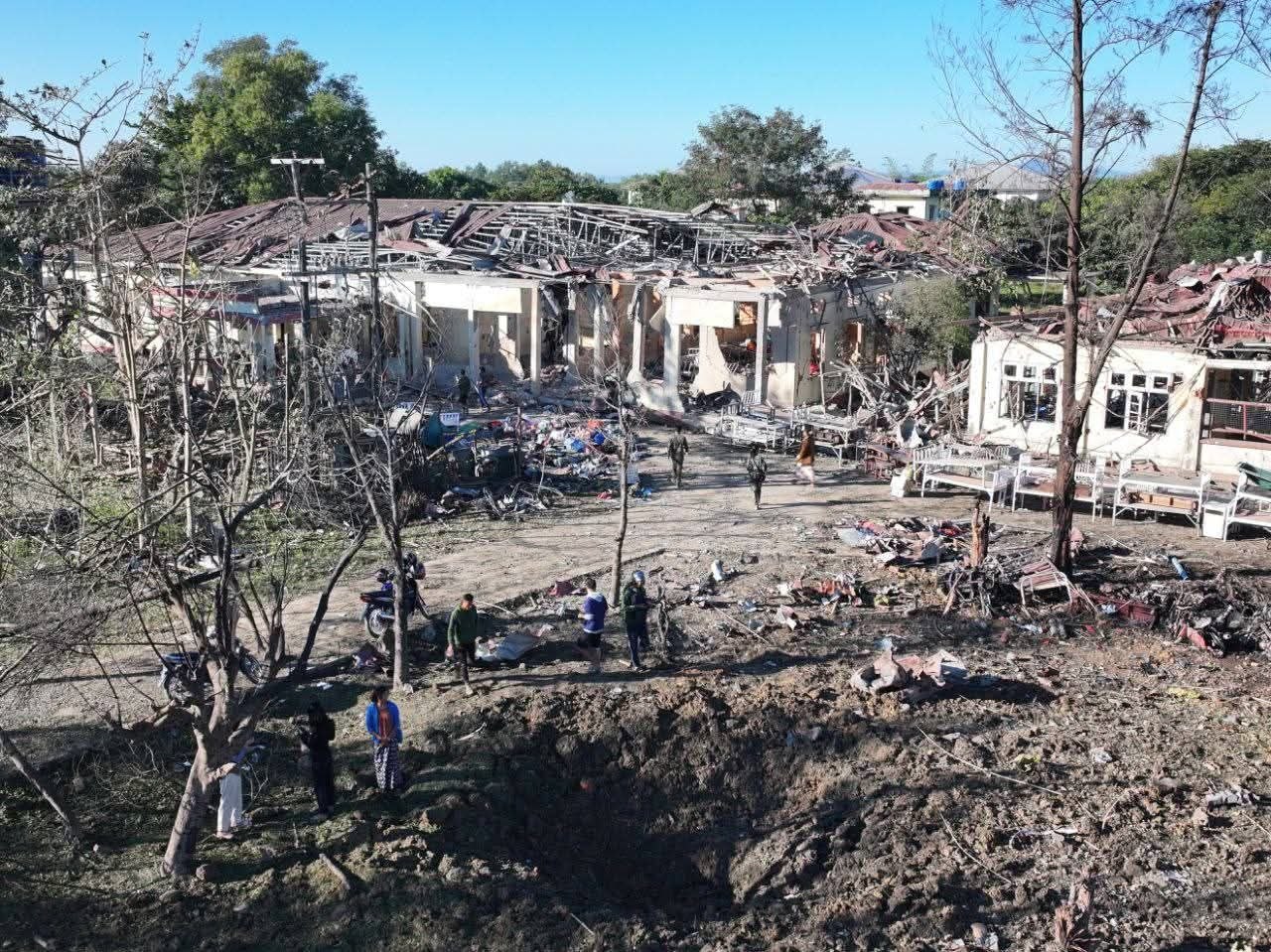
On December 11 last year, the military junta launched an airstrike on the Mrauk-U District Public Hospital, located in the ancient cultural heritage area under Arakan Army control, killing 33 people and injuring 76 others.
Following the bombing, patients had to be relocated to safer locations. Without regular wards, operating theatres, emergency treatment rooms, or medicine storage facilities, medical staff have been forced to continue providing treatment under temporary and makeshift conditions, according to the Arakkha Health Department.
“After the bombing, it became completely impossible to continue operating the hospital. All the medical supplies and equipment were destroyed. We had to urgently relocate patients to safer places to protect them from airstrikes. Even now, we are still providing treatment under makeshift conditions,” a healthcare worker from Mrauk-U District Hospital told Border News Agency.
The airstrike on Mrauk-U District Public Hospital demonstrates that healthcare services in territories controlled by the Arakan Army are facing not only shortages of medicine but also serious security risks, as hospitals themselves can become targets of airstrikes.
Healthcare workers in Arakkha said that relocating patients from hospitals to temporary facilities has increased the risks associated with emergency surgeries, blood transfusions, and maternal and newborn healthcare.
“The hospital is gone. We are now treating patients with injections and IV drips inside these temporary tents. Every day passes with constant fear and anxiety,” a family member accompanying a patient at a temporary medical facility said.
The attack also destroyed the hospital beyond repair, including essential emergency medical equipment, resulting in a major loss for local residents who depend on it for emergency treatment and other healthcare services.
Regarding attacks on civilian targets, the United Nations Office of the High Commissioner for Human Rights (OHCHR) has also issued strong warnings.
Concerns Over Medical Treatment and Medicine Shortages
In addition to the destruction of hospitals, restrictions on transportation have made it almost impossible to purchase basic medicines, while medicine prices have increased more than tenfold.
Essential equipment needed for emergency surgery and oxygen cylinders are also in short supply. As a result, providing emergency treatment to patients in territories controlled by the Arakan Army has become extremely difficult, according to the Arakkha Health Department.
Although the Arakan Army controls most townships, it has not yet been able to provide comprehensive advanced healthcare services to the public, according to Arakkha residents.
The Arakkha Health Department said that medical equipment and medicines remain insufficient to treat long-term illnesses such as cancer and kidney disease, as well as severe injuries sustained during the war.
In addition, as the military junta continues to carry out almost daily airstrikes, patients are increasingly afraid of being killed in airstrikes while receiving treatment in hospitals, according to local residents.
“We are more afraid of being killed in an airstrike while lying in a hospital bed than we are of the illness itself. There are no hospitals left in our homeland where we can receive treatment,” an Arakkha resident receiving medical treatment in Aizawl, Mizoram State, told Border News Agency.
As a result, people from Arakkha suffering from chronic and emergency medical conditions have been forced to cross international borders and travel to neighbouring countries such as Bangladesh and India to receive treatment, despite the high costs and numerous security risks.
During these cross-border journeys for medical treatment, they also face various dangers, including arrest, kidnapping, and killing by armed groups. Residents said that patients and their families are living in constant fear and anxiety.
Nevertheless, in their efforts to recover from illness and survive, people are forced to overcome these dangers and sell whatever limited possessions they have.
“That is why I urgently sold the cow and farmland we had at home and came here for treatment,” an Arakkha resident receiving medical treatment in Aizawl, Mizoram State, told Border News Agency.
Cross-Border Travel Difficulties
Although the Arakan Army controls the Arakkha–Bangladesh and Arakkha–India border areas, there is still no official permission for people to cross the borders for travel. While cross-border movement has reportedly been permitted through informal arrangements, some Arakkha residents have been arrested and deported by Bangladeshi border guards.
As a result, some people have been forced to return home without receiving medical treatment, according to Arakkha residents.
In addition, armed groups claiming to represent the Rohingya have reportedly committed kidnappings, killings, and abductions targeting people travelling across the border for medical treatment. Consequently, fewer people are now travelling to Bangladesh to seek medical care, residents said.
Therefore, although more people are now travelling to Mizoram State in India for medical treatment, they continue to face difficulties related to transportation, lengthy journeys, and high expenses, according to Arakkha residents.
Patients from territories controlled by the Arakan Army have been forced to travel for several days, crossing difficult land and water routes, as well as forest paths and mountainous terrain.
“It took almost a week to get here from Arakkha. We were worried about airstrikes along the way, and there were so many difficulties because we had to travel through forest routes,” a person who travelled to Aizawl for medical treatment told Border News Agency.
Furthermore, during rainy days, roads become muddy and slippery. The journey is so difficult that even healthy people struggle to endure it, while seriously ill patients can feel as though they may lose their lives along the way, residents said.
After spending substantial amounts of money on transportation and local guides to reach Aizawl, patients and their families face another set of difficulties.
Language and Local Challenges
Upon arriving in Aizawl, Mizoram State, people from Arakkha have become heavily dependent on interpreters who help them communicate with hospitals and medical professionals because of language barriers.
Taking advantage of this situation, some interpreters have reportedly been charging between 1,000 and 2,000 Indian rupees per day, equivalent to approximately 50,000 to 100,000 Myanmar kyats, placing a significant financial burden on people travelling from Arakkha for medical treatment.
“Without an interpreter, we cannot communicate with the doctors at all. We cannot even understand what illness we have or what medicines we need to take. So we have no choice but to pay whatever amount they demand,” an Arakkha resident receiving medical treatment in Aizawl told Border News Agency.
Furthermore, some patients and their families have faced additional difficulties because of alleged deception and fraud by certain interpreters.
“Some interpreters collect large amounts of money, claiming it is for hospital expenses, but they do not pay the full amount to the hospital. Instead, they keep a portion of the money for themselves,” a man who personally experienced this situation in Aizawl told Border News Agency.
Living expenses in Aizawl are also extremely high, creating further financial difficulties for patients’ caregivers and family members.
Accommodation and food expenses quickly consume whatever money patients and their families bring with them, leaving them struggling to cover the costs of treatment.
When they eventually run out of money, some are forced to discontinue their medical treatment, and there have reportedly been heartbreaking cases in which patients have died as a result.
Although some Arakkha families living in Aizawl have offered assistance by providing affordable accommodation and food, such support is insufficient for long-term needs.
Even when patients die while receiving medical treatment, there have been distressing cases in which their families cannot afford the transportation costs to bring their bodies back to their hometowns, according to people living in Aizawl.
“On top of the psychological trauma from having our homes bombed, we are now being deceived even in a foreign land. It feels as though our minds are dying before our bodies,” a volunteer in Aizawl said.
Although offices representing the United League of Arakan/Arakan Army (ULA/AA) are located in Aizawl, and some senior officials also reside there, Arakkha residents have criticised them for allegedly failing to provide necessary assistance to people facing these difficulties.
“They do not intervene to help people when they are cheated at hospitals or when patients die. This is something they should be doing,” an Arakkha resident told Border News Agency.
Rising Commodity Prices and Expensive Medicines
The military junta’s implementation of its Four Cuts strategy during the decisive war in Arakkha has severely damaged the entire healthcare system for local residents, according to Arakkha residents.
Restrictions on the transportation of medicines, the closure of hospitals and clinics, shortages of healthcare workers, and the lack of electricity have collectively made it extremely difficult for sick people to access medical treatment.
In addition, the increasing number of internally displaced people, shortages of drinking water, poor sanitation, and insufficient food supplies and household income have contributed to an increase in diseases such as skin infections, tuberculosis, malaria, and dengue fever, according to healthcare workers from the Arakkha Health Department.
Human rights activists have pointed out that the healthcare crisis facing the people of Arakkha is not simply a matter of medicine shortages but is closely connected to military, economic, and humanitarian problems.
Due to transportation difficulties caused by the military junta’s Four Cuts strategy, medicine prices in territories controlled by the Arakan Army have increased dramatically, according to local residents.
“A medicine that costs 2,000 kyats in Yangon and Mandalay can cost between 4,000 and 6,000 kyats when it reaches Rakhine, meaning the price increases twofold or threefold,” a medicine shop owner in Mrauk-U said.
Such increases in medicine prices have particularly affected internally displaced people and low-income families. Those already struggling to afford basic necessities can no longer afford to purchase medicines at these inflated prices, according to Arakkha residents.
As a result, some internally displaced people and members of low-income communities are facing greater risks to their lives because they cannot receive timely medical treatment.
Routine vaccinations for pregnant women and newborn babies have also been affected, residents said.
Furthermore, the lack of electricity in territories controlled by the Arakan Army has made it difficult to store vaccines and medicines that require refrigeration, according to healthcare workers from the Arakkha Health Department.
“Since there is no electricity, it is impossible to use refrigerators to store vaccines and medicines that require cold-chain storage. As a result, we are facing difficulties because we do not have sufficient facilities to provide routine vaccinations for children,” a healthcare worker from the Arakkha Health Department told Border News Agency.
Increased Disease Transmission Among Internally Displaced People
Internally displaced people have reported an increase in skin infections and other skin diseases in displacement camps because of overcrowding, shortages of drinking water, and poor sanitation.
According to people providing assistance to displaced communities, internally displaced people from townships including Ponnagyun, Kyauktaw, Thandwe, and Gwa are among those experiencing the highest rates of illness.
Furthermore, shortages of medicines, clinics, and hospitals have contributed to the increasing spread of diseases.
“Civil society organisations are conducting outreach medical services, but they cannot provide complete treatment because there are not enough medicines,” a volunteer healthcare worker from a civil society organisation said.
This demonstrates that providing mobile medical services alone is insufficient. Without access to medicines, basic healthcare supplies, clean water, and disease prevention materials, it will not be possible to control the spread of diseases, according to local healthcare workers.
Medical teams from the Arakkha Health Department have been conducting outreach medical services, but they are also facing medicine shortages, healthcare workers said.
Shortages of Healthcare Workers in Arakkha
The Arakan Army has been establishing administrative mechanisms under the Arakkha People’s Revolutionary Government in territories under its control and providing healthcare services to the people of Arakkha, according to local residents.
However, although the Arakkha Health Department is providing healthcare services, it continues to face challenges, including insufficient medicines and shortages of healthcare workers, according to Arakkha residents.
Even before the Myanmar military coup, healthcare services in Rakhine were being provided at an average ratio of only one doctor for every 20,000 people. Following the military coup, the number of doctors reportedly declined by approximately half, according to healthcare professionals.
More than three million people live in Rakhine. Despite high maternal and under-five child mortality rates, the region reportedly had only around 160 doctors, including retired doctors operating private clinics, according to healthcare professionals.
The already limited number of healthcare workers, combined with the further decline in medical personnel, has made access to healthcare even more difficult for the people of Arakkha. Residents said that the number of patients dying from preventable causes has continued to increase.
In addition to the decline in healthcare workers, the military junta’s disruption of communication channels and restrictions on the transportation of medicines have made access to medical supplies extremely difficult. Medicine prices have also increased by approximately threefold to tenfold, according to Arakkha residents.
Residents said that hundreds of people have died in territories controlled by the Arakan Army because they could not receive timely medical treatment due to the absence of doctors or because they could not afford to travel to distant clinics.
In some areas controlled by the Arakan Army, children from internally displaced families and other low-income communities have also died because they could not receive timely medical treatment, according to people assisting displaced communities.
Shortages of Medicines for Tuberculosis and Chronic Diseases
Since the military coup in Myanmar, infectious diseases and chronic illnesses have become increasingly common. Following the outbreak of the decisive war in Arakkha, some patients have been left without access to medicines altogether, according to Arakkha residents.
Furthermore, restrictions imposed by the military junta during the decisive war have made it impossible for patients to receive timely treatment for both infectious diseases and long-term chronic illnesses, according to healthcare workers in Arakkha.
“Cases of infectious diseases such as tuberculosis are increasing again. Because regular treatment medicines are unavailable, some people are dying even though their deaths could have been prevented,” a female healthcare worker from Arakkha told Border News Agency.
Previously, international organisations provided medicines for patients with tuberculosis and sexually transmitted infections. However, international humanitarian organisations said that civil society healthcare organisations, including Médecins Sans Frontières (MSF), had been forced to close their offices because of the restrictions.
As a result, people suffering from diabetes, heart disease, hypertension, and kidney disease are facing life-threatening situations because they can no longer obtain their regular medicines, according to Arakkha residents.
“I have diabetes and high blood pressure. Within just a few days of running out of my medicines, I started experiencing heart palpitations and dizziness. I cannot buy the medicines, and the transportation routes are blocked. I am extremely worried,” a patient with chronic illnesses from Arakkha told Border News Agency.
Healthcare workers from the Arakkha Health Department said that even a few days without medication for chronic illnesses can cause patients’ health conditions to deteriorate rapidly, making this an issue that requires urgent attention.
Health Conditions of Internally Displaced People
According to a statement released by the Humanitarian and Development Coordination Office (HDCO), the number of internally displaced people in territories controlled by the Arakan Army has exceeded 600,000.
Among them, internally displaced people from Kyaukphyu, Ramree, Taungup, Ponnagyun, and Kyauktaw townships are struggling without employment and have become dependent on humanitarian assistance, according to people providing support to displaced communities.
“Almost all displaced people are unemployed. The only work available is collecting firewood, picking bamboo shoots, and gathering vegetables in the mountains,” said Ko Naing Lin Htun, who is assisting internally displaced people.
Because of the lack of employment opportunities, internally displaced people have also experienced a decline in their ability to purchase food. Even when they collect firewood to earn an income, they cannot find markets where they can sell it, according to people assisting displaced communities.
“Even after spending an entire day collecting firewood, they can earn only around 5,000 to 10,000 kyats, but there is no market where they can sell it,” Ko Naing Lin Htun added.
Although civil society organisations and charitable groups are providing assistance to internally displaced people, the support remains extremely limited compared with the scale of their needs. As a result, displaced families continue to struggle to meet their basic living expenses and cannot afford medical treatment or access adequate healthcare services, according to people working on displacement issues.
“Each household receives only around 10,000 kyats. It is just enough to keep people from starving to death. Once food and other basic living expenses are taken care of, healthcare and education become the next major challenges,” said Ko Naing Lin Htun, who is assisting internally displaced people.
This demonstrates the direct relationship between basic living conditions and healthcare. Healthcare workers said that inadequate nutrition weakens the immune system and can make illnesses more severe when people become sick.
Challenges Facing Children and Vulnerable Groups
As the decisive war in Arakkha enters its second year, internally displaced people and other low-income communities are struggling to survive on barely enough food to avoid starvation, according to local residents.
Internally displaced people and other low-income families have been forced to purchase food on credit simply to survive from day to day.
“We buy food on credit and repay the debt whenever we receive money. We hardly ever get to eat meat or fish. I have three children, so I cannot go out to work. I am struggling alone to support the family,” said Ma Myint San Yi, a female internally displaced person from Ponnagyun Township, speaking to Border News Agency.
This demonstrates that healthcare assistance for internally displaced people cannot be limited to providing medicines alone. Food and nutrition, income opportunities, care for people with disabilities, and access to medicines for chronic illnesses must also be addressed simultaneously, according to people working on displacement issues.
Malaria and Dengue Fever Outbreaks in Wai Thar Li Village
Residents of Wai Thar Li Village in Mrauk-U Township, which is under the control of the Arakan Army, said that malaria and dengue fever had spread to almost the entire village and that emergency assistance was urgently needed.
“If there are five people in one household, around four of them are suffering from dengue fever. We have been told that some cases are at Stage 2 malaria. People are also dying continuously,” a woman from Wai Thar Li Village said.
Although almost the entire village, including children, has been affected by fever, residents have not received adequate medical treatment. They have therefore been urgently appealing to hospitals, doctors, and humanitarian organisations to come and provide assistance.
The outbreak of malaria in Wai Thar Li Village highlights the shortage of essential disease prevention measures, including mosquito repellent, mosquito nets, emergency medicines, and disease surveillance systems, according to civil society organisations.
Disease Outbreaks and Warnings from the AHD
According to announcements from the Arakkha Health Department (AHD), since the beginning of the rainy season, the number of people hospitalised due to dengue fever in Ramree, Mrauk-U, Rathedaung, Minbya, and Myebon townships has reached 33.
According to disease statistics for 2025 in territories controlled by the Arakan Army, there were 2,452 dengue fever cases and eight deaths. Mrauk-U Township recorded the highest number, with 946 cases, followed by Minbya Township with 704 cases.
“Although preventive health guidelines have been issued, we are struggling enormously to distribute essential mosquito repellent, mosquito nets, and other preventive materials directly to local residents because of territorial conditions and transportation restrictions,” a staff member of the Arakkha Health Department said.
Main Causes of the Healthcare Crisis
In territories controlled by the Arakan Army, the military junta’s Four Cuts strategy has created serious difficulties in purchasing and transporting medicines. As medicine prices continue to rise, healthcare supply routes risk being completely disrupted, potentially pushing healthcare services for the people of Arakkha into an even more severe crisis, according to local residents.
Furthermore, shortages of healthcare workers and the lack of hospitals and clinics in territories controlled by the Arakan Army have reduced the capacity to detect and treat illnesses in a timely manner, according to healthcare workers from the Arakkha Health Department.
In addition, overcrowding in internally displaced camps has accelerated the spread of skin infections, tuberculosis, and other infectious diseases.
People providing assistance to internally displaced communities said that inadequate access to basic food supplies and insufficient household income among displaced people and other low-income families have weakened their immune systems and reduced their ability to afford medicines.
Moreover, the absence of electricity and cold-chain storage facilities has made it difficult to preserve vaccines and medicines requiring refrigeration. Restrictions on the delivery of international humanitarian assistance have also prevented emergency medicines and healthcare teams from reaching areas in need in a timely manner.
Therefore, addressing the current crisis requires more than simply delivering medicines. It is necessary to simultaneously restore the operation of hospitals and clinics, facilitate the transportation of medical supplies, strengthen mobile healthcare teams, and improve access to clean water, sanitation, and nutrition in internally displaced camps, according to people working on displacement issues.
The territories controlled by the Arakan Army are facing multiple overlapping crises. In addition to armed conflict, the impacts of global climate change, including the anticipated challenges associated with a Super El Niño, are likely to create even more difficult challenges for healthcare services for the people of Arakkha.