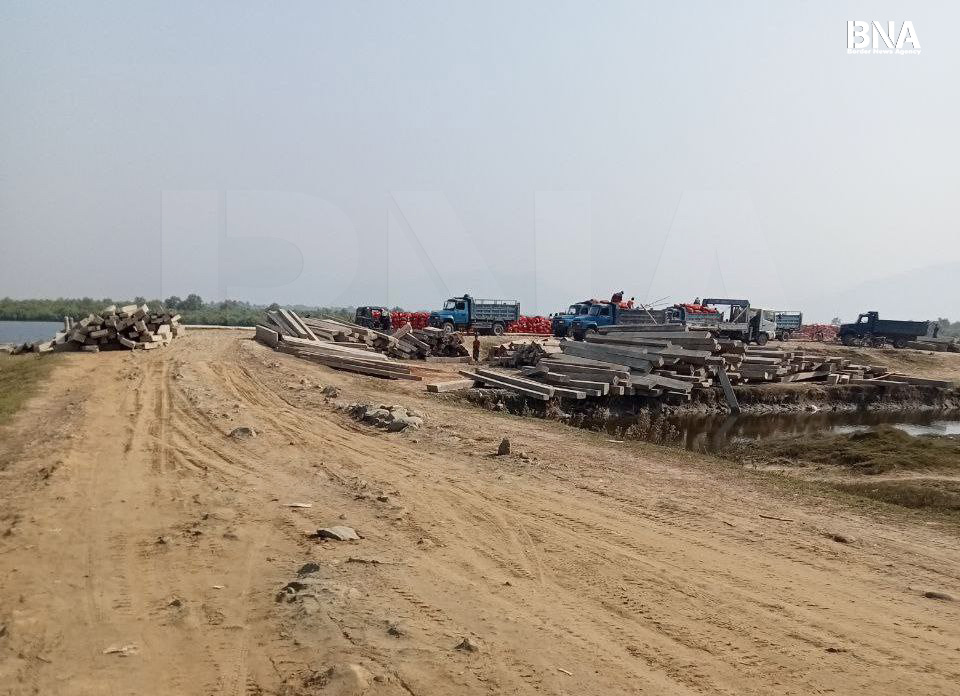

Merchants and local residents from Maungdaw Township have confirmed that cross-border trade between Arakan and Bangladesh has resumed through the Kanyin Chaung Economic Zone, which is under the control of the Arakan Army (AA).
Rice, timber, and other goods are primarily being exported from the Kanyin Chaung Economic Zone, while commodities such as cement and potatoes are being imported, according to traders.
The cross-border trade between Arakan and Bangladesh is being facilitated under the leadership of the Arakan People’s Revolutionary Government, with the Arakan Chamber of Commerce overseeing the operations.
Although the flow of goods through the Kanyin Chaung Economic Zone port remains steady on a daily basis, there are still many challenges. Arakanese traders say that proper negotiations and agreements between the authorities of both countries are necessary to improve the situation.
“This is currently being carried out based on mutual understanding. It would be more convenient if there were official agreements between the two countries. Additionally, if we can boost local production and export more goods, it will be even better. Right now, we are doing as much as possible under the current circumstances,” a trader from Maungdaw told Border News Agency.
Since the start of the Arakan decisive war in November 2023, trade exports to Bangladesh had come to a halt. However, merchants and local residents from Maungdaw confirm that cross-border trade resumed at the beginning of 2025.
The entire Maungdaw Township, which hosts multiple Arakan-Bangladesh border trade stations, has been under the full control of the Arakan Army (AA) since December 8, 2024, following a decisive offensive operation.
Following this, the Arakan People’s Revolutionary Government has been working to restore trade along the Arakan-Bangladesh border. The Central Arakan Chamber of Commerce, led by Chairman U San Kyaw Hla, is overseeing trade operations, according to merchants and local residents.
In addition to the Arakan-Bangladesh border, trade is also being conducted along the Arakan-India border. Traders and residents confirm that commerce is gradually resuming in various regions of Arakan under the control of the Arakan Army (AA).
However, ongoing clashes continue to pose challenges, including transportation difficulties, taxation issues, and a lack of essential infrastructure such as roads and bridges, according to merchants and local residents in Arakan.
Additionally, they emphasize the need for the Arakan People’s Revolutionary Government to establish clear legal frameworks, trade policies, and taxation regulations for border trade and economic activities. They also stress the importance of ensuring equal opportunities for traders and the public while preventing monopolization in the economy.
“It would be better if traders and the public clearly understood what they need to do. Instead of giving privileges based on connections, equal opportunities should be provided for everyone. This includes clear regulations on how much tax should be paid for each type of goods. Most importantly, there should be no economic monopolization,” an Arakanese merchant told Border News Agency.
In the Arakan decisive war, the Arakan Army (AA) has gained full control over multiple townships, including Paletwa, Maungdaw, Buthidaung, Rathetaung, Ponnakyun, Kyauktaw, Mrauk-U, Minbra, Myaybon, Pauktaw, Rambre, Thandwe, Taunggoke, Ann, and Gwa.
In areas under the control of the Arakan Army (AA), the Arakan People’s Revolutionary Government is establishing administrative mechanisms to govern effectively. This includes administration, judiciary, education, healthcare, economy, land management, taxation, immigration, police forces, firefighting services, and media operations, according to officials from the revolutionary government.
The only remaining townships yet to be captured by the Arakan Army are Sittwe, Kyaukphru, and Manaung. Frequent clashes continue in Kyaukphru Township, while tensions remain high in Sittwe, with both sides maintaining strong military positions, according to local residents.
In Maungdaw border trade and other areas under Arakan Army (AA) control, the taxation and customs department of the Arakan People’s Government is collecting a 3% tax on imported goods, according to Arakanese traders and residents.
Arakan-Bangladesh border trade is being conducted not only through the Kanyin Chaung Economic Zone port but also at least five other locations based on mutual understanding. Exports include buffaloes, cattle, goats, crabs, fish, and other local products, while imports primarily consist of food items, consumer goods, and medicines, according to merchants and locals.