
Written By Lin Khine
Border News Agency
Mrauk-U, June 23.
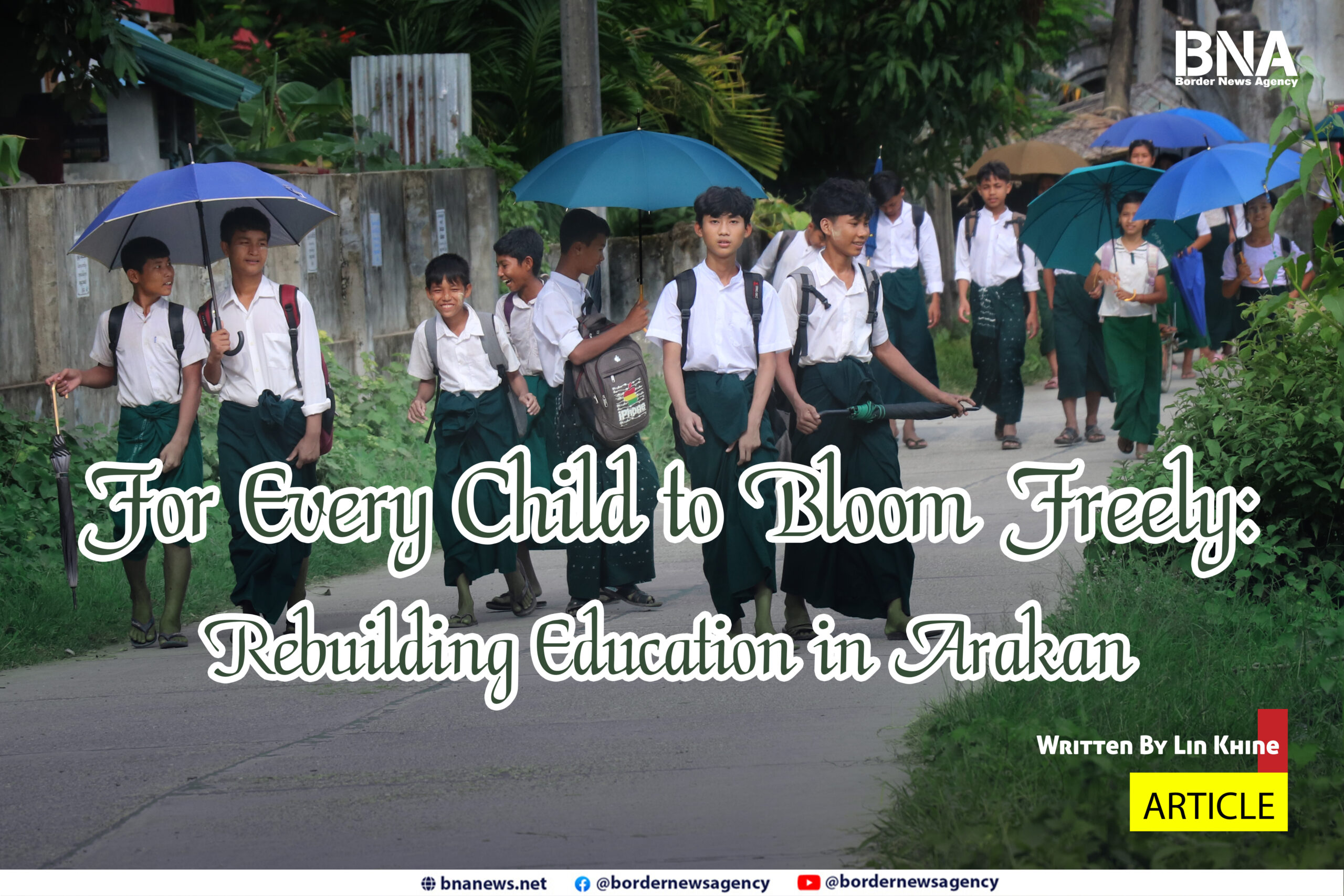
The rain is now gently falling, and the fields are filled with water. Farmers have started heading into the fields. It’s also time for children to return to school.
However, schools in the Arakan region still cannot fully reopen. Not every child in Arakan has the opportunity to attend school yet.
“For these two children—one in second grade and the other in eighth grade—I want to send them to school. They couldn’t attend school last year either. The children are quite good at their studies,” said Daw Yin Yin, a displaced woman from Minbra Township.
However, for families who have fled their homes due to the war, they are no longer receiving any support from aid organizations. As they struggle just to have enough food for each meal, they simply cannot afford to send their children to school.
In Arakan, sending a child to school is not easy. Just the cost of printed school textbooks alone is at least 30,000 kyats, and a dozen blank notebooks costs about 25,000 kyats.
On top of that, there are also monthly school fees. Although Daw Yin Yin wants to send both of her daughters to school, the financial burden makes it impossible to follow her heart.
“I’m thinking of going around to offices (of the Arakan People’s Government) to ask for support,” Daw Yin Yin said.
In Arakan, many parents share the same struggle as Daw Yin Yin, they want to send their children to school but simply can’t afford to.
With the soaring prices of basic food items and a severe lack of job opportunities in the region, most parents are barely getting by just to feed their families.
As a result, they are no longer able to support their children’s education. The number of children dropping out of school without even completing primary level has been steadily increasing.
In some areas under the control of the Arakan Army, Border News Agency conducted a small informal survey among parents of schoolchildren. The results revealed that nearly half of the children who were supposed to attend school this academic year had dropped out.
The survey, conducted in the townships of Pauktaw, Minbra, and Myaybon, involved the parents of 30 students. Among them, 14 parents said they had already withdrawn their children from school
Meanwhile, even among the 16 students who are still attending school, their families are struggling hard to keep them in class.
These difficulties stem from the harsh realities of daily survival, parents are finding it increasingly impossible to support their children’s education.
Since the military coup in 2021, the number of students dropping out before even completing basic education has noticeably increased. This year, that number has risen even more sharply.
In the 2023 school year, during which Cyclone Mocha struck the Arakan region, there were over 370,000 students enrolled.
Back in 2021, the year the military seized power, the number had dropped to over 350,000. Under the previous civilian government in 2020, the total number of enrolled students had reached more than 530,000, according to education department records.
Now, under the administration of the Arakan People’s Revolutionary Government, some district-level education officials estimate that the number of enrolled students in the region has dropped to around 300,000.
“The number of students has clearly decreased. In some districts, the highest is only around 60,000. There are even districts with just a few thousand. Across all of Arakan, it’s probably no more than 300,000,” said a district-level education official.
Looking at these figures, it’s evident that the number of children receiving basic education in the Arakan region has significantly declined, and the student dropout rate has noticeably increased.
Why has the number of students decreased?
Compared to the period under the previous civilian government, the number of students in the Arakan region has dropped by nearly half.
This sharp decline has raised serious concerns about the future of children’s education, according to former education officials and observers.
They point out that this significant drop in student enrollment began after the military seized power and is mainly due to the severe struggles families face in meeting their basic daily needs.
Because of this, nearly half of the parents are struggling just to put food on the table and can no longer afford expenses like textbooks and school fees for their children.
“In the past, we could earn income by farming and cutting grass just to get by and support the family. That way, I could send my child to school. But this year, there’s no work. I have to pull my son out of school,” said Daw Than May, mother of a fourth-grade student from Pauktaw Township.
In the Arakan region, where agriculture is the main livelihood, the rising prices of basic food items and farming inputs, combined with falling prices for agricultural products, have discouraged farmers from fully cultivating their land.
As a result, many manual laborers who depend on agriculture have lost their jobs and are now struggling to meet their basic food and living needs.
They have even reached the point where they have to pull their own children out of school.
Because there are so many low-income, manual labor families in the Arakan region, the number of parents unable to continue their children’s education is increasing.
Additionally, over 10% of the Arakan population consists of families displaced by war, many of whom no longer receive the regular monthly financial support they once relied on forcing them to withdraw their children from school as well.
“It’s been over six months since we stopped receiving any humanitarian aid, so finding food is really difficult. We rely on donations and begging. Sending my children to school is no longer easy,” said a displaced woman from Thandwe Township who is currently taking refuge in Myaybon Township.
How is the education system functioning in Arakan?
In all areas controlled by the Arakan Army, the Arakan People’s Revolutionary Government has established the Arakan National Education Department and is preparing to reopen schools.
However, due to shortages of teachers, concerns about civilian locations, and frequent airstrikes targeting schools, hospitals, and other civilian facilities by the Myanmar junta, not every school can be reopened yet.
The Arakan People’s Revolutionary Government has set up a central education department as well as education offices at the district, township, and regional levels to manage the education sector.
The Arakan Army established the Arakan National Education Department around the 2020 ceasefire period, but it has been fully operational only after the recent intense battles in the region.
This education department includes not only administrative staff but also appoints teachers at the township level.
However, currently, the department has not been able to provide salaries to the teachers. Instead, teachers are being paid through fees collected directly from the students.
How are school fees paid?
Because the education department is currently unable to provide salaries for teachers, fees are collected directly from the students. This has placed an even heavier burden on parents, making it more difficult for them to keep their children in school.
The Arakan People’s Revolutionary Government’s Arakan National Education Department appoints teachers at the village and neighborhood levels within local communities.
The financial support for these teachers is gathered proportionally from the students attending their classes.
The Arakan People’s Education Department has set guidelines stating that school fees for children from Kindergarten to Grade 12 should not exceed 10,000 to 30,000 kyats per month.
However, on the ground, parents report that fees for primary school children range from 5,000 to over 10,000 kyats; for middle school students, fees are around 20,000 to 40,000 kyats; and for high school students, fees can be as high as 50,000 to 100,000 kyats per month.
They say that because there are fewer students, schools have to charge higher fees.
“Our department only allows collecting up to 30,000 kyats at most,” said an official from the district office of the Arakan National Education Department.
In some villages, parents take the lead in organizing contributions of rice or food supplies during school breaks in the summer.
The Arakan National Education Department has stated that children displaced by conflict and those who cannot afford school fees should be granted exemptions from paying school fees.
However, in reality, parents say that these exemptions are rarely granted.
“One might be told they don’t have to pay school fees, but we still can’t afford the cost of textbooks. We don’t even have enough food to eat,” said a parent of a displaced student from Myaybon Township.
Are the teachers qualified?
The Arakan People’s Revolutionary Government’s Arakan National Education Department appoints and organizes teachers who are already living in local villages and neighborhoods to carry out teaching duties.
While some villages do have experienced and qualified teachers, the majority face a shortage of teaching staff. In many areas, due to this shortage, young people who have only completed high school or hold university degrees often without any teaching experience are being assigned to teach, according to field observations by Border News Agency.
Due to a shortage of teaching staff within the Arakan National Education Department, individuals who do not fully meet the qualifications are also being recruited and used as teachers, according to reports.
Some parents have taken matters into their own hands by hiring experienced teachers privately to teach their children.
“There are cases where we hire our own teachers. Yes, it costs more. But those teachers are available because they’re not earning enough through the official education system,” said a parent from Minbra Township.
To address the shortage of teachers, the Arakan People’s Revolutionary Government has invited former education staff to join and support the system. At the same time, young people who have passed the matriculation exam (university entrance level) are also being recruited and appointed as teachers.
In addition, preparations are reportedly underway to open a teacher training college, which is expected to launch within this academic year, according to sources close to the matter.
“What really needs to happen is for all the teachers inside our own land to come and support the education system for our people. That’s what we want to see,” said a high school teacher from the Arakan National Education Department.
Teachers who apply to join the Arakan National Education Department are being assigned to vacant teaching positions at schools in need.
In the Arakan region, some teachers relocated to areas under the control of the junta or to junta-administered zones during periods of intense fighting. Others have left the region entirely to seek work in other parts of the country or even abroad.
Among those who have remained in Arakan, some teachers are still conducting private tutoring independently and have not joined or collaborated with the Arakan People’s Revolutionary Government.
What schools can students attend after matriculation exam?
The Arakan National Education Department under the Arakan People’s Revolutionary Government held end-of-year exams for basic education students during the 2023–24 academic year and has already released the exam results.
In some cases, students who passed the military-run exam for the same academic year were not officially recognized by the revolutionary government and were required to retake exams under its system.
Students who have passed the matriculation exam and are examined for eligibility by the Arakan Health Department under the Arakan People’s Revolutionary Government can attend local institutions such as education colleges and medical training schools within the Arakan region.
They also say that preparations are underway to open a business school within the Arakan region.
Other vocational colleges and universities, however, have yet to be established locally in Arakan.
But for students who want to continue their studies abroad, arrangements have been made to assist and support their travel and enrollment, according to officials from the Arakan National Education Department.
“Currently, the most urgent resources needed for nation-building are in healthcare and education, such as schools and clinics. There are also plans to reopen more universities,” said an official from the Arakan National Education Department in an interview with Border News Agency.
Education should be accessible to everyone
When building and developing a nation, education is one of the most essential basic needs. Therefore, it is important for those responsible, non-governmental aid organizations, former education staff, and parents to work together and cooperate.
They emphasize the need to create an education system where every child can learn, and to arrange support so that teachers do not have to ask for extra school fees and receive proper salaries.
Additionally, it is necessary to provide training programs to ensure teachers are fully qualified. Experienced teachers should also be encouraged to collaborate and actively participate with the Arakan People’s Revolutionary Government.
“There is nothing more important than education. Even if it’s not completely free, there must be a system that works for everyone. Although we are still in the revolutionary period, this needs to be done as soon as possible,” said a retired official from the education department.
Only then can situations like those faced by struggling families like Daw Yin Yin’s where children are forced to drop out of school be prevented from increasing further.
Like the poem “Our School” says, “When the flowers bloom, they reach out like tendrils; in the sunlight, they pour golden nectar,” schools must come together to thrive like golden nectar in the sunlight. Everyone must work unitedly to build schools that allow every child to have access to education, so that each flower-like child can unfurl their buds and blossom beautifully.

Comments 1
I don’t think the title of your article matches the content lol. Just kidding, mainly because I had some doubts after reading the article.