
The Myanmar junta has reportedly halted and banned maritime trade between Yangon, Myanmar, and Teknaf port, Bangladesh, starting today, January 24, according to confirmations from the trading community.
That trade route was initiated in October last year as an alternative to border trade with Bangladesh, which had been suspended since the start of the decisive Arakan war. Since then, direct trade between Yangon and Teknaf had been conducted.
The Bangladesh border trade had been conducted exclusively through the Maungdaw and Sittwe border trade routes.
However, on November 13, 2023, after the Arakan Army (AA) attacked and captured the Myanmar junta’s military posts and border checkpoint along the Maungdaw-Ah Ngu Maw road, nearly all border trade shipments came to a halt.
Although it had been halted, since the beginning of 2024, direct border trade with Bangladesh has resumed using maritime routes.
The direct maritime trade between Yangon and Teknaf is being led by U Kyauk Taung, a prominent Rakhine businessman, who is well-known for his influence in the region.
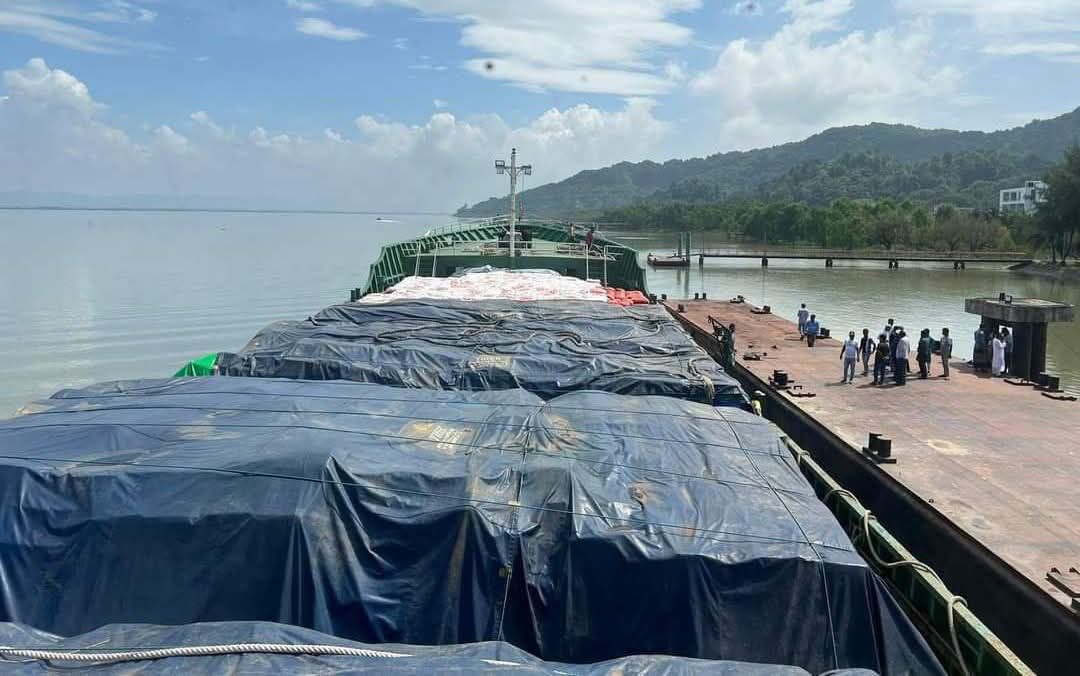
After the Arakan Army (AA) took control of the Arakan maritime route, on February 16, the AA conducted inspections on a large cargo ship as part of their security measures.
A week after the AA conducted inspections, the Myanmar junta halted and banned border trade with Bangladesh. As a result, cargo ships carrying goods from Yangon to Teknaf were forced to turn back, according to traders.
A trader told Border News Agency, “Today, the Myanmar side has closed the Bangladesh route. The ships carrying goods have to turn back. Now everything has come to a halt. Even a frozen fish cargo ship has been forced to turn around.”
This year, direct maritime trade between Yangon and Teknaf has been conducted five times. On October 21 of last year, a cargo ship named Htike Htar Thakhin, owned by the prominent businessman U Kyauk Taung, arrived at Teknaf port, Bangladesh, from Yangon, Myanmar, via the Bay of Bengal.
The direct maritime trade between Yangon and Teknaf is being conducted with the approval of coup leader Min Aung Hlaing. Traders and those observing Rakhine affairs say that this trade generates U.S. dollars for the military regime through the influence of the prominent businessman U Kyauk Taung, who plays a key role in facilitating this process.
A Rakhine affairs observer told Border News Agency, “Since the day the fighting started in Rakhine, the junta has blocked all trade flows. Even from Sittwe port, goods can’t be transported anymore. Maungdaw is also under the control of the AA. In the meantime, U Kyauk Taung is facilitating the flow of U.S. dollars for the junta. If Min Aung Hlaing didn’t approve, U Kyauk Taung wouldn’t be able to do it. It’s a mutually beneficial arrangement.”
Border trade experts say that the Bangladesh border trade is not only the largest in terms of goods volume but also the sole source of foreign currency, specifically U.S. dollars, for Myanmar.
As a result, after the military coup, Myanmar traders faced restrictions as the Bangladeshi government-owned Sonali Bank blocked bank drafts for border trade transactions.
Since the start of the decisive Arakan war, the Myanmar junta has blocked all land and sea routes in the Arakan region. Additionally, all trade and goods shipments into the Arakan region have been prohibited.
In addition, the Myanmar junta has restricted the movement of the entire population of the Arakan region, while the people are suffering from poverty, disease, and violent attacks. Traders and the people of Arakan believe that U Kyauk Taung, a prominent businessman facilitating foreign currency inflows for the junta through his connections, should be held accountable by the Arakan People’s Revolutionary Government.
A trader told Border News Agency, “If the Arakan Army doesn’t agree, it’s not easy to enter Teknaf port. If you enter the Naf River, you have to go through Maungdaw. If U Kyauk Taung is required to pay customs, then all other traders will also have to pay. If the AA doesn’t intervene, this illegal passing will continue. Even cargo ships can be seized by the AA.”
U Kyauk Taung, a key figure with close ties to coup leader Min Aung Hlaing, is using military connections to engage in illegal activities, including unauthorized logging, smuggling, and unlawful trade. He has been helping support the military regime through various illicit ventures. As a result, the people of Arakan are calling on the international community to take action by imposing sanctions, blocking his access to international markets, and denying him entry to other countries.
During the decisive war in Arakan, while the local population is facing severe shortages of essential goods such as food, medicine, and basic necessities, U Kyauk Taung and his associates are reportedly supplying vital resources to the Myanmar junta, which continues to perpetrate violence against the people of Arakan. The people of Arakan believe that these actions are fueling the junta’s ongoing oppression.
The people of Arakan believe that the actions of U Kyauk Taung and his associates, by supporting the junta, are directly contributing to the violence and killings carried out against innocent civilians. At a time when ordinary people are unjustly being murdered, these individuals are seen as prioritizing their own personal gain, risking the lives of the people of Arakan for their benefit.
The traders suggest that the Myanmar junta’s decision to block the Yangon-Teknaf maritime trade route may be linked to the Arakan Army’s interception and inspection of ships. During these inspections, goods, including those on vessels owned by U Kyauk Taung, were likely identified. In response, the traders believe the junta may have suspended the trade route following intelligence reports and requests from the ship owners for assistance.
A trader told Border News Agency, ‘It seems the ship owners asked the junta for assistance after the Arakan Army conducted inspections. The junta likely blocked the route because they were worried about the AA gaining an advantage. U Kyauk Taung is likely the main figure behind this. He probably advised the junta to block the route, which is why they took action. However, traders still want to continue the trade.”
The Arakan Army (AA) has fully captured and controls the entire area along the Naf River, including the Kanyin Chaung Economic Zone on the opposite side of Teknaf port in Bangladesh, as well as the coastal areas stretching from An Ngu Maw port to the Bay of Bengal.