
Bordar News Agency
Mrauk-U, June
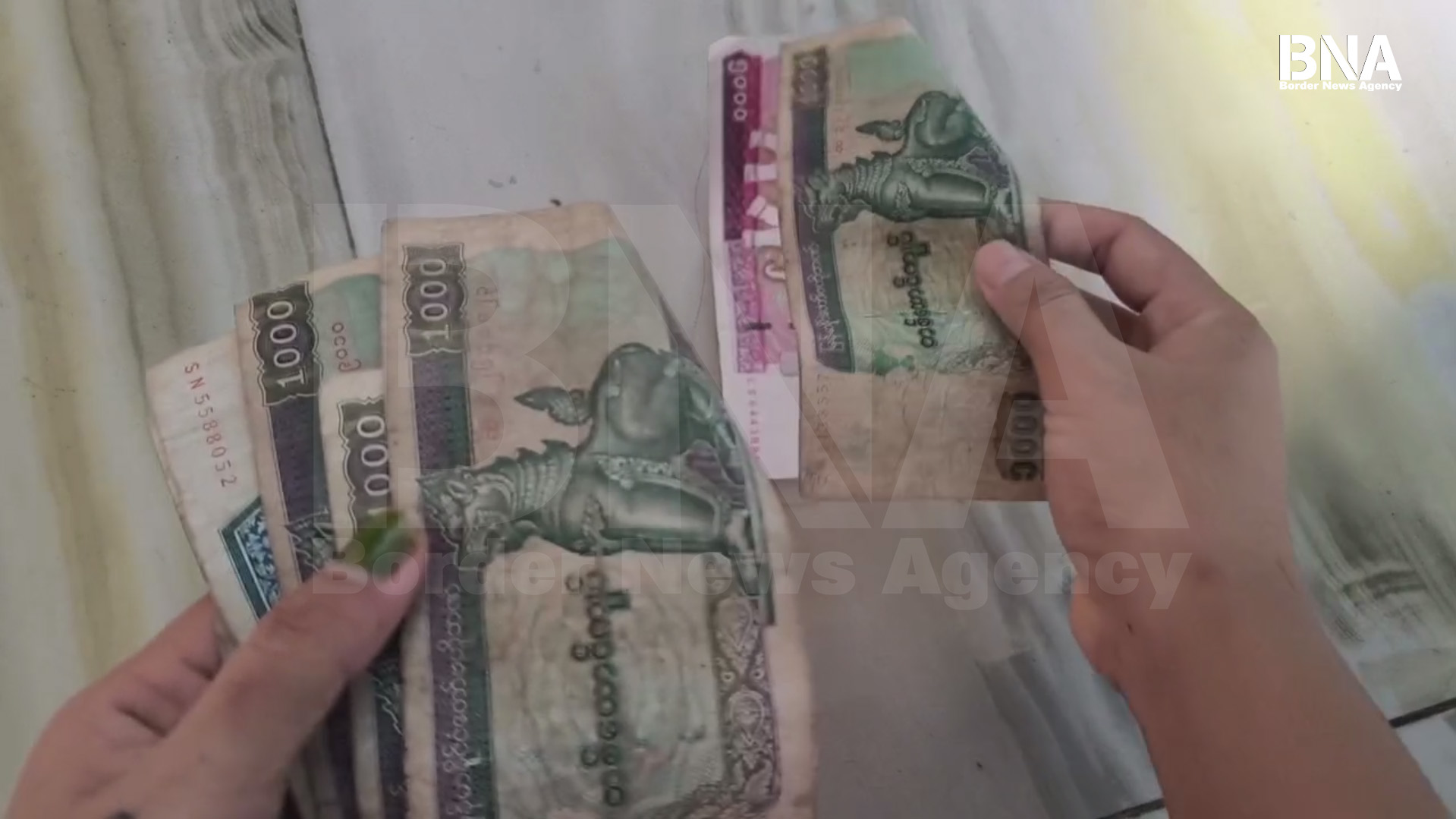
Due to the suspension of banking operations in Arakan, old and worn-out banknotes are rapidly losing their value, and local residents are calling for urgent solutions to address the currency crisis.
Since the outbreak of the decisive war in Arakan, banking operations in the region have come to a halt. As a result, locals have been forced to rely on old and worn-out banknotes. With these notes becoming increasingly damaged and fragile, residents say it is becoming difficult to continue using them for daily transactions.
“If the banknotes are old and worn out, people no longer accept them. As for small changes, they’re not being used at all. It’s frustrating because sometimes we have no choice but to throw them away. And when exchanging them with money changers, we’re forced to accept only half the value,” a local resident in Arakan told Border News Agency.
Residents say that in areas under the control of the Arakan Army, old and deteriorated banknotes – including 50, 100, and 200 kyat notes and small denominations – are no longer being accepted in daily transactions.
Locals in Arakan say that old banknotes have become increasingly difficult to use when purchasing goods, forcing buyers to exchange them at only half their original value.
“A worn-out 10,000-kyat note is now worth only 5,000 kyats when exchanged. These old notes have lost half of their actual value,” a resident told Border News Agency.
Locals say that when it comes to higher-value denominations, the depreciation is even worse – 100,000-kyat notes are being exchanged at just one-fifth of their value, while amounts above that are traded at one-sixth. A 1,000-kyat note is accepted for only 500 kyats, 5,000 for just 2,500, and a 10,000-kyat note for 5,000 kyats – all at significantly reduced rates.
As a result, ordinary working-class people and small-scale vendors, who often have no choice but to accept old and damaged banknotes or small changes, are suffering financial losses.
Residents in Arakan also report that some small-scale money exchangers, operating with limited capital, are now using counterfeit or mismatched banknotes instead of simply worn-out ones. In some cases, two torn halves of different banknotes are patched together and passed off as a single note during exchanges.
“We run a money exchange business. We travel around different townships to exchange money and also accept customers at home. We exchange at half the original value. What we do is trade good-quality notes from our side in exchange for old and worn-out notes brought in by others. But when we return these notes to the dealers, we often have to pay double the rate we exchanged them for. That’s because we also have to cover travel expenses across the region,” a local woman who deals in worn-out banknotes, told Border News Agency.
Locals say that while more people are now engaging in the business of buying up old and worn-out banknotes, the shortage of such notes is actually making the situation more difficult, rather than solving it.
Although the Arakan People’s Authority has issued a regional directive urging people to continue accepting worn-out banknotes in daily transactions, many still refuse to do so. As a result, the scarcity of usable currency and the growing problem of damaged notes remain unresolved, prompting calls for immediate and practical solutions.