
Border News Agency
Kyauktaw, July 29
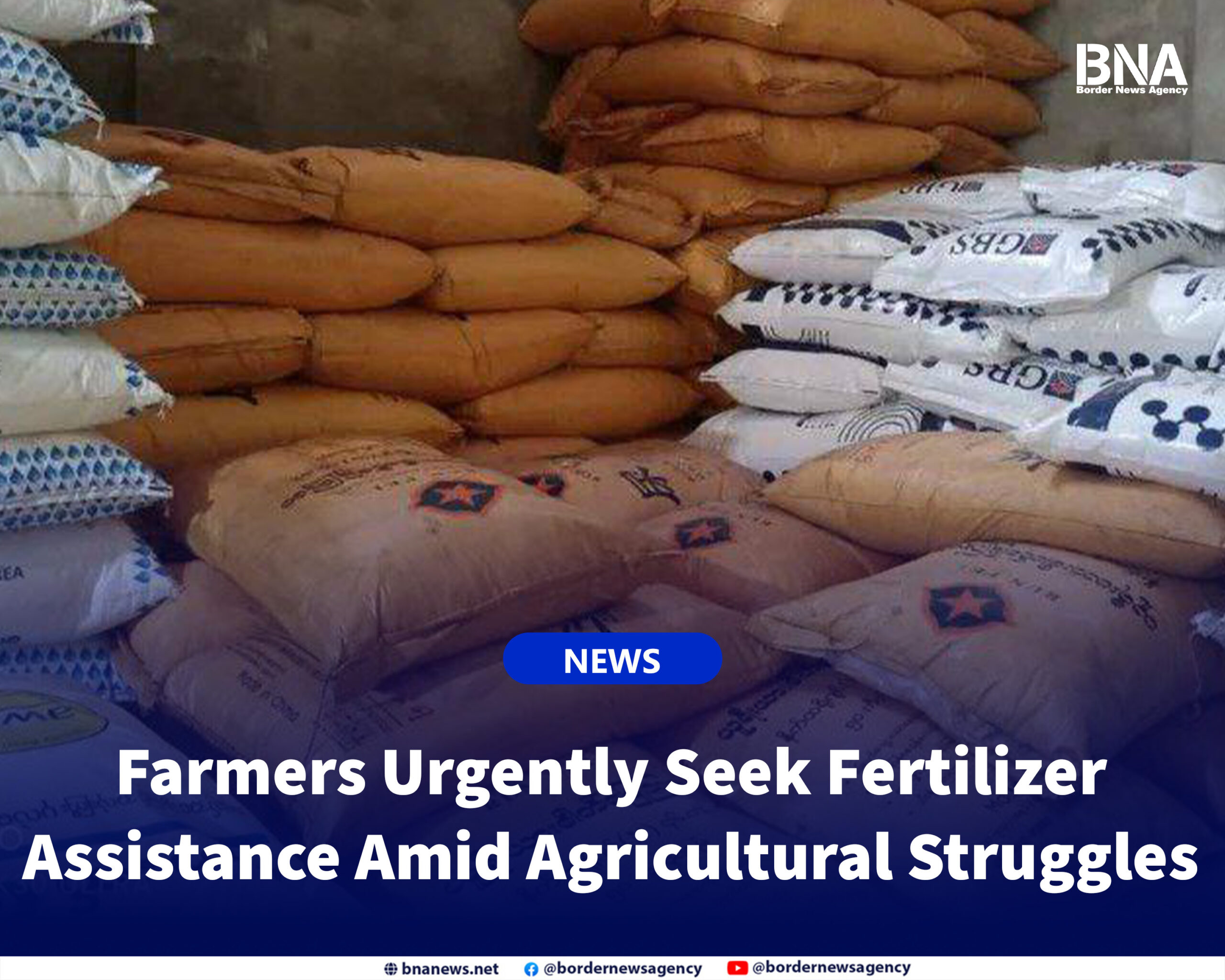
Farmers from Arakan said that they are in need of fertilizers to support their agricultural activities.
They explained that the paddy plants they have cultivated now require fertilizers, but due to financial difficulties, they are unable to purchase and use them, which is why they are calling for fertilizer assistance.
“The paddy plants have now reached the stage where they need to be fertilized. But the prices of fertilizers have gone up, so we can’t afford to buy them. Since the start of the farming season, we’ve already invested all the capital we had, and now it’s all gone. We really need fertilizer assistance,” a farmer from Kyauktaw Township told Border News Agency.
In addition, farmers said that because it has been raining continuously from the planting season up until the growth stage, there has been flooding and waterlogging, which has weakened the paddy plants. Therefore, they stressed the need to apply fertilizers in time.
“Applying fertilizers on time is absolutely necessary to increase the yield,” farmers said.
“If we don’t apply fertilizers, the rice won’t produce good yields. When the plants are weak, they can’t grow properly and the crops become stunted. Fertilizers need to be applied, but we can’t afford them. Prices have gone up so much that only those who can manage it are applying, and even then, they only put about two cans’ worth of fertilizer for every 100 acres,” a farmer told Border News Agency.
In Arakan, the price of fertilizers during the rainy season has risen to 200,000 kyats for a bag of white urea, 350,000 kyats for a bag of compound fertilizer, and as high as 500,000 kyats for a bag of triple-mix fertilizer.
Before the clashes broke out, the price of sulfate fertilizer was just over 90,000 kyats per bag, white urea fertilizer was 95,000 kyats per bag, and compound fertilizer was only 60,000 kyats per bag.
Farmers said that since the Arakan decisive war began in 2023, the military council has blocked roads and waterways, preventing goods from entering the region. As a result, commodity prices have skyrocketed, and farmers are unable to apply fertilizers to their fields.
Because they cannot apply fertilizers on time, farmers explained that they are facing the difficulty of low paddy yields every year.
Although there are more than 120,000 acres of paddy fields in the Arakan region, farmers estimate that this year, they will not be able to cultivate even half of the farmland.
Farmers said that the reduction in the amount of paddy farmland is also due to the high cost of agricultural inputs, the rising wages of laborers, the difficulty in selling harvested paddy and rice, and the instability in the region.







Comments 1
Your article helped me a lot, is there any more related content? Thanks!