
Border News Agency
Mrauk-U, September 2
U Kyaw Zan, Secretary of the Central Land Management Committee of the United League of Arakan (ULA), explained issues related to land management in Arakha in the Rakhine language in an interview with ULA/AA media outlets. Border News Agency presents the full interview in Burmese translation.
Q: How was the Administration and Land Management Committee initially formed, and what are its objectives?
A: In order to systematically implement the processes involved in forming the Administration and Land Management Committee, the Central Management Committee was established on November 18, 2022. During 2023, district- and township-level management committees were gradually established and expanded.
The three main objectives of establishing the management committees are: Resolving disputes: To systematically resolve conflicts arising within communities in a fair and lawful manner.
Improving administrative and public services: To effectively provide public administration and essential public services needed in local communities.
Strengthening environmental protection and the governance system: To carry out environmental conservation activities and effectively support the implementation of the administrative system in the Arakha region.
Q: What are the main causes of the complex land disputes that have emerged?
A: The main causes of complex land disputes include: Distortions and inconsistencies in land management systems under successive administrations, unclear land ownership documents, and unresolved land disputes resulting from conflicts have left behind a large number of complicated land-related problems.
Weaknesses in laws and administration, the lack of a strong and systematic land law framework, misconduct by some officials, corruption, abuse of authority, and practices of resolving disputes arbitrarily have contributed to the problems.
As the population has increased, demand for land has also risen. The increasing value of land has consequently caused land disputes to become more widespread.
Impact on social cohesion, investment, and stability: Land disputes have created social divisions among local residents and between villages, reducing mutual trust within communities.
Justice and administrative burdens: Current revolutionary governments and administrative bodies are facing significant burdens in terms of time, manpower, and judicial resources as they attempt to address the large number of unresolved land cases inherited from the past.
Delays in regional development: Uncertainty over land ownership makes it difficult to invest in agriculture, businesses, and reconstruction and recovery efforts.
To address the longstanding land-related problems inherited from successive periods, sustainable solutions can only be achieved through strong land policies, transparent judicial processes, and meaningful public participation.
Solutions must not focus solely on documentary ownership. Fair and compassionate policies are also needed to ensure that farmers who have genuinely cultivated and made their livelihoods from the land for many years do not lose their livelihoods and rights.
Relevant investigation teams must conduct transparent field inspections to ensure that the rights of citizens and their legitimate land-use rights are not harmed.
Authorities can reduce unnecessary suspicion and anxiety by clearly informing the public about their land-management decisions, policies, and plans.
Building mutual trust between the government or administrative authorities and local communities is a key driving force for regional development during the post-conflict or transitional period.
Current land problems should not merely be addressed through temporary solutions. Strong land-use policies must be developed to promote the future growth of the region’s economy and agricultural sector.
Stability in the land-management system is a fundamental foundation for unlocking the region’s major opportunities and potential for development.
Q: How is land in Arakha currently being managed?
A: Because of historical land-management problems inherited from successive periods and the weaknesses of the old system, relevant departments are still working together and coordinating their efforts. There are still challenges in establishing a fully systematic land-management system.
Interdepartmental coordination: Because land issues are complex, responsible administrative, judicial, and field-inspection departments are working together to discuss and implement solutions.
Human-resource challenges: During the transitional or revolutionary transition period, there are not yet enough skilled personnel and staff. Nevertheless, efforts are being made to provide the best possible services to meet the people’s security and livelihood needs.
Building trust between the public and the government: Because people remain concerned about the remnants of the old system and its longstanding administrative failures, authorities need to work transparently to ensure that government policies are aligned with the wishes of the people.
Platforms for direct consultation and discussion are being created so that the revolutionary government’s policies can be aligned with the actual needs of the people.
Only by directly listening to the people’s voices and needs and allowing broad participation across different sectors can people shape their own future.
Policies and principles must be clearly presented to the public so that people understand them effectively. Only by building trust in this way can unnecessary disputes and difficulties be reduced.
Only by following policies that genuinely correspond to the public interest and the people’s wishes can the region firmly overcome challenges, including land-related problems.
The meaningful participation and trust of the people are fundamental foundations for regional development and stability.
Q: Why does an ordinary private contract for a land transaction not provide full legal protection?
A: Simply signing a bilateral agreement in a land transaction does not provide a fully systematic and secure legal guarantee. To obtain strong legal protection and ensure that future rights and benefits are not lost, the following points must be given particular attention.
Legal registration of the sale contract: An ordinary agreement signed between two parties may not provide full legal protection if a dispute arises. A legally registered contract should be executed at the relevant land-registration office.
Stamp duty and taxes: To obtain secure ownership rights, the transaction must be officially registered after paying the stamp duty and other taxes and fees required by law.
Land type and required documents: Depending on the type of land—for example, ancestral land, grant land, or agricultural land—the transaction must be conducted with the actual owner or a person holding a legally valid General Power of Attorney (GP) or Special Power of Attorney (SP).
Forms 105 (land map) and 106 (land history/record) must be officially obtained from the relevant administrative or land-record department and checked before completing the transaction.
Coordination with ward/village land-management committees: Future complications can be avoided by obtaining verification and recommendations from the relevant village/ward land-management committee and local authorities confirming whether there are any actual disputes over the land.
Future rights and benefits: Only when land ownership has been legally and systematically registered can the owner fully claim compensation, replacement land, and the legal right to resell or lease the land if regional development projects are implemented in the future. If ownership documents are not secure, people may automatically be excluded from future regional development benefits or lose their rights.
Q: What long-term losses could someone face if they purchase land using only a private contract?
A: Purchasing land solely through an ordinary private agreement in order to avoid or simplify stamp duty and other taxes can lead to significant losses in the long term.
Inability to transfer the registered ownership: A private contract is merely an agreement between two parties. It does not change the registered owner’s name in the records of the government or relevant land-registration department.
The original owner’s name remains on the record: The land will continue to be registered under the name of the original owner or the person whose name appears on the grant. If the buyer later wishes to transfer the registered ownership, they may face difficulties locating the original owner or their legal heirs, or the original owner may have changed their position.
Risk of losing compensation and replacement-land rights: If land is acquired by the state or a regional government, or if regional development projects—such as roads, bridges, or industrial zones—are implemented and the land is reassessed or acquired, compensation or replacement land is generally provided to the person whose name is officially registered as the owner.
Risk of receiving no compensation: A person who purchased land only through a private contract may lack sufficiently strong legal evidence of ownership. As a result, they may have no recognized right to compensation, or the original registered owner may be the person who receives the compensation.
Requirement for Forms 105 and 106: Only by obtaining and checking Forms 105 and 106 from the land-record or administrative authorities can the boundaries, ownership history, and existing restrictions concerning the land be verified.
A registered owner of grant land, or a person holding a valid power of attorney from that owner, must be involved in order to execute a legally registered contract.
Q: What needs to be done to eliminate the harmful practices of the old system and transition to a new system?
A: In the past, organizations and authorities at different levels often allowed contracts and agreements to be made informally and easily. These practices have contributed to legal weaknesses and ownership disputes today.
To end these harmful practices of the old system and systematically reform the system, cooperation is required based on the guidelines of the Central Land Management Committee, as follows:
- Moving from old practices to a strong, long-term legal system
Contracts that were previously made through personal connections or informal permissions from officials or offices cannot necessarily receive full legal protection.The practice of avoiding taxes and assuming that an ordinary private contract alone is sufficient must be completely abandoned, and the system must transition to formal legal registration. - Guidelines issued to grassroots organizations
The Central Land Management Committee has already issued clear guidelines to grassroots land-management organizations to prevent complications involving contracts and land documents.Step-by-step review systems are being implemented to eliminate misconduct, corruption, and the misuse of rights and authority. - Responsible public participation
Rather than prioritizing short-term convenience, members of the public should obtain full protection for their land ownership rights by completing legally registered contracts.
Disputed or fraudulent land transactions should be openly reported to the relevant management committees so that the problems can be addressed collectively.
Only by overcoming the mistaken practices of the old system through a strong legal framework under the new system, together with responsible public cooperation, can long-term stability and land justice be established.
Q: Is it legal to build a house on agricultural land without permission? What could happen if the rules are violated?
A: Under agricultural land law, residential construction on agricultural land is not permitted without the relevant authorization. A person who has been granted the right to cultivate agricultural land cannot independently change its use for purposes other than agriculture.
Unauthorized use and construction: If someone constructs buildings without permission, uses agricultural land improperly, or exceeds the scope of their authorized rights, the relevant authorities may have the power to order closure or revoke a business license or permit.
Direct enforcement measures: Violators may face legal fines, rejection of applications for concessions or permissions, temporary suspension of business licenses, or permanent revocation/cancellation. Depending on the applicable law, a license or authorization may be revoked for several months, up to two years, or potentially longer.
Restoration to the original condition: Under the relevant regulations, simply paying a fine does not necessarily end the matter. Unauthorized, improper, or encroaching construction must be removed or otherwise restored to its original condition.
Unauthorized construction or violations within airport land or facilities may result in serious legal consequences, including fines and the revocation of licenses or operating rights.
Types of agricultural land and cultivation rights: All types of agricultural land—including farmland, garden land, and land used for perennial crops—are intended for agricultural purposes. To grant people the right to cultivate such land, the administrative or land authorities issue an Agricultural Land Use Certificate (Form-7).
Requirements under agricultural land law: Under Section 10 of the Agricultural Land Law, people who have obtained the right to cultivate agricultural land must comply with specified conditions. One of these conditions is that agricultural land may not be used for other purposes without permission—for example, subdividing agricultural land into plots for sale or constructing buildings.
Action against violations: Authorities may have the power to reclaim or revoke agricultural land from people who violate the regulations. However, such land cannot be arbitrarily confiscated; authorities must act in accordance with the law.
Roadside encroachment and declining agricultural land: There is no legal protection for unauthorized buildings constructed by encroaching on agricultural land along roadsides. At the same time, it is regrettable that large areas of agricultural land are being lost because farmland is being left uncultivated.
Q: If someone wants to use agricultural land for another purpose or expand it for public benefit, what procedures must be followed?
If agricultural land is to be used for another purpose or a development project is to be implemented, the following procedures must be followed:
- Applying for permission to use agricultural land for another purpose
Private individuals cannot independently convert or expand the use of agricultural land. If cultivated farmland is to be used for another purpose, the applicant must apply for official authorization from the government or relevant authorities to change its use. - Expanding roads or projects for the public interest
If the proposed use is for a public purpose, such as expanding roads because of population growth, obtaining approval may be easier. However, if it is intended primarily for private interests, there are greater limitations on obtaining permission. - Four procedures for projects serving the public interest
A meeting must be held to establish the need for expanding the road or implementing the project, and an official record of the decision must be obtained.
For agricultural land connected to a road, the exact width—measured in meters or feet—of the land to be designated as land reserved for the government’s long-term development plans must be clearly determined.
Responsible officials at the community, township, and district levels must inspect whether the proposed expansion would affect existing farmland and local production, and submit their findings to the Central Land Committee.
Once approval for the expansion is granted by the central authority, the relevant land must be precisely demarcated and documented, and appropriate compensation or relocation costs must be provided in accordance with the law.
- Private land and development projects
It is very difficult for private individuals to obtain permission to use privately purchased or cultivated agricultural land for other purposes, such as expanding roads, bridges, or infrastructure, or converting it to a different type of use.However, if the land is intended to be developed as an urban residential or housing project, an opportunity may be available through a Public-Private Partnership (PPP) with the government.
- Warning to the Public
Warning
The public is hereby informed not to engage in the unauthorized subdivision and sale of agricultural land located along roadsides, or construct illegal buildings on such land, without formally applying for and obtaining permission to use the land for other purposes. - Legal Action to Be Taken in Accordance with the Law
Both sellers and buyers who illegally subdivide and sell or purchase land without legally authorized land-subdivision, cultivation, or alternative-use permits may subsequently face legal prosecution.
They may also face measures including the demolition of illegally constructed buildings and the confiscation of agricultural land that has been used in violation of regulations by the government or relevant authorities.
Therefore, the public is officially warned not to subdivide and sell land without obtaining the required legal authorization.
Q: Do members of the public have an opportunity to apply for permission to use agricultural land for other purposes?
A: If a person who has obtained the right to cultivate agricultural land, or another relevant member of the public, wishes to construct a house on their agricultural land, they must apply for permission to use the land for another purpose in accordance with Procedure 59, using Form MA-N 14, through the relevant levels of the Land Management Committee.
Under Subsection (a) of Procedure 59, if the Central Land Management Committee determines that the proposal contains sufficient grounds for approval, it will issue an Order to Use Agricultural Land for Another Purpose (Form MA-N 15).
We have also drafted and enacted procedures for applying for permission to use agricultural land for other purposes in order to systematically reform and manage agricultural land in Arakha.
Q: Are private individuals free to independently expand and construct residential areas in rural and urban areas?
A: Private individuals have no unrestricted right to independently expand or construct rural or urban residential areas.
Under land-related laws and procedures, the Central Land Management Committee is the highest and sole authority established by the government with the power to designate agricultural land or vacant and virgin land for expansion into rural, urban, or community residential areas.
No individual may expand agricultural land into a village or residential land for another purpose without obtaining an authorization order from the Central Land Management Committee.
After the Central Land Management Committee issues an authorization order, an official notification must be issued to designate the area as village or community land in accordance with legal procedures.
The legally authorized bodies responsible for this process at the local level are the Township Administration Bodies.
Based on the official order, the relevant land-record authority must arrange for the agricultural land or vacant land to be removed from the relevant land registers and maps as agricultural land and reclassified as community or residential land.
In summary, the main authority responsible for deciding whether community residential land may be expanded is the Central Land Management Committee.
The General Administration Department and Land Records Department are responsible for implementing the decision on the ground.
Q: What are the consequences if agricultural land is left uncultivated instead of being used for farming?
A: Under agricultural land law, people who have obtained the right to cultivate agricultural land are not legally permitted to abandon or leave the land unused without a valid reason.
According to the obligations imposed on agricultural land-right holders, if agricultural land is left uncultivated:
First stage: The landholder may be required to pay a prescribed fine for leaving the agricultural land unused without sufficient justification.
Second stage: If the landholder continues not to cultivate the land even after paying the fine, they may be removed from the agricultural land.
Third stage: The Agricultural Land Use Certificate (Form-7) may be cancelled, and the government may reclaim the agricultural land.
Although the law may not specify a fixed number of years during which agricultural land may remain uncultivated, the fundamental purpose of agricultural land law is to ensure national food security and promote the agricultural sector. Therefore, agricultural land is not intended to be abandoned or left unused without justification.
However, under the relevant procedures, exemptions may be granted when valid reasons have been submitted and approved. If the land is left unused continuously for three years without repeatedly obtaining the necessary permission or exemption, the authorities may record it as vacant and virgin land due to non-cultivation and have the authority to reallocate it to another person for actual agricultural cultivation.
If you are unable to cultivate the land yourself, you may lease it to another person for cultivation. Alternatively, if you need to temporarily suspend cultivation because of natural disasters such as flooding or soil degradation, or because of family health or financial difficulties, you need to submit a written explanation stating the reasons.
By doing so, you may be exempted from having the land reclaimed and classified as vacant and virgin land.
Q: Does a government have the right to reclaim agricultural land for reasons related to the public interest?
A: A government has the full authority to reclaim land as land under government administrative control for public-benefit projects and government needs, such as roads, bridges, hospitals, schools, and other state development projects.
Legally, this is referred to as the power of land acquisition, and it is practiced in countries around the world. Such action must be carried out in accordance with laws enacted or approved by the relevant government.
How to address the actual conditions on the ground in the Arakha region may present significant challenges. Under the current fragile and unstable circumstances, this is an issue that must inevitably be considered in light of the need to rebuild the country.
From the perspective of a government striving to rebuild the country, these matters need to be reviewed carefully, while also ensuring that appropriate arrangements are made for the people concerned.
Under the current circumstances, there are plans to administer land acquisition based on the 1894 Land Acquisition Law, with certain modifications and reforms. As a revolutionary government operating under significant challenges, we will proceed using the most appropriate approach available.
Issues relating to resettlement and the restoration of people’s livelihoods will also be taken into consideration as necessary. We believe that, in the long term, this can lead to an appropriate and balanced outcome.
Q: How can the relevant authorities protect people who suffer losses as a result of land being reclaimed by the government?
A: During the post-conflict reconstruction period, both positive and negative consequences will inevitably accompany every action taken along the path toward a certain level of development.
Under the current circumstances, we believe that if a negative impact experienced today can ultimately benefit many future generations, it may be necessary to accept a reasonable level of loss or sacrifice.
As a government that has emerged from the Arakha region, we believe that we can provide the best possible protection for the security and well-being of the people of Arakha.
We believe that every instance of reclaiming land as land under government administrative control, when carried out because of reconstruction needs, should be protected and regulated by law.
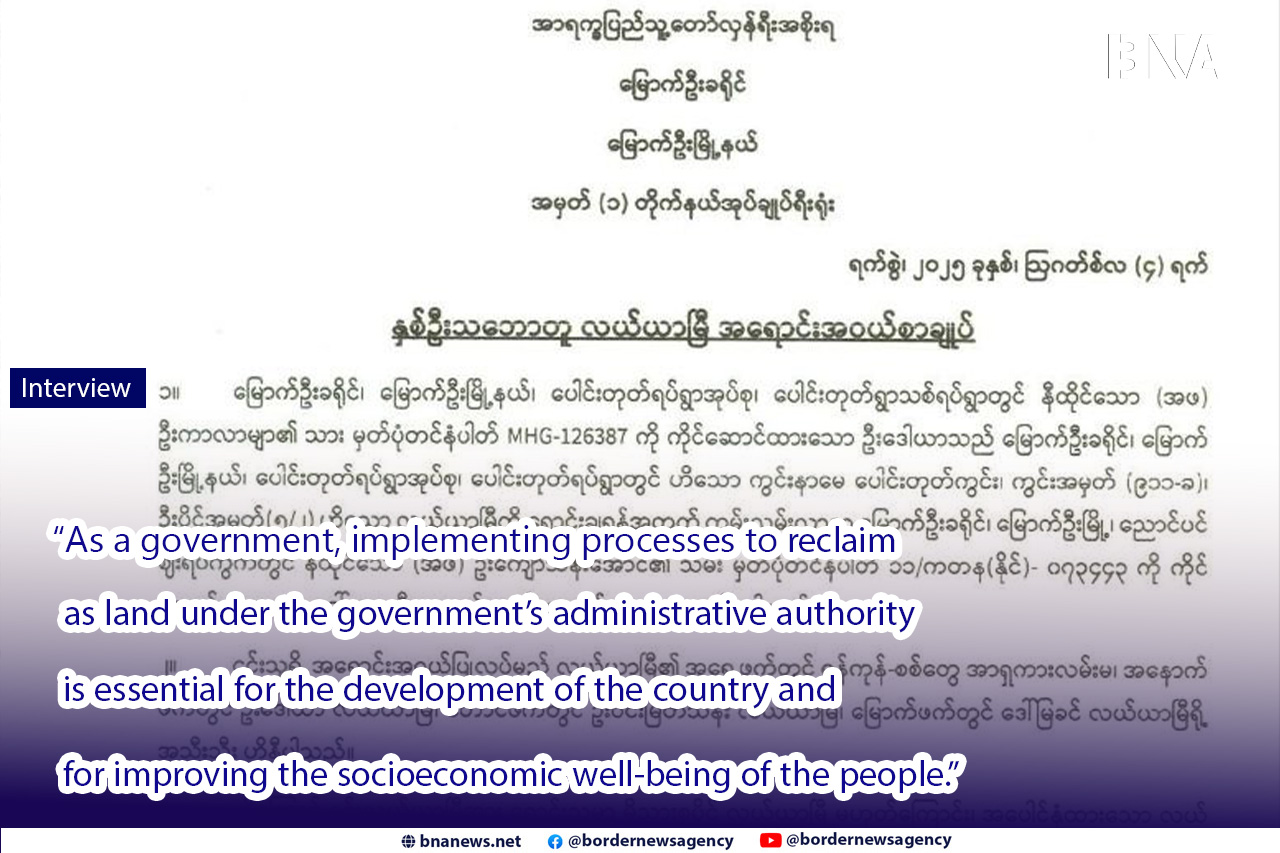
Q: Why are processes for reclaiming land as land under government administrative control necessary?
A: For a government, implementing processes to reclaim land as land under government administrative control is essential for the development of the country and for improving the socioeconomic well-being of the public. It is also a major and important component of the functioning of the government administration.
The main reasons for reclaiming land as land under government administrative control include:
Construction of public services and facilities such as roads, bridges, markets, schools, hospitals and clinics, parks, and public buildings.
Development of rural and urban residential areas and industrial zones.
Construction of facilities related to national security and defense.
Projects related to social welfare and environmental protection.
Long-term and strategic development projects requiring land for essential infrastructure and other matters necessary for the public interest.
The relationship between land, people’s livelihoods, and socioeconomic development is very broad. Given the challenges involved in addressing other longstanding problems that have developed over successive periods, this issue is also necessary to ensure full mutual trust and cooperation between the government and the people concerned in all aspects of the country’s reconstruction process.
We also believe that the officials responsible for carrying out these duties will be able to provide the best possible public services to the people concerned.







Comments 2
HappyLukePlus, now that’s a name that promises good times! Gotta check out what they’re holding. Hoping for some smooth gameplay and a few free spins to get me started. Thinking about signing up… anyone have a referral code? See what all the fuss is about: happylukeplus
The bonuses at jili90club are actually decent compared to other places. I had a great run last night and the withdrawal process was surprisingly quick. Great experience so far!