
Written by Nat Shawn May
Border News Agency
Mrauk-U, September 1
The rainy season is slowly falling over the distant Mayu mountain range. Small drops of rain are falling like pearls.
The Mayu coastal area has many beautiful and touching places. But it also has many painful and difficult lives.
In a small village in the Mayu coastal area, the cry of a newborn baby can be heard.
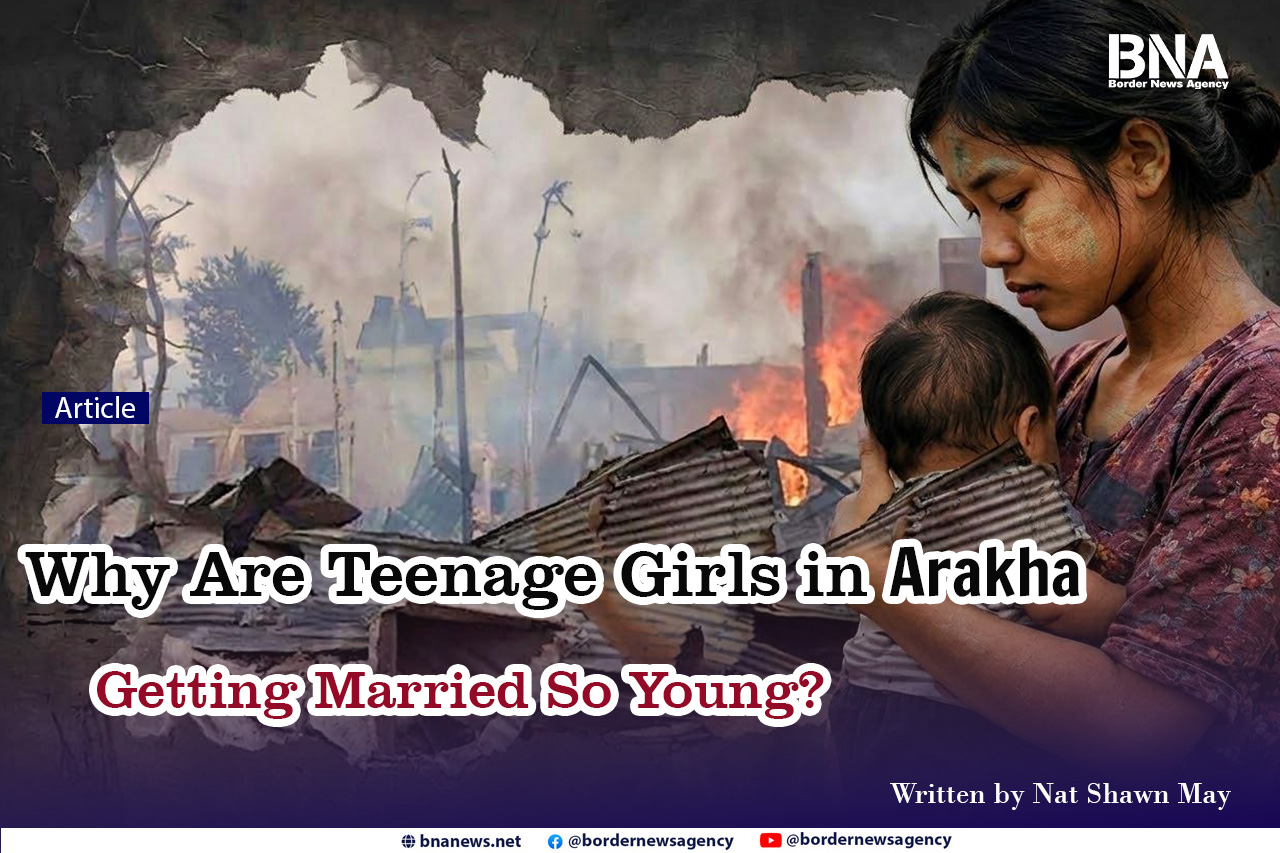
On that rainy morning, a 15-year-old girl was holding a crying baby who was only a few months old. She was struggling to carry the baby in her arms.
Ma Ei, a small and thin girl, was quickly hanging her baby’s clothes on a line with one hand. The scene showed how tired and exhausted she was, even though she was still very young.
“I never thought that I would become a mother at the age of 15,” Ma Ei said quietly while holding her baby and looking at her.
This scene was seen in front of a small hut in a poor village in the Arakha region. There are only a little more than 30 households in the village.
In the Arakha region, early marriage among teenage girls like Ma Ei has recently become a common situation.
Local people and organizations working in the area say that the closure of schools because of the war, poverty, and lack of security are pushing young girls toward early marriage.
In other areas, children are now returning to school as the school year begins. But Ma Ei can no longer go to the classroom. She has already become a young married mother with a baby.
Teenage Marriage and Loss of Education
Early marriage among teenage girls is not simply caused by a person’s behavior or character. It is mainly connected to conflict, poverty, and the loss of access to education.
Under Myanmar’s Child Rights Law, passed by the Union Parliament in July 2019, both males and females must be 18 years old to get married.
The law prohibits marriage before the age of 18.
Myanmar also signed and ratified the United Nations Convention on the Rights of the Child (CRC) in July 1991.
The convention clearly protects children’s rights to education and protection. It also calls for children to be protected from marriage before the age of 18.
However, in conflict areas such as Arakha, the rule of law is weak. As a result, these legal protections are often not properly enforced.
Young women also do not receive enough legal protection or support. Because of this, many of them choose marriage as a way to survive, stay safe, and deal with their difficult living conditions, according to local sources.
According to data from the United Nations Children’s Fund (UNICEF) and the Myanmar Demographic and Health Survey (DHS), about 16 percent of women in Myanmar get married before the age of 18. In the Arakha region, the rate is higher, at 21.8 percent.
The long-term closure of schools because of the ongoing conflict in Arakha is one of the main reasons why girls are losing access to education.
According to a report by the Institute for Strategy and Policy–Myanmar (ISP-Myanmar), more than 6.3 million school-age children across Myanmar are unable to attend school.
The report also says that school closures caused by conflict are a major reason for children dropping out of school. In the Arakha region, the rate of children unable to attend middle school is as high as 49 percent.
“The fighting caused schools to close, and my parents were too poor to continue paying for my education. I wanted to take a computer course after passing Grade 10. But when I did not know what I could do in the future, I felt that marriage was the only option, so I accepted it,”
Ma Ei said, explaining how she lost the chance to continue her education.
Conscription Laws Add More Pressure
While young girls are already losing their education, Myanmar’s military conscription law has added another pressure.
The conscription law introduced by the military junta came into effect in 2024. Under the law, women between the ages of 18 and 27 are required to serve in the military.
However, pregnant women, mothers with young children, people with chronic illnesses, and people with disabilities are exempt from military service under the law.
In addition, the Arakan Army (AA), which has taken control of 15 townships, including Paletwa, has also introduced its National Defense Emergency Provision (NDEP). Under this provision, women between 18 and 25 and men between 18 and 45 are restricted from leaving the area and are required to serve, according to the provision.
However, pregnant women, mothers who have young children to care for, people who are the only person responsible for caring for and supporting elderly parents, and students who are still attending school are exempt from military service.
People with chronic or infectious diseases, including HIV/AIDS, tuberculosis, kidney disease, diabetes, and heart disease, as well as people with physical disabilities, are also included among those exempted.
The exemptions for pregnant women and mothers with children under these conscription laws and emergency provisions have created another pressure on young girls and their parents. They may see early marriage as a way to protect girls from military service.
“When we heard about the conscription law and the restrictions, both my parents and I became very afraid. We were afraid that I would be forced to join the military. We heard that married women and mothers with children could be exempted. So we quickly decided that I should get married, hoping that it would protect both me and my parents.”
Ma Hla May, a 17-year-old girl from the Arakha region, said this.
Lack of Security and Parents’ Fear
In addition to the pressure of military conscription, the breakdown of law and order in conflict areas has increased the risks faced by young girls.
They are at greater risk of sexual violence, kidnapping, and exploitation.
Because girls are living with insecurity, some parents worry about their daughters’ safety and want to put them under the protection of a man through marriage.
The voices of young girls show their difficult situation. But parents, especially mothers, also face a lot of emotional pain and pressure because they are sometimes forced to make decisions about their daughters’ futures.
“I wanted to send my daughter to a sewing course or teach her some kind of skill. But there are no jobs in our village, and we are also afraid that she may be forced to serve in the military. We are displaced by the fighting. So, for her safety, we decided to let her get married. As a mother, I feel very sad because she is still so young.”
Daw San San, whose daughter was married at the age of 18, said.
Financial Hardship and Food Distribution
According to estimates by the United Nations Office for the Coordination of Humanitarian Affairs (UNOCHA) and local organizations, between 300,000 and more than 500,000 people have been displaced by the conflict in the Arakha region.
Displacement has also brought serious financial difficulties to families and made it harder for them to meet their basic needs.
When families have many children and food becomes scarce, some parents may believe that marrying off a young daughter can reduce the family’s financial burden by one person.
Food assistance at displacement camps and aid centers is often distributed according to household size. In some cases, families may create a new household through marriage so that they can receive more food assistance. This can also put additional pressure on young girls to marry early.
“There are five brothers and sisters in my family. Because of the fighting, businesses and jobs have closed, and our family is facing serious financial problems. I am the oldest child, and my parents can no longer support all of us. I got married without thinking carefully because I hoped it would reduce the financial burden on my family.”
Ma Hnin Mu, a 16-year-old girl, said.
Traditional Practices, Health Challenges, and Uncertain Futures
In addition to economic hardship, traditional practices and social pressure that remain deeply rooted in the community also play an important role.
There are still conservative social attitudes that judge and criticize girls if they remain unmarried until they become older.
These traditional attitudes can create additional pressure on young women to marry early.
“I got married and had a baby when I was 16. People in the village mocked me, saying that I was a bad girl and that my parents had failed to control me. But no one saw the loss of education and the hardships my family faced because my parents could not afford to support me. They only knew how to blame me.”
Ma Khin Khin Cho, who lives in a displacement camp in the Arakha region, said.
Although young girls may get married because of social pressure, the World Health Organization (WHO) and UNICEF have pointed out that pregnancy and childbirth before the age of 18 greatly increase the risks of maternal death and newborn death.
In addition to physical health risks, young mothers also face serious emotional and psychological pressure.
Young mothers in the area say that becoming mothers before reaching adulthood has caused them to experience depression, anxiety, and a loss of hope for the future.
Giving birth while their bodies and minds are still developing creates serious health risks. In conflict areas, these risks are even greater because access to healthcare is often blocked or severely limited.
“I was only 17 when I gave birth, so I was very afraid. I got married without really knowing what marriage meant. Now I live under stress every day, and I don’t know what to do. I feel like I have lost my way in life.”
Ma Aye Aye said.
A women’s rights activist working in the region also pointed out that this is not simply a matter of marriage. It is a problem connected to war and people’s safety and survival.
“Blaming the girls will never solve this problem. We need to provide community-based sewing, handicraft, and other vocational training so that they can support themselves without getting married. If young women have skills that allow them to earn an income, early marriage could be reduced significantly.”
A women’s rights activist from the Arakha region said.
Alternative education and independent education systems have already started operating in areas controlled by the Arakan Army.
However, because of the effects of the war, economic hardship, and security problems, many young girls still cannot fully access these opportunities. They continue to face situations where early marriage becomes their only option.
Marriage may provide young women with temporary protection in some situations. But in the long term, it can leave them facing many challenges, including losing their education and falling back into the cycle of poverty.
Experts say that the early marriage of teenage girls in the Arakha region is not simply caused by their behavior or character. It is linked to the fighting, pressure from conscription laws and emergency provisions, poverty, and the inability of parents to support their daughters.
Therefore, simply blaming young girls will not solve the problem. Parents and responsible authorities urgently need to provide and support alternative education, vocational opportunities, and safe protection systems for young girls.
Otherwise, not only the future of teenage girls but also the future of the next generation will remain in darkness.






Comments 3
One of the best online casino experiences I have had recently. The graphics are crisp and the gameplay is very fair. 1cassinoonline
Really enjoy the vibe here and the variety of table games is top notch. Every time I log in I find something new to try and the payout speed is genuinely impressive. Highly recommend for anyone chasing a smooth experience. casinodepalermo
The data and insights here are incredibly helpful for my strategy. It is a must visit for anyone serious about their game. Check idpaitoangka