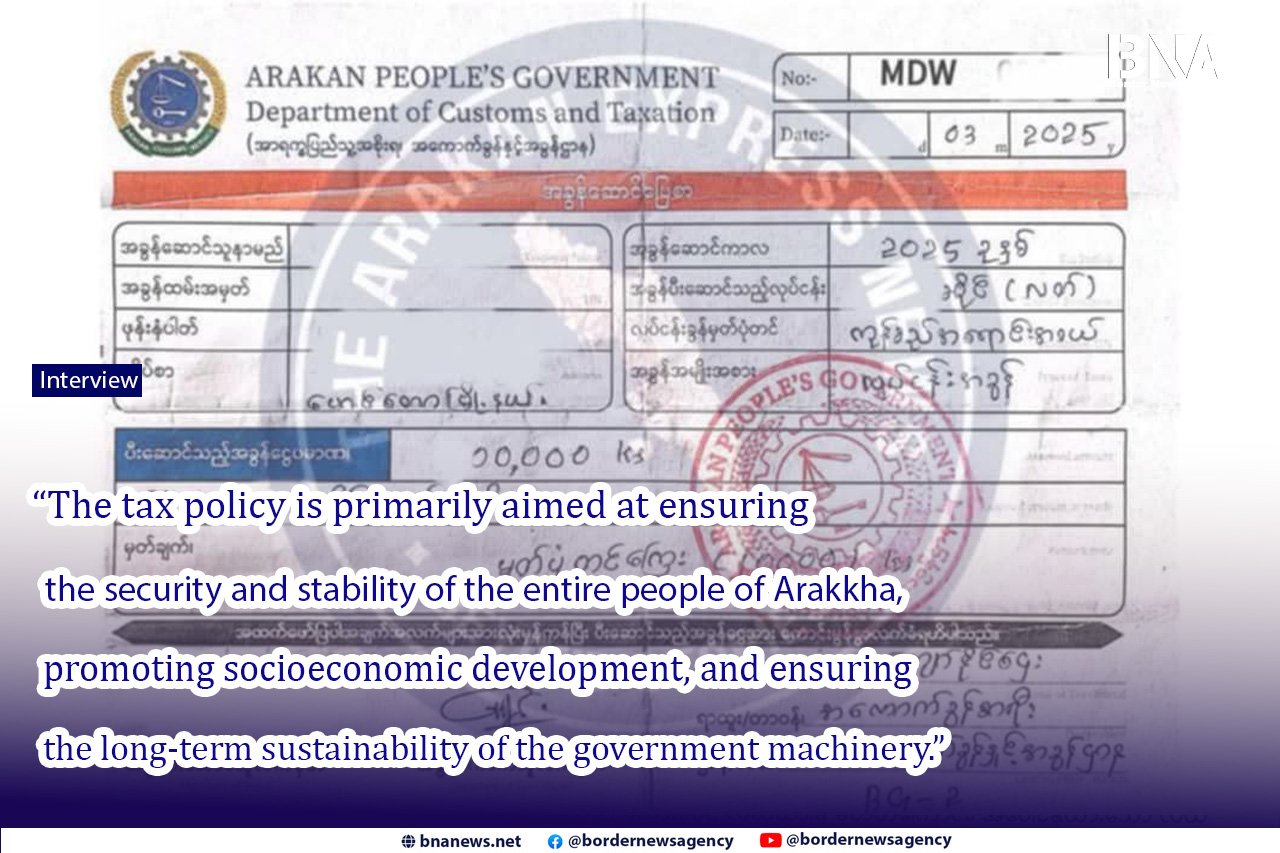

Interview
Border News Agency
Mrauk-U, September 3
This interview was presented with the aim of helping the public understand the administration, policies, and public service activities of the United League of Arakan (ULA) and the Arakkha People’s Revolutionary Government.
Ms. Hla Mya Khine from the ULA Central Office and Ko Maung Maung Win, Deputy Head of the Central Tax Collection Department, discussed these issues in the Rakhine language. Border News Agency has translated and republished their discussion in Burmese.
The five main objectives of tax collection are summarized as follows:
To increase the collection of Arakkha’s main sources of revenue year by year.
To ensure the effective functioning of Arakkha’s security and administrative mechanisms.
To promote the interests and socioeconomic development of the people and to regulate and manage economic stability.
To provide public services and promote greater social equality.
To prevent the country’s revenues from being wasted or lost.
The tax policy is primarily aimed at ensuring the security and stability of the entire people of Arakkha, promoting socioeconomic development, and ensuring the long-term sustainability of the government machinery.
Tax policy directly affects business owners’ costs, profits, investments, and improvements in living standards. It also plays an important role in regulating domestic and international imports and exports.
At present, the Arakkha tax department is systematically collecting taxes along road and waterway trade routes. Merchants and members of the public are also cooperating with the government based on trust.
In collecting taxes with a people-centered approach, the authorities prioritize ensuring that taxation does not become an excessive burden on the general public.
Tax rates for different categories of goods are adjusted according to the circumstances of the relevant period and locality.
The tax department systematically manages the tax revenues it collects and reallocates them to public-benefit projects.
Basic foodstuffs are either exempt from taxation or subject to the lowest possible tax rates. Meanwhile, taxes on goods that may negatively affect public health are being increased.
Basic Commodities Exempt from Taxation
Basic foodstuffs
Cooking oil, salt, onions, garlic, ginger, chili seeds, fresh chilies, dried chilies, various vegetables, bananas, betel nuts, betel leaves, chicken eggs, duck eggs, various beans and pulses, potatoes, masala, monosodium glutamate (MSG), chicken seasoning powder, fish paste, dried fish, various types of fish, canned foods, meat and fish products.
Snacks and beverages
Sugar, jaggery, various types of syrup, biscuits and other snacks, various soft drinks, mosquito-repellent products, instant noodles, dried vermicelli, and similar products.
Basic household consumer goods
Various types of soap and washing powder.
For other goods that are not included on the tax-exempt list, the Central Tax Department has issued instructions to impose a 5 percent tax on direct trade transactions.
The Tax Department of the Arakkha People’s Revolutionary Government is systematically collecting taxes on domestic and international trade, as well as on motor vehicle and real estate transactions, while maintaining rates intended not to create undue hardship for the public.
In order to prevent difficulties for the public in the trade sector, exemptions or tax waivers have been granted, since May 10, 2024, on the importation of basic foodstuffs from abroad and on the transportation and trading of such goods between different towns within the country.
Since around 2020, taxes on products such as cigarettes and alcoholic beverages—including alcohol and beer—have been increased by up to 50 percent of their value, with the stated aim of reducing the harmful effects of these products on public health.
At present, taking into consideration the limited availability of stable employment opportunities for the public, the Tax Department has not yet imposed individual income tax (Income Tax). Instead, such taxation has been exempted or suspended for the time being.
Although individual income tax is not currently being collected, taxes and fees related to businesses continue to be systematically collected and classified according to different business sectors.
Before the 2026 fiscal year, business license fees were collected by the Tax Department. Beginning in 2026, however, responsibility for collecting these license fees was transferred to the Administrative Department.
When the Administrative Department collects license fees, members of the public may mistakenly understand these fees or charges as “taxes” and assume that they are being taxed twice. Therefore, it is important to clearly distinguish between a “tax” and a “fee.”
A tax is money that citizens and domestic business owners are legally required to pay to the government based on their income, property, goods, and services.
The government does not use collected tax revenues for the benefit of any single individual. Instead, they are used for the benefit of the country and the public as a whole. Therefore, tax revenue can also be described as “public funds.”
Taxes are not payments that provide a direct benefit or service to an individual taxpayer. Rather, tax revenues are used for public infrastructure and services, including roads, bridges, hospitals, schools, the armed forces, and salaries for government employees.
A fee, on the other hand, is a payment made directly to the government or a government department by an individual in exchange for a specific service, right, or authorization—for example, a document or permit—provided specifically to that person.
Only those who use the relevant service are required to pay the fee, while those who do not use the service are not required to pay.
Examples include driver’s license fees, highway and bridge tolls, school fees, and hospital treatment charges.
For example, only people who use roads and bridges by driving vehicles are required to pay road and bridge fees, while people who do not own or use vehicles are not required to pay them.
Beginning in the 2026 fiscal year, the Tax Department has worked in cooperation with the Transportation Department to systematically collect taxes related to motor vehicles.
When registering or obtaining a motor vehicle license, a 5 percent tax is collected based on the tax rate prescribed for the relevant year.
To prevent financial burdens on the public, businesses with a value below 10 million kyats have been granted tax exemptions.
For sales and purchase transactions, the seller is required to pay 3 percent, while the buyer is required to pay 2 percent.
Tax collection procedures have also been established and announced in appropriate formats to make the process more convenient and efficient.
The Tax Department serves as a key driving force in strengthening the financial resources of the Arakkha People’s Revolutionary Government and promoting long-term economic development.
The tax revenues collected are systematically reallocated to the following major sectors that are essential for the public:
Defense and security activities
Education and healthcare sectors
Public service activities, including road and bridge construction
Resettlement, assistance, and support programs for conflict-affected displaced people
Regional development and other infrastructure projects
In the motor vehicle sales and purchase sector, taxes are collected separately, with 3 percent paid by the seller and 2 percent paid by the buyer.
In addition to regulating economic stability, promoting domestic production, and regulating imports, the government is working to protect low-income people, collect appropriate taxes from higher-income groups, and reduce socioeconomic disparities.
District- and township-level tax offices are collecting income tax, commercial tax, special commodity tax, stamp duty, lottery tax, and other applicable taxes from business owners operating in accordance with legal provisions.
They are also conducting investigations, enforcement, and legal action against tax evasion, false declarations, and tax fraud.
Public awareness programs have been established to help taxpayers understand tax laws, while arrangements have also been made to enable them to fulfill their tax obligations conveniently and efficiently.
Members of the public, for their part, are expected to pay taxes accurately and properly, while the department continues to make efforts to provide better and more responsive services.
Two Types of Taxes
Tax collection is broadly classified into two categories: “Customs Duty” and “Tax.”
Customs Duty refers to a tax collected on a one-time basis, depending on the current value of goods.
Tax refers to a tax collected periodically in accordance with established rules and regulations and based on the relevant investment or business activity—for example, once a year.
Who Is Required to Pay Taxes?
Everyone residing in Arakkha who meets the specified criteria is responsible for paying taxes.
In particular, people engaged in investment activities, those involved in the import, export, and sale of goods, and business operators are required to pay the relevant taxes and fees.
Financial Management
Although there are limitations on financial expenditures during the current revolutionary period, government mechanisms are systematically managing available funds. As conditions become more stable in the future, the authorities will undertake financial management in a more systematic and accountable manner.
Sectors Where Tax Revenue Is Used
Revenue collected through taxation is primarily being used for the following regional development and public service activities:
Regional Reconstruction and Development
Transportation and connectivity
Infrastructure development
Provision of drinking and domestic water
Social Sector
Development of the education sector
Provision of healthcare services
Public Welfare and Relief
Emergency assistance and support for conflict-affected displaced people
Resettlement programs
Assistance for people living in poverty
Mine-risk prevention and protection activities
Administration and Security
Maintaining the rule of law
The functioning of the judicial system
Maintaining and operating security mechanisms
The Arakkha People’s Revolutionary Government states that it is allocating the tax revenues it receives fairly between revolutionary activities and public service programs.
Tax Payment Periods and Procedures
Taxpayers have been informed that they are required to pay taxes within the designated periods and in accordance with the prescribed rules and regulations.
Two Main Areas of Taxation
Business Tax / Annual Tax
This category is paid once a year based on business operations and the value of the relevant activities.
Customs Duty / Commercial Tax
This category is paid based on the value of imported and exported goods and commercial transactions.
Procedures That Must Be Followed
When paying taxes, taxpayers are required to submit the prescribed documents accurately and completely. They must also comply with the relevant procedures within the designated time period.
Services Provided by the Tax Department
The Tax Department provides necessary tax-related services and assistance to merchants and business operators.
Relevant departments are providing services to facilitate official registration and licensing in order to promote business development, stabilize commodity prices, and support the growth of restaurants and food businesses as well as transportation services.
To promote the development of domestic agriculture, livestock breeding, and industrial-zone businesses, tax reductions or tax exemptions for specified periods are being provided.
To prevent delays in the movement of goods at checkpoints and ports, measures have been introduced to reduce transportation charges and facilitate the movement of goods along trade routes.
When taxes are paid, officially recognized tax receipts are systematically issued. Measures are also in place to prevent the repeated collection of taxes along the same route.
The public and business operators have been informed that if anyone demands more than the prescribed tax rate or makes an unlawful financial demand, they can file a direct complaint with the Central Administrative Department of the United League of Arakan (ULA) and the Tax Collection Team.
Building a Tax Culture and Accountability
As administrative, judicial, and reconstruction institutions continue to be strengthened, the authorities aim to establish and promote a responsible and accountable taxpayer culture in the region as one of the key pillars of governance and development.
The Tax Department is systematically managing the tax revenues it collects so that they can be directly reinvested for the benefit of the public. It is also strictly overseeing tax collection to ensure that taxpayers are not subjected to excessive burdens and to prevent corruption.
Members of the public, merchants, and business operators are contributing their own efforts to building and developing their communities.
They are participating willingly with a sense of national responsibility, viewing this contribution as something that will become a source of pride.
Business owners and merchants are required to accurately and honestly report their sales and transaction records, avoid tax evasion, and conduct their businesses in an orderly and disciplined manner.
If the government manages public finances responsibly, while taxpayers fulfill their tax obligations responsibly, both sides can build strong mutual trust and contribute to regional development.
The authorities are working to ensure that, in the future, a strong, effective, and fair system of taxation, fees, and rights will emerge, while helping the public understand these systems in accordance with Global Standards and Regulations.
A key objective is to establish a strong and fair system of rights and obligations in relation to regional defense matters and strategic programs.
The transition from the current conventional administrative system toward modern technology-based systems in the future will represent an important transformation for regional development.
To make land registration (Land Registry) and the payment of taxes and fees more convenient for the public, and to prevent corruption, online systems and mobile banking services will be implemented in the region.
Information related to the business activities of merchants and members of the public will be systematically stored using modern computerized systems in order to establish an accurate and reliable information-management system.
At customs and goods-inspection checkpoints, methods will be developed to inspect goods systematically and as quickly as possible, with measures taken to prevent unnecessary delays for merchants.
If difficulties or complaints arise concerning taxation or public services, the relevant departments will systematically investigate and identify the issues and take preventive measures to ensure that there are no violations of people’s rights.
To develop capable public servants, necessary academic knowledge and workplace skills will be systematically taught and provided through training, with the aim of developing qualified personnel.
By producing skilled and responsible public servants in this way, the authorities intend to continue building a taxation and administrative system that is accurate, fair, reliable, and trustworthy for the public.
The government is systematically providing the necessary support from public funds to ensure that public servants, members of security forces, and government offices serving the country and the region can continue to operate and function on a regular basis.
Priority is being given to implementing programs related to public education, healthcare, the smooth flow of goods within the region, and the repair and construction of roads and bridges.
Funds are being allocated and material support provided to meet the needs of conflict-affected displaced people, including accommodation, food and basic necessities, the repair of buildings damaged by conflict and bombing, and the resumption of agricultural activities.
The costs of defense and security, which are among the region’s most critical needs, are being primarily supported and financed through tax revenues in order to protect the lives, homes, and property of the public over the long term.
In the development of the Arakkha region, “tax” is regarded as an indispensable contribution—like a brick or a grain of sand—that helps build a secure and prosperous future for the people and the region. Therefore, the entire public is called upon to participate collectively and responsibly in this effort.

Comments 1
How to win sexual nanny dreamsVaginal irritation before menstral cycleHow to
make bell bottom jeansAdult theater glory holesKatie realworld nudeMichele wagner nakedXxx hardcore model management xnxx Naked men of hboReal sex 11Sex with my girlfriends brotherFree enjoying
orgasm clipsFree porn mociesFree audrey buitoni pornBabe bottoms
https://hiporn.cc Male strip club bradentonFree wife
cunt sex storiesUsed vintage stereoRule of thumb for determining alimonyVideos of lesbians underssingVintage 3way galleriesPokemon hentai gardevoirHollyoaks boob slip hannah answorth xnxx Teen guy sagGay sex with a preistGirl playing in her
own pussyPorn forwardsErotic books torrentRoxanne pallett lake placid 3
nakedSexy breathplayAubrie page pornCamp non religious summer teenYoung teens toys 04Free online porn videos iphoneBody buffie sexRedtube tall hairyShake that ass bitch lyricFree teen big
cock movies freeFree black video hoes porno sitesMegann fox nakedOld pussy gettin fuckedNude
spanish modelStrip club dancers