
Interview
Border News Agency
Maungdaw, November 24
Following the International Court of Justice (ICJ) ruling, discussions have emerged regarding the security, rule of law, repatriation, and future political situation of the Arakan region.
At present, there are growing views that an inclusive legal framework and guarantees are necessary to ensure the safe repatriation of refugees and peaceful coexistence among different communities.
On these issues, Ko Htun Lin, a resident of the Arakan region, shared his views with Border News Agency.
“In my view, this ruling represents an important historical milestone in the pursuit of international justice for the genocide committed against the Rohingya people in 2017.
The ICJ has ruled that Myanmar committed genocide against the Rohingya and violated its obligations to prevent genocide and punish those responsible.
This also represents international legal recognition of the losses and suffering experienced by the Rohingya people.
We should not view this ruling through a political lens targeting any particular ethnic or religious group. Genocide is a crime committed against all humanity, and whoever commits it must be held accountable and take responsibility.
On the other hand, this ruling could have significant implications not only for Myanmar but also for the political future of the Arakan region.
In particular, having the capacity to govern a territory is politically important. Equally important, however, is the ability to protect the rights of all people living in that territory, regardless of their ethnicity or religion.
Personally, I fundamentally support the right of Rohingya refugees to return and live in their places of origin.
However, repatriation is not simply a matter of transporting people back to their homeland. Most importantly, there must be guarantees that they can return voluntarily, live in safety and dignity, and not face further discrimination or violence after their return.
In addition, issues relating to citizenship, legal documentation, freedom of movement, property ownership, and employment opportunities must also be addressed.
At the same time, the Arakan region has suffered severe socioeconomic destruction as a result of decades of war and conflict.
Local Arakanese communities, Rohingya people, and other ethnic communities have all experienced their own forms of suffering and loss.
Therefore, the repatriation process must also take into account the security of local residents and the region’s socioeconomic conditions.
Repatriation should not be carried out forcibly against the wishes of local communities. What we want is not simply to return or receive one particular group of people, but to build an environment where everyone, regardless of ethnicity or religion, can live safely and equally.
I believe the ICJ ruling could have an impact on the Arakan region in three major areas: politics, human rights, and international relations.
The first is politics. At present, the ULA/AA is exercising extensive administrative and judicial authority in the Arakan region.
Under these circumstances, the international community may not simply look at who controls the territory. It may increasingly scrutinize how that authority is exercised and how the rights of all ethnic communities in the region are protected.
The second concerns human rights and governance. The Rohingya issue is inseparable from the future governance of the Arakan region.
How issues such as citizenship, the right to return, property rights, freedom of movement, and political participation are addressed will become key factors in determining the quality of the future governance system.
The third is international relations. The Arakan region shares a border with Bangladesh and is also a strategically important area in the geopolitics of the Bay of Bengal.
Resolving the Rohingya refugee crisis and guaranteeing human rights will become increasingly important not only for relations with neighboring countries but also for relations with the international community.
Therefore, I do not view this ruling merely as a source of pressure on the Arakan region. Rather, I see it as a challenge and an opportunity to build a better political and governance system for the future.
It is evident that the current ULA administrative mechanism already has institutions responsible for judicial and law enforcement matters. However, the existence of these institutions alone does not mean that a comprehensive legal system guaranteeing equal rights for everyone, regardless of ethnicity or religion, is already in place.
In my opinion, establishing administrative institutions alone is not enough to ensure peaceful coexistence. There must be legal guarantees against discrimination based on differences in ethnicity, religion, and beliefs; protection of everyone’s lives and property; access to justice; and opportunities for political participation in decision-making processes.
In particular, a legal framework is needed that can simultaneously address the Rohingya people’s citizenship and legal documentation issues, the political aspirations of the Rakhine people, and the rights of other ethnic minorities.
I believe that if we want to build peace in the Arakan region, we should not establish a system in which one ethnic group uses its power to control another.
Instead, we need a system in which everyone is equal before the law and individuals respect and uphold one another’s rights.
Personally, I am concerned about the possibility of further conflicts emerging in the future.
This is because the conflicts that have taken place in the Arakan region have not been limited to military confrontations between armed groups. They are also intertwined with historical grievances, political discrimination, citizenship issues, and mutual distrust rooted in ethnic and religious differences.
If the root causes of these problems are not addressed, new conflicts could emerge within communities in the future, even if the current armed conflicts come to an end.
In particular, hate speech based on ethnicity and religion, misinformation, and the exploitation of ethnic conflicts for political interests are extremely dangerous.
Furthermore, the absence of justice, loss of property, and lack of security could deepen grievances and tensions among communities.
Therefore, if we want to prevent further conflicts in the future Arakan region, military victories alone will not be sufficient.
It is necessary to establish an inclusive political system, an independent and fair judicial system, and a governance system that guarantees the rights of everyone, regardless of ethnicity or religion.
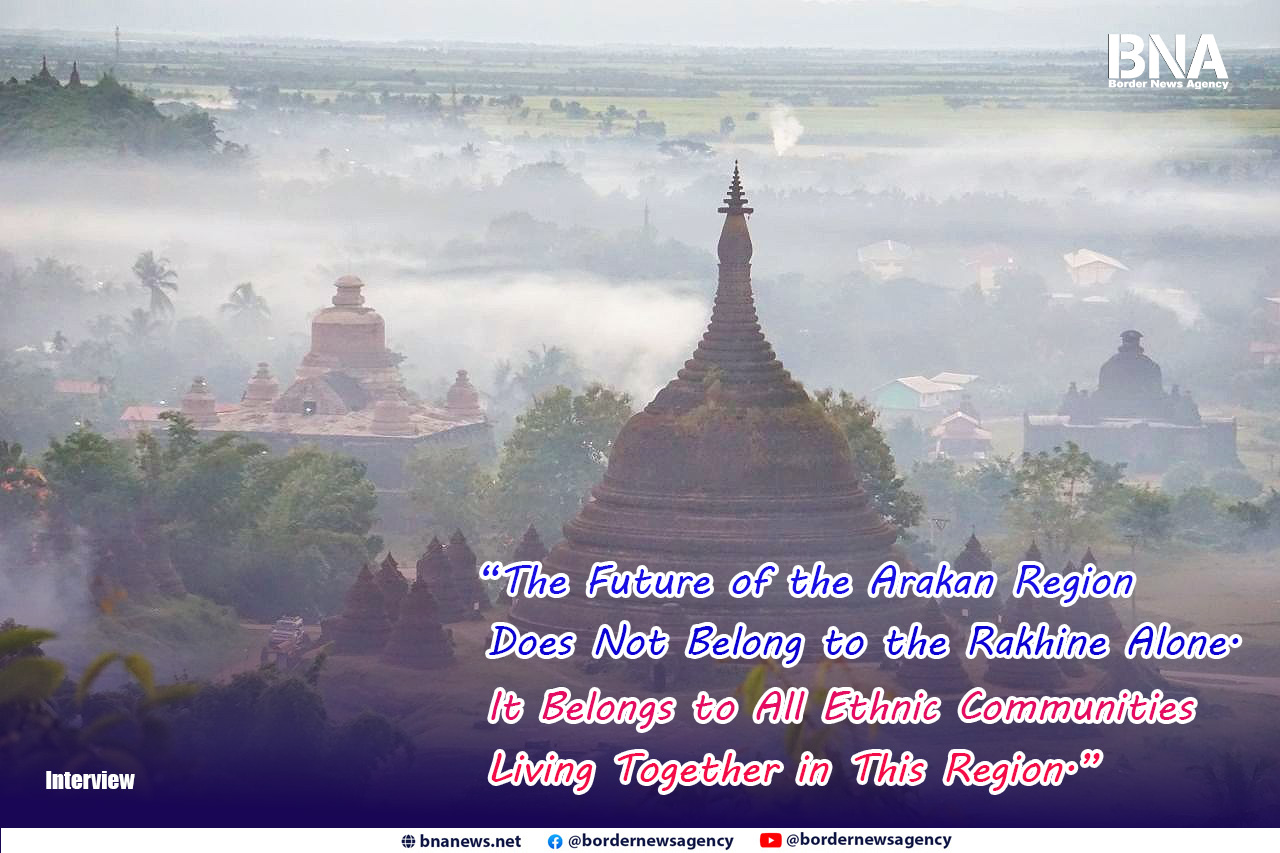
What I want to emphasize most is that the future of the Arakan region does not belong to the Rakhine people alone. It belongs to all ethnic communities living together in this region.
When building that future, we must recognize the pain and suffering experienced by other communities, respect one another, and make justice the foundation of our society.”