
Border News Agency
Mrauk-U, August 20
What is a Social Contract?
A “Social Contract” is a set of social commitments or agreements made among people.
The main purpose of such a social contract is to enable everyone to live together peacefully within society. It represents a necessary mutual understanding—not only among members of the public, but also between the people and the governing authorities.
The social contract also encompasses the traditional customs and practices of ethnic communities and minorities. It ranges from community-based social and welfare associations and local rules and customs to the laws and constitutions of a country.
What Happens When the Social Contract Breaks Down?
A commitment or contract must be based on justice and the free will of those involved.
Why do societies establish social contracts? Because people want to live peacefully, preserve justice, and avoid causing harm to one another.
Therefore, when the social contract breaks down, justice can disappear, people can suffer psychological trauma, and eventually mutual trust within society may completely erode.
The State of the Social Contract in Arakan
In its August 2026 report, “ပြည်ကြီးဝန်ကို အိုးတန်ဆန်ခပ်,” “A Burden Beyond the Pot’s Capacity”, the independent research organization ISP Myanmar presents two perspectives concerning the strength of the social contract in the Arakan region.
The first perspective concerns the approach to the three branches of power—the administration, judiciary, and legislature—in areas controlled by the Arakan Army (AA).
The second perspective concerns the assessment of the situation from the perspective of the civilian population.
From the perspective of the social contract, the smallest social unit of Rakhine society is the family.
Within the institution of the family, there are, at a minimum, mutual commitments and obligations between two people—a husband and a wife.
The family structure of Rakhine society has traditionally been based on the monogamous marriage system.
According to ISP Myanmar, there has been dissatisfaction among women regarding the abolition of the monogamous marriage law. It also cautiously assesses that gaps in the judicial system could undermine social cohesion and stability.
“Whether it is an ordinary law or a law that abolishes the monogamous marriage system, people should be asked, ‘Have you ever seen or read a law like this before?’ In the same way, everyone who governs and takes care of the people should ask themselves the same question. The reason is that sometimes, while trying to do something, we may go too far. I do not want to say that everything that goes too far is necessarily wrong, but it is certainly something very worrying,” women’s rights activist Daw Nyo Aye told the Border News Agency.
The 2015 Monogamy Law: A Law or a Trap?
When Myanmar enacted the 2015 Monogamy Law, human rights organizations strongly criticized it.
The main concern was that the law was not based on genuine intentions.
Critics argued that, rather than simply strengthening monogamous marriage, the law was designed to gain political advantage and target Muslims.
Another problem was that some parts of the law were written in a way that allowed their meaning to be stretched or interpreted in different ways.
For example, the phrase “living together as husband and wife” was left unclear.
Whether a relationship was simply sexual, whether the couple was actually living as husband and wife, or whether it constituted adultery could be difficult to prove in court, especially when the law could carry a sentence of up to seven years in prison.
Another problem was the lack of protection for someone who was deceived by a married person. For example, if a married man lied to an unmarried woman by saying, “I am single,” and entered into a relationship with her, the woman who was deceived could have little or no legal protection.
Such a woman could be treated as a “mistress” or “second wife.” As a result, she could lose rights to child support, division of marital property, and compensation, and could even face legal action herself.
In other words, the law contains loopholes and carries the risk of being misused or applied unfairly.
Human rights organizations have pointed out that Myanmar already has provisions, such as Section 497 of the Myanmar Penal Code, under which a person can be prosecuted for having an affair with another person’s wife. They also note that laws already exist to provide protection when a Buddhist woman marries a man of another religion.
Therefore, whether or not a monogamy law exists, Arakan has long had customary laws and traditions that have influenced family and social life in the region.
Customary Laws and Legal Traditions Influencing Arakan
Manugye Dhammathat (Volume 7, Article 17)
If a husband abandons his wife out of hostility and fails to provide her with living expenses or support for three consecutive years, the marriage is automatically considered dissolved.
The wife does not need to separately apply to a court for a divorce.
A husband who abandons his innocent wife loses all of his property and must leave the household with only the clothes he is wearing.
(Similar judicial precedents have also existed.)
1898 Code of Criminal Procedure (Section 488)
If a husband abandons his wife and children without providing them with financial support, a magistrate may order him to pay a monthly maintenance allowance.
1890 Guardians and Wards Act (Sections 7 and 25)
A mother may apply to the court to be appointed as the guardian of her child when this is in the child’s best interests.
In addition to these laws, women in Arakan have traditionally rejected polygamous relationships involving multiple wives as part of the region’s social norms and expectations.
The Military and the Family Social Contract
In any country, a military institution that promises to protect its people should not contribute to the breakdown of families. It should not encourage marital infidelity. These are matters of military ethics and honor.
That is also why marriages and divorces involving military personnel are supposed to be reviewed and approved before they take place.
Even when a military member wants a divorce, the unit is expected to call both spouses together and attempt to mediate. Their views should be heard freely, and the process should be impartial.
If a divorce takes place, the parties should be given access to the fair rights and protections to which they are entitled.
However, the problem faced on the ground is that when a divorce occurs in families with little or no property, the wife and children may receive little or no financial support. Even when support is provided, it may be completely inadequate given current living costs.
This is pushing families toward a serious social crisis.
“It is heartbreaking because we have no legal protection. We have to carry the burden of raising our children. We have no income and nowhere to turn. We have no jobs, and we are being humiliated. We have reached a point where we sometimes feel that we do not even want to go on living in society,” a woman who said she had been forcibly divorced from an Arakan Army (AA) officer told the Border News Agency.
Although the Arakan Army (AA) has not formally abolished the monogamy law through legislation, people within the AA community have confirmed that AA personnel have been allowed to take another wife.
For this reason, legal experts have pointed out that the Arakan People’s Revolutionary Government should provide protection and assistance to women, take responsibility for affected families, and establish programs to protect and assist those who have suffered harm.
Because such legal protection and assistance are not being provided, family members of AA personnel say that married women in Arakan are living with both physical and emotional insecurity.
“Married women in Arakan are living with the fear, ‘Will my husband abandon me one day?’ Men are also beginning to see women not as human beings, but as possessions, because they believe they can take another wife whenever they want,” a female official of the Arakan People’s Revolutionary Government told the Border News Agency.
People within the AA community have confirmed that even regional commanders at the rank of brigadier general, deputy heads of central training schools, and officers at the tactical commander level have been allowed to take another wife without the consent of their existing wife.
However, women who have been affected say that they cannot legally file complaints or take legal action, and that they receive no legal protection.
“Because marital infidelity cannot be prosecuted, we have no legal protection at all,” a woman who said she was forcibly divorced from an AA regional commander at the rank of brigadier general told the Border News Agency.
ISP Myanmar’s Warnings and Analysis
ISP Myanmar has warned that the governance system and legitimacy of the United League of Arakan/Arakan Army (ULA/AA) could face long-term challenges because of limited judicial and administrative capacity in Arakan, the inability to effectively prevent sexual violence, and the failure to provide adequate security for women.
“We believe that the ULA/AA is exploiting loopholes in marriage law. If a senior leader who already has a legally recognized wife and has signed a marriage document at the military headquarters is allowed to legally take another wife on the grounds that he ‘wants to have descendants,’ then others would also have to be allowed to do the same. This is neither monogamy nor a law permitting polygamy. Instead, it becomes a system that allows a man to abandon his first wife whenever he no longer wants her,” a senior woman in the United League of Arakan (ULA) told the Border News Agency.
ISP Myanmar also warns that if these social and economic crises are not addressed and managed in time, the public may begin to question the political and revolutionary goals of the ULA/AA, potentially leading to a “Legitimacy Crisis.”
Therefore, women’s rights activists have recommended that the Arakan People’s Revolutionary Government formally enact laws protecting women and provide awareness programs and training for all government employees, including those working under the ULA/AA.
“Most importantly, gender equality lessons should be included in ULA/AA training programs. Laws should be enacted in accordance with international laws protecting women, and the Arakan government itself must be the first to strictly follow those laws. Public awareness programs should also be conducted,” a female official of the Arakan People’s Revolutionary Government told the Border News Agency.
Women’s groups within the AA say that women in areas controlled by the AA continue to face significant physical and psychological harm because of weaknesses in security and the justice system.
Women in Arakan have criticized the practice of allowing ULA/AA members and Arakan People’s Revolutionary Government employees to take another wife without the consent of their existing wife, saying that it effectively gives men legal permission to sexually exploit women.
“What is happening is like giving men a legal license to sexually exploit women,” said a woman who said she had been forcibly divorced from an AA tactical commander at the rank of major.
Some women who were forcibly divorced have also confirmed that Daw Hnin Zar Phyu, the wife of AA Commander-in-Chief General Twan Mrat Naing, has spoken out in support of and defended AA officials in some cases.
The women involved believe that Daw Hnin Zar Phyu’s statements defending ULA/AA personnel and employees of the Arakan People’s Revolutionary Government may reflect the views or position of AA Commander-in-Chief General Twan Mrat Naing.
“Although the ULA/AA has strengthened its territorial control and governance, many challenges remain regarding women’s security and rights. What is most important is that the Arakan government must have the political will to address these issues, while international organizations also need to provide support,” a female member of the United League of Arakan told the Border News Agency.
Documents obtained by the Border News Agency show that women who were reportedly forcibly divorced included the wives of AA regional commanders at the rank of brigadier general, deputy heads of central training schools at the rank of lieutenant colonel, and tactical commanders at the rank of major.
The documents also show that women who were reportedly forcibly divorced included wives of officials of the Arakan People’s Revolutionary Government, including deputy district administrators and township-level officials.
Women who experienced these cases confirmed that those who pressured them into forced divorces included Daw Hnin Zar Phyu, the wife of AA Commander-in-Chief General Twan Mrat Naing, as well as AA regional commanders, battalion commanders, and lower-ranking officers.
In addition, affected women said they had been pressured to delete personal accounts and posts in which they spoke about their experiences on social media. They also reported being summoned and warned by the Department of Law Enforcement and Security (DILAP) and being threatened with the termination of temporary assistance they had been receiving.
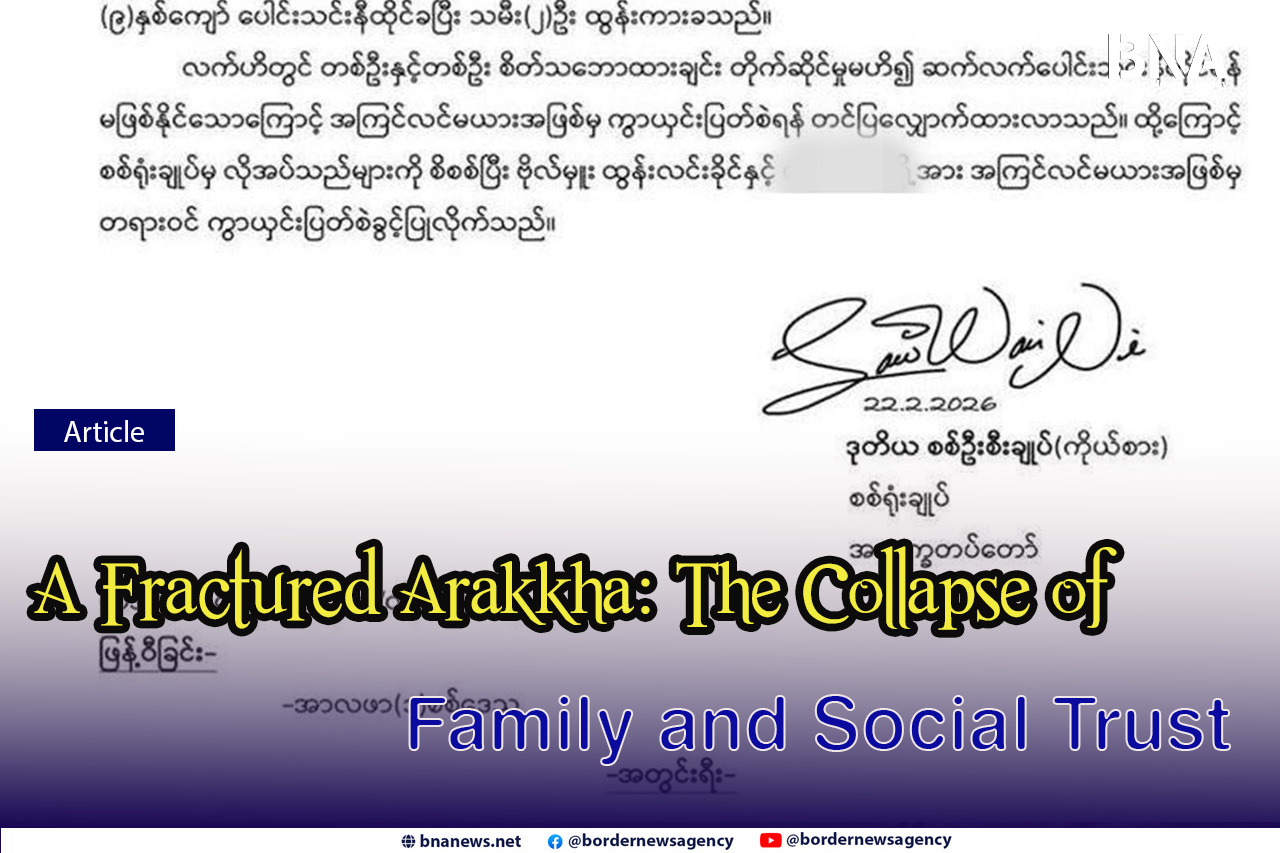
In some cases, documents reportedly authorized and signed on behalf of Dr. Nyo Twan Awng, Deputy Chief of Staff of the AA headquarters, stated that a unilateral divorce had been approved. However, the women involved said that they had not personally agreed to or consented to the divorce.
ISP Myanmar has also pointed out that harsh action against women who criticize the administration violates freedom of expression and represents a setback for women’s participation in peace and political affairs.





Comments 7
Lurker here, and this post is spot on. It’s relevant to the topic here. If you open https://guio.qv12329.com/, you’ll find a straightforward listings site — both local and remote work you can dig through without the clutter. Hope that helps someone here!
If money’s tight, the good part is https://mfqq.ymxusyai.cc/ is free to browse. It’s a listings site that lists local and remote openings, kept current daily. Thanks again!
Hello there, simply became alert to your weblog via Google, and found that it is really informative. I’m going to be careful for brussels. I will appreciate for those who continue this in future. Many other folks shall be benefited from your writing. Cheers!
The login process is seamless and the customer support is surprisingly responsive. It is a very trustworthy site. Log in via vnnk88dangnhap today.
The community here is great and the rewards keep me coming back every day. Such a fun way to spend some free time. Cheers to yk777game!
Super addictive gameplay and the graphics are top notch. It’s the perfect place to unwind and try your luck. ph111jili is where the action is.
Do yoou mind iif I qulte a ffew oof your popsts
ass lohg ass I provvide creddit annd soueces bqck too yor site?
My website is in tthe exact swme nicche ass yours aand my vsitors woupd defknitely bdnefit from
some of thee ingormation you presdent here. Plase lett mee knnow if tthis alright wiith
you. Regards! xnxx