
Interview
Border News Agency
Mrauk-U, September 3.
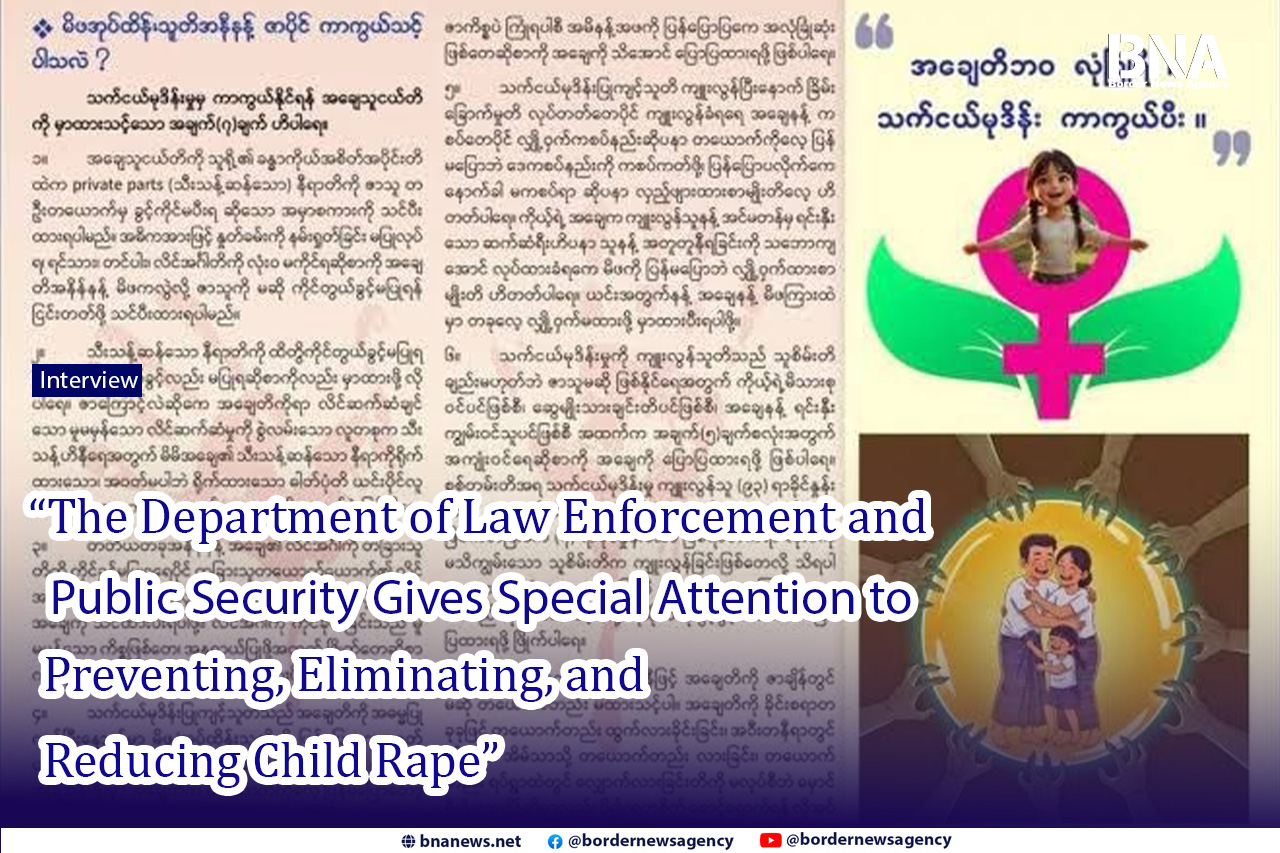
“The Department of Law Enforcement and Public Security under the United League of Arakan and the Arakha People’s Revolutionary Government is giving special attention to preventing, eliminating, and reducing child rape.”
Border News Agency presents a Myanmar-language version of an interview with Daw Hla Mya Khaing from the Central Party Office of the United League of Arakan (ULA), who discussed rape and child protection in the Rakhine language.
Question: First, could you explain what child rape means?
Answer:
Child rape means committing rape against a girl under 12 years old.
Another point is that having sexual contact with a girl under 16 years old is considered rape, whether she agrees or does not agree.
In ASEAN countries and internationally, sexual activity involving a girl under 16 years old may be considered child sexual abuse or rape, regardless of whether she agrees.
Question: Who is at risk of sexual violence?
Answer:
People of all ages, religions, and social backgrounds can become victims of sexual violence, including children.
Children are especially vulnerable because they may not yet have the ability to protect themselves. They can easily be tricked or taken advantage of.
Children with mental, physical, or developmental difficulties may face a higher risk.
Children with disabilities may also be more vulnerable.
Children who are often left alone at home because their parents or guardians are busy may also be at risk.
Children who do not receive enough care and protection from their parents, relatives, or community may also become victims.
Children whose parents have separated and who live with other guardians or communities may also be more vulnerable.
Children from very poor families may also be at greater risk. Some may be tricked with money, food, or other forms of assistance.
Children may also be deceived in workplaces and become victims of sexual exploitation.
Question: What are the causes of child rape, and who commits these crimes?
Answer:
There can be many different causes of child rape.
First, excessive use of drugs and alcohol can affect a person’s judgment and self-control. This may increase the risk of crimes such as rape and murder.
Second, sexual content, explicit language, and pornographic movies or videos are easily available on social media. Easy access to such content and addiction to it may also contribute to the problem.
Third, economic and social problems can create difficulties within families. These problems may lead to poor education, declining social values, and the misuse of power or opportunities.
Another factor is a lack of empathy and respect for others. Acting impulsively without thinking about the consequences can also contribute to sexual violence.
A lack of knowledge and education about sexual health and safety may also be a factor.
Who are the offenders?
In many cases, the offender is someone who is close to the child.
Relatives, family friends, acquaintances, and other trusted people may abuse the trust placed in them and commit sexual violence.
The interview states that 93 percent of child rape cases are committed by people who are known to the child, while only 7 percent are committed by complete strangers.
Therefore, the person who poses a danger is not always a stranger walking on the street.
The offender may be a family member, relative, close acquaintance, or someone living in the same village.
In many cases, the person who commits the abuse is someone who is very close to the child.
Question: Where can child rape happen?
Answer:
Child rape can happen at any time and in any place.
Therefore, parents and guardians need to remain alert at all times.
It can happen in places far from other people, at home when parents or guardians are away, on quiet roads or small streets, and in areas covered by thick bushes or vegetation.
It can also happen near wells, farms, fields, and many other places.
Therefore, people should not carelessly think, “Child rape cannot happen in our community.”
Everyone needs to remain aware and take precautions.
Question: How can child rape be prevented?
Answer:
Prevention is one of the most important ways to address child rape.
Parents and guardians should always pay close attention to their children and their surroundings.
In communities, displacement camps, and neighborhoods, parents and guardians should carefully watch over and protect their children.
They should also pay attention to unusual or suspicious behavior by people in the community or neighborhood.
For example, they should be careful around people who drink too much alcohol and behave aggressively or inappropriately.
In many cases of child rape, the offender may deliberately plan the crime. Therefore, parents and guardians need to be especially careful.
When children go outside or travel somewhere, parents should teach them to go with their brothers, sisters, or another trusted adult whenever possible.
Children are young and may not have enough experience to recognize dangerous situations. Some offenders may take advantage of this by tricking children with gifts, money, food, or other things.
Therefore, children should be regularly warned and taught about these dangers.
Question: What should families know?
Answer:
Parents and guardians should teach children about body safety.
Children should understand that no one has the right to look at or touch their private body parts.
Many children in Myanmar still have limited knowledge about these issues. Therefore, parents and guardians should take the lead in discussing these subjects and teaching children how to protect themselves.
Parents and guardians should also teach children important safety rules.
If someone touches a child’s body in an inappropriate or harmful way, the child should be taught to tell a parent or guardian immediately.
Children should never be told to keep such an incident secret.
Sometimes an offender may threaten a child and say, “Do not tell anyone.”
Even if this happens, children should feel safe enough to tell their parents or another trusted adult.
Parents should build a strong relationship with their children based on love, trust, and open communication.
Many countries provide children with different forms of education about sexual safety and child protection.
Children need to learn how to protect their bodies and how to recognize unsafe, inappropriate, or suspicious behavior.
In our communities, people sometimes treat sexual abuse as a secret or shameful subject and avoid talking about it.
Parents should instead create an open and supportive relationship with their children.
This can help families prevent child sexual abuse.
Question: What should parents do if child rape occurs?
Answer:
Child rape is something that should never exist in our society.
If child rape occurs, parents or guardians should immediately report the case to the relevant local authorities and responsible departments.
Some parents and guardians may become angry and blame the child. They may ask why the child went to a place where they should not have gone.
However, the child is not responsible for the crime. The offender is responsible.
Some families may hide the case because they are afraid that it will damage the family’s reputation or bring shame to the family.
They may choose not to report the case or take legal action.
This can give the offender an opportunity to avoid punishment and may allow the person to abuse other children in the future.
If parents hide the crime, the risk to other children may become greater.
Therefore, parents and guardians are encouraged to be brave and report such cases.
They should take action to protect their children’s rights and future instead of worrying about shame or negative comments from other people.
Laws and Harm Caused by Child Rape
According to the legal provisions mentioned in the interview, sexually abusing a child under 12 years old is a serious criminal offense.
Under the laws described in the interview, an offender may face a prison sentence of 10 to 20 years or life imprisonment.
The interview also states that sexual activity with a girl under 16 years old is considered rape, whether she agrees or does not agree.
The offender may face 10 to 20 years in prison and may also be required to pay a fine.
Psychological Harm
The emotional and psychological harm caused by child rape can remain with a child throughout their life.
Victims may experience fear, emotional pain, stress, shame, anxiety, and other long-term psychological problems.
Physical Harm
Because children’s bodies are still developing, sexual violence can cause serious physical injuries.
In severe cases, the injuries may even put a child’s life at risk.
For the rule of law to be maintained, crimes committed against children must be dealt with effectively and seriously.
Strong action is also necessary to discourage offenders from committing such crimes again and to create a safe environment where children can grow up safely.
Protecting children is also essential for the development of future human resources and society.
Law Enforcement and Security Measures
The United League of Arakan (ULA) and the Arakha People’s Revolutionary Government’s Department of Law Enforcement and Public Security say that they are giving special attention to preventing, eliminating, and reducing child rape.
They also say that effective action is being taken to punish offenders.
According to the department, since August 2026, special courts have been established to effectively deal with serious crimes, including child rape and murder, and to impose appropriate punishments.
District, township, sub-township, and community party committees, together with the Public Relations and Mobilization Departments, women’s organizations, and youth organizations, are reportedly working together to raise awareness about preventing child rape in communities.
They are conducting awareness-raising talks and distributing educational pamphlets to communities.







Comments 12
وی ایوژن پروتئینی پیشرفته
و چندمرحلهای است که از ترکیب
سه منبع پروتئینی شامل پروتئین وی ایزوله، پروتئین وی کنسانتره
و کازئین میسلار تشکیل شده است.
وی موتانت شامل ترکیبی از پنج منبع
پروتئین وی مختلف است که هر کدام با سرعت
جذب متفاوتی عمل میکنند.
گینر دایماتیز یک مکمل
غذایی با کالری بسیار بالا است که به طور خاص برای کمک به افرادی طراحی شده که به دنبال افزایش وزن
و حجم عضلانی هستن.
کراتین موتانت یکی از خالصترین و باکیفیتترین
مکملهای افزایش قدرت و حجم در دنیاست که توسط برند معتبر موتانت در کانادا تولید میشود.
I’ve been trying a few sites lately and this one really stands out. The interface is smooth and the payouts are surprisingly fast. Definitely worth a shot if you like a seamless experience. Check it out at plataforma777win97
گینر المکس با هدف کمک به ورزشکاران برای دریافت کالری، پروتئین و کربوهیدرات مورد نیاز برای افزایش
وزن و ساخت عضله تولید شده است.
وی رونی کلمن دارای حداقل چربی و کربوهیدرات است که این موضوع آن را برای
کسانی که به دنبال افزایش توده عضلانی خالص هستند.
گینر یو اس ان یک افزایشدهنده وزن و حجم عضلانی است که برای افرادی با متابولیسم سریع و کسانی
که به دنبال دریافت کالری مازاد برای رشد حداکثری عضلات هستند،
طراحی شده است.
گلوتامین اپلاید با بالاترین استانداردهای کیفی تولید شده و فرم میکرونایزد ان باعث میشود
تا جذب آن در سیستم گوارش با
سرعت بسیار بالایی انجام شود.
گینر الیمپ در واقع
پکیجی جامع از کربوهیدراتها، پروتئینها، و مواد مغذی حیاتی دیگر است که برای کمک به
ورزشکاران و افرادی که به دنبال افزایش کالری
دریافتی روزانه و در نتیجه،
افزایش وزن و حجم عضلانی هستند،
طراحی شده.
کراتین الیمپ با
فراهم کردن خالصترین فرم کراتین، به سرعت وارد جریان
خون شده و جذب سلولهای عضلانی میشود.
گینر لابرادا توسط شرکت معتبر لابرادا نوتریشن، که
توسط بدنساز افسانهای لی لابرادا تاسیس شده، فرموله شده است.